The car is dead in a Logan Square alley, on the Stevenson shoulder, or in a Naperville driveway, and it still has to reach a shop, a buyer, or another city. Search results mix rental dollies with professional shipping. For a disabled car, the real choice is an immediate tow versus scheduled auto transport.
Start with the car’s condition and destination
Start with what the car can still do. A car that steers, rolls, and brakes is a different load from one with a locked wheel, bent suspension, or a dead EV that will not go into transport mode. Tell the person quoting the job the truth. A running car can often drive onto a trailer. A dead one usually has to be winched. That changes who can take the work.
Then name the destination in plain terms. A body shop off Harlem is not the same as a buyer in another state. A storage lot in Elk Grove Village, against the O’Hare freight maze, is not the same as a driveway in Aurora. If the car only has to cross Cook County, an operator on a flatbed is often the simpler path. If it has to leave the metro on I-80, I-57, or I-55, you are looking at long-distance towing or a separate transport company. Quick Tow Chicago is a referral service. We match you with independent local operators. We don’t run a carrier fleet, and we don’t ship cars ourselves.
Write the condition in one sentence you can repeat on the phone. Dead battery. Blown engine. Collision damage. Flooded from an underpass. Missing wheels. Each of those changes loading. A wheel that will not turn can stop a two-wheel pickup. A car with no keys can stop a drive-on carrier. If you aren’t sure, say you aren’t sure. Guessing is how people book the wrong truck.
Write the pickup surface too. Alley gravel in Pilsen. A heated downtown garage. A snow-packed curb in Gage Park. A wide lot south of Joliet, by the largest inland port in North America. Carriers that haul several cars at once often want a wide, legal place to stop. A single flatbed can often work a tighter spot. That isn’t a universal rule. It’s a question to ask before anyone is dispatched.
Timing sits next to geography. If a shop in Oak Lawn will not take the car until Thursday, an immediate tow just moves the storage problem. If the car is blocking a driveway in Cicero tonight, waiting for a scheduled carrier doesn’t solve the night. Condition, place, and deadline. Get those three straight before you compare methods.
When an immediate tow may fit
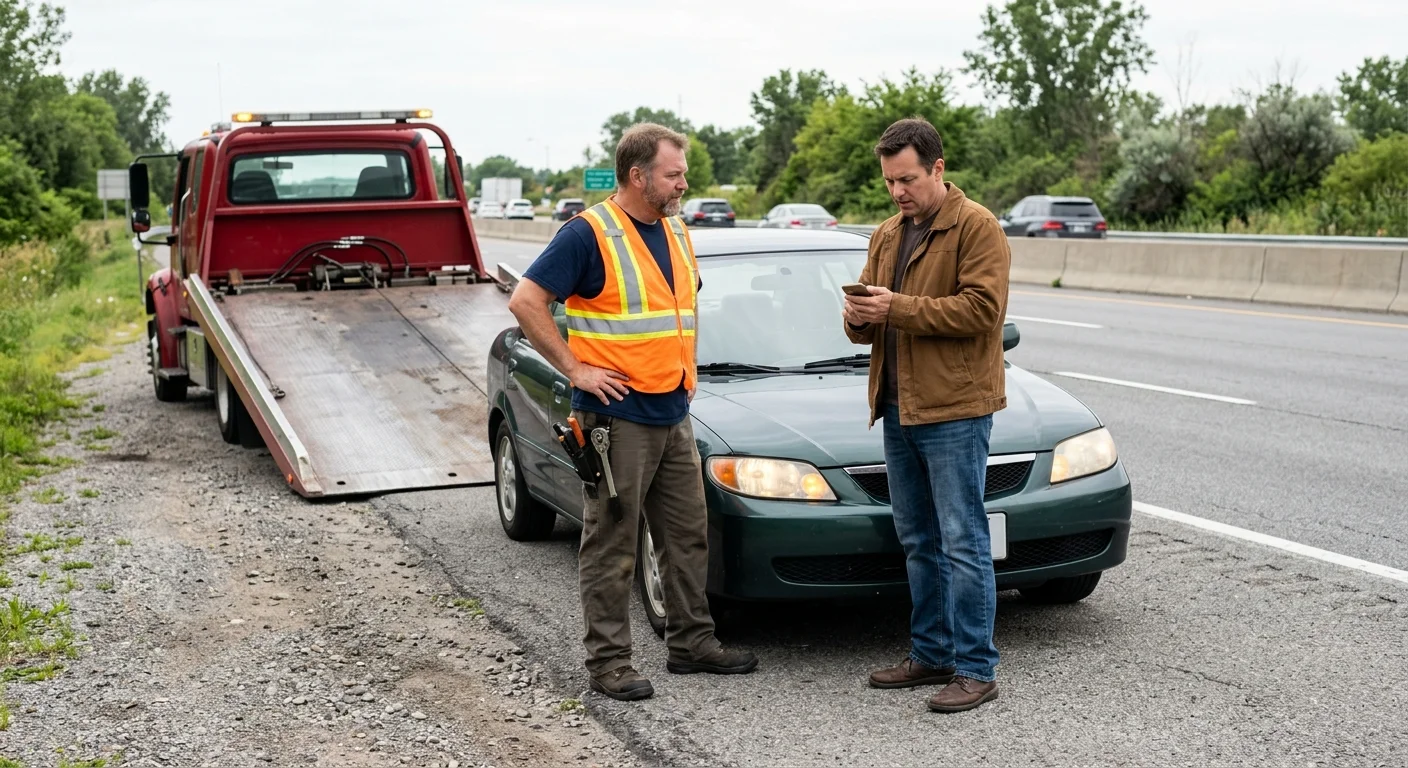
An immediate tow is a one-vehicle job. An independent operator comes to the car, loads it, and takes it to the address you name. That usually fits when the car is in the way, on a shoulder, or sitting where it will get ticketed or hit.
Expressway shoulders are the clearest case. If you died on the Kennedy, the Dan Ryan, the Eisenhower, the Edens, or at the Jane Byrne Interchange, you are in live traffic. IDOT’s Chicago-area Emergency Traffic Patrol, the crews people call Minutemen, can protect a scene and clear hazards. They do not repair vehicles and they do not tow them away. You still need an operator for the car.
The same is true after a crash. Cook County logged 164,559 crashes in 2024, about 54 percent of all crashes in Illinois. A car that will not roll after a hit on Harlem or on I-294 isn’t waiting for a multi-car carrier to build a route. It needs a recovery and a direct haul to a shop or a holding lot.
Winter pushes the same way. O’Hare averages 38.4 inches of snow a year, 121.3 nights at or below freezing, and 6.5 nights at or below zero. A dead car on an arterial during the city’s winter overnight parking ban is a street problem, not a shipping problem. That ban runs December 1 through April 1 on 107 miles of arterial, from 3 a.m. to 7 a.m., snow or no snow. A scheduled pickup next week doesn’t help if the city moves the car first.
Immediate tows also fit inoperable cars that a carrier will not accept as-is. Many transport bookings assume the vehicle can steer and roll onto a deck. Some accept inops. Some don’t. If the provider you called wants a running car, the honest move is a tow to a meeting point, or a tow the whole way. Don’t assume a car hauler can winch from a jammed garage ramp on Lower Wacker.
A long-distance tow is still a tow. It’s one operator, one car, one destination. It can make sense when you need a known handoff, a specific shop, or a car too damaged for a shared trailer. There is no published Illinois mileage line that says tow until here, ship after that. Anyone quoting a cutoff is using their own equipment and schedule, not a statute. Ask for the quote before the truck rolls.
When scheduled vehicle transport may fit
Scheduled auto transport is a logistics booking. A carrier, often hauling more than one vehicle, picks up on a window and delivers on a window. That can fit a disabled car if the provider accepts nonrunning vehicles, if you can wait, and if pickup and delivery spots can take a large truck.
This is the usual conversation when the car is already somewhere safe. A driveway in Naperville. A lot in Elk Grove. A shop that will hold it. You are moving to another state, selling the car to an out-of-town buyer, or sending a project car to a builder. The car doesn’t have to leave tonight. That is when people search tow or ship a disabled car and mean a later date, not a shoulder.
Transport is also what people mean when they compare a tow dolly with auto transport. A rental dolly lifts two wheels and leaves two on the pavement. You drive the tow vehicle. For a disabled car that will not roll, steer, or stay in neutral, a dolly is the wrong tool. Rear-wheel drive, all-wheel drive, and many EVs have extra limits in the owner’s manual. We can’t confirm a single 60/40 weight rule, or the weight of a 20-foot car hauler, as Illinois law. Those figures aren’t in the sources we use. If you are towing behind your own truck, that’s your hitch, your ratings, and your insurance. It isn’t the job we dispatch.
A professional carrier keeps all four wheels off the road. That avoids dolly wear on the trailing tires. It doesn’t automatically mean enclosed, covered a certain way, or delivered on a set morning. Those terms belong to the transport company. Quick Tow Chicago doesn’t sell that product. If a referred tow operator can’t take the distance, they should say so. Then you book transport separately and confirm the inop policy in writing.
Sometimes the honest answer is both. A flatbed takes the dead car out of a tight city garage, or off a street in Little Village, and meets a carrier at a wide lot. That extra step costs time and a second quote. It can be the only way a shared trailer will take the car. Ask before you lock either booking.
Don’t treat “ship it” as faster. A dedicated tow leaves when that operator is free. A carrier is building a route across several pickups. Neither comes with a time promise from us. We don’t publish arrival windows. The operator or the transport company sets their own schedule, and you confirm it with them.
Compare pickup access and delivery expectations
Pickup is where a lot of these jobs fall apart. A long car hauler can’t copy a city wrecker into a Lincoln Park alley. A loading dock in the industrial park by O’Hare is a different truck than a third-floor garage with a low clearance bar.
Walk the access before you book. Can the truck enter legally, turn, and sit without blocking a bus lane. Is there a height bar. Is the car facing a wall. Will the operator need a winch, dollies under a locked wheel, or a longer strap run. Take photos in daylight if you can. Send them with the year, make, model, and whether the car rolls.
Delivery needs the same walk-through. “Drop it in Chicago” is not an address. Name the shop, the lot, or the driveway. Ask who will be there, and whether the car can be left if nobody answers. A transport company may use a nearby wide street as a meeting point and ask you to meet the truck. A local tow operator may be able to place the car in a specific stall. Neither result is promised unless it is in the quote.
If the destination is out of our four-county service area, say so up front. We serve listed places in Cook, DuPage, Kane, and Will. Northwest Indiana is outside that map. A tow toward Calumet City is not a tow into Indiana unless the operator you hear from agrees in the quote.
For the car itself, prepare it the way you would for a long haul: personal items out if the provider requires that, parking-brake instructions followed, charge cables and aftermarket spoilers called out. Don’t leave the operator to discover a body kit on the ramp.
People also ask whether a truck or an SUV is better for towing. That question is about the vehicle you would drive while pulling a dolly. It doesn’t choose a professional tow versus a carrier. If you aren’t hitching the disabled car to something you will drive, skip it.
Confirm the operator’s quote and terms
The number you hear before dispatch is the number that should match the invoice for that described job. If the description changes, the quote can change. A car that “rolls” and then doesn’t is a different job. A second-story garage that was described as a driveway is a different job.
Ask what equipment they plan to send. Wheel-lift versus flatbed isn’t trivia on a disabled car. AWD, low kits, and locked wheels are why people book a flatbed in the first place. Confirm whether a winch is part of the quoted work. Confirm whether storage, yard time, or a second person is extra. We don’t set those prices. The operator does. Long-distance cost from Chicago depends on distance, condition, and equipment, and it’s still a quote, not a published rate card from us.
If you are booking transport instead, ask a parallel list. Do they accept a nonrunning vehicle. Open or enclosed. Who loads. What the pickup window is. What happens if the truck can’t access the street. What the claim process is if something is damaged. We can’t confirm insurance language for a carrier we don’t operate. Get it from them.
Keep city pound rules out of this quote unless the car is actually in a city lot. A private tow to a shop is not a City of Chicago impound. Those are different regimes, with different paper. Mixing them is how people show up with the wrong documents.
If the disabled car is a total loss, Illinois salvage rules can apply under 625 ILCS 5/3-117.1. A salvage certificate is required in listed situations, including some insurance total-loss payments. That is title work with the Secretary of State. It isn’t a towing price, and we don’t quote title fees. Confirm the paper trail with the insurer or the buyer before the car rolls across a state line.
Get the quote, the equipment, the pickup, and the drop in one conversation. Then decide whether you need a tow, transport, or a tow that meets a carrier.
When to call us
Call when the car can’t stay where it is, can’t roll onto a shared trailer, or needs a referred operator for a direct haul rather than a shipping reservation. The line takes calls 24 hours a day. A notice plays, the call is recorded, and we dispatch an independent local operator. Call us at (773) 830-6930.