Your car is gone from a curb, a River Oaks stall, or an apartment space in Calumet City. The next step depends on where it sat, not on the word tow on a slip of paper. A city street, a private lot, and a breakdown on Sibley Boulevard follow three different rules.
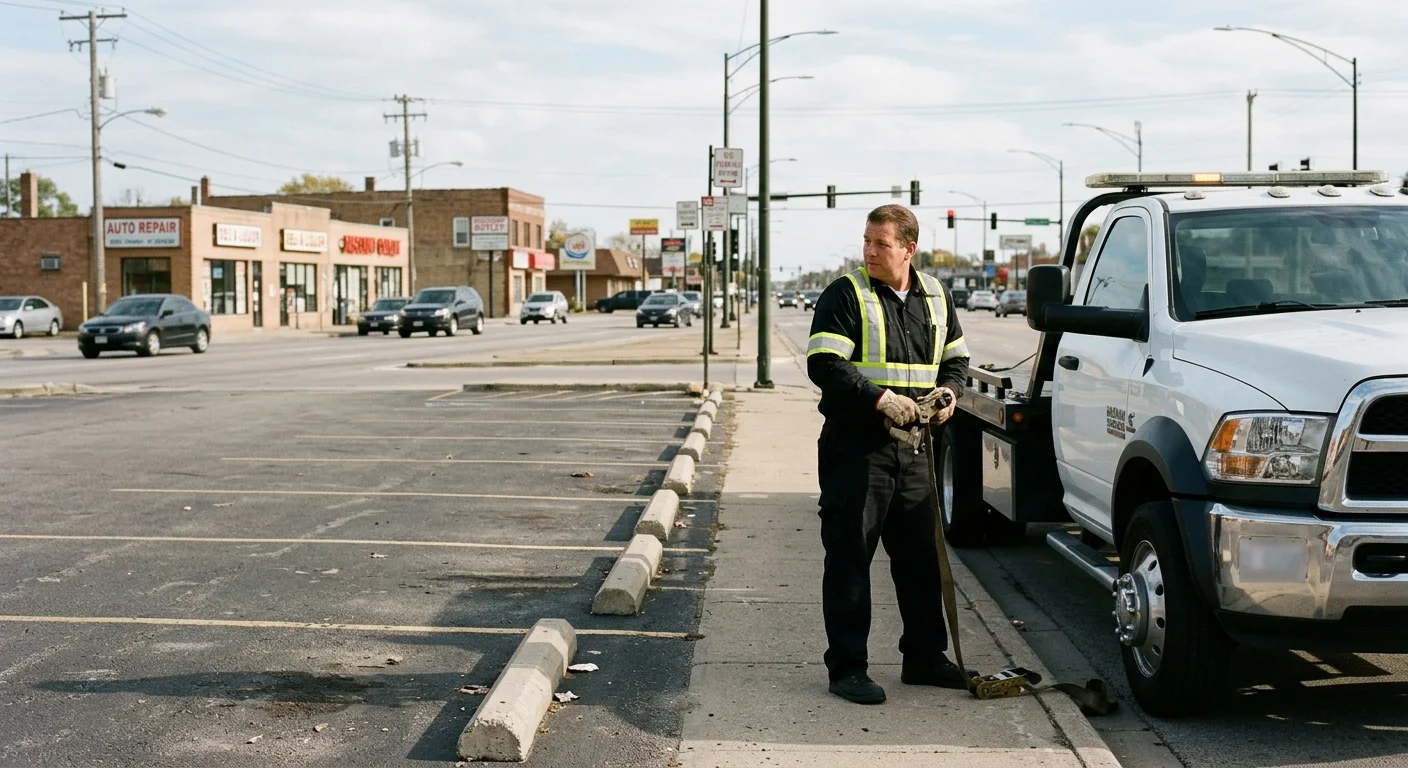
Where the car was parked in Calumet City
Calumet City sits in southern Cook County, pressed against the Indiana line. Torrence Avenue and Sibley Boulevard (Illinois Route 83) carry the shopping and through traffic. State Street and Wentworth Avenue run the older commercial and residential grid. River Oaks pulls weekend parking. The Bishop Ford Expressway (I-94) sits just west. Chicago’s Hegewisch and East Side neighborhoods sit immediately north. Burnham and Lansing sit next door.
That map is not one legal system. A space on a city street is a Calumet City municipal problem. A stall in a shopping lot is a private-property problem under Illinois relocator law. A dead car on the shoulder of Sibley, or on a ramp toward I-94, is a breakdown. That is a third track. Walk a few blocks north into Chicago and you are in a fourth world: the city’s pound system, which this suburb does not use.
Stand in the empty space and name it. Curb with city signs. Painted stall in a plaza. Numbered apartment space. Shoulder. Those four scenes send you to four different people.
Do not assume a Chicago auto pound has it. Calumet City is its own municipality. The City of Chicago’s four pounds, the $250 and $350 tow fees under Municipal Code 9-92-080, and the city’s vehicle-search tool apply inside Chicago, not here. If you parked north of the line in Hegewisch or the East Side, start with our guide on who towed my car in Chicago. If you parked in Hammond, you are in Indiana. This line does not cover Northwest Indiana.
Towing Calumet City IL is a local search for a reason. The operators who work this grid know Torrence, Sibley, and the lots around River Oaks. They also know the city line. A page that treats this town like any other south suburb misses that border. Your first job is to say, out loud, where the car was sitting when it disappeared.
City street tows follow a municipal process
If the car was on a public street, in a posted no-parking zone, or moved at the direction of Calumet City police, you are likely looking at a municipal impound. That is not a Chicago pound tow. It is not a private relocator job either. Illinois treats suburban and municipal impounds under 625 ILCS 5/11-208.7.
The statute says a municipal administrative fee must be reasonable and related to the city’s administrative and processing costs. It sets no dollar cap. Calumet City’s own fee, daily storage rate, lot address, hours, and release forms could not be confirmed from the sources this site is allowed to cite. Do not guess them from a Chicago schedule, and do not treat another suburb’s lot as this one. Ask the City of Calumet City, or the police department that ordered the tow, for the current figure and the lot that actually has the car.
State law does lock in process. The owner has the right to an administrative hearing. The city must give notice within 10 days of impoundment. An initial hearing must be scheduled and convened no later than 45 days after the date the notice is mailed. If the hearing officer finds the vehicle was stolen or hijacked at the time it was impounded, the municipality must refund any administrative fees already paid.
Bring what the city asks for at release. Typical asks in Illinois are photo ID, proof of ownership, and payment of the city’s charges. The exact list is the city’s, not ours. We cannot publish a Calumet City lot phone, address, or deadline because those were not verified for this page. A number copied from a forum post is how people drive to the wrong yard.
Quick Tow Chicago cannot release a city impound. We do not run a lot. We do not hold a municipal contract you can cash in at a window. If the car is in the city’s custody, the city is the only office that can give it back. Pay there, on their terms, after you confirm they have the vehicle.
A street tow in this town is still a Cook County event. Cook County logged 164,559 crashes in 2024, about 54 percent of all crashes in Illinois. Police-directed tows after a wreck on Torrence or Sibley follow this municipal track, not a shopping-lot relocator. If you are standing on a public curb, start with the city, not a private invoice.
Apartment and shopping-lot tows follow a private relocator
If the car left a River Oaks stall, a strip-plaza space off Torrence, or a numbered apartment spot, you are probably in private-property relocation. In Cook County that work is done only by commercial vehicle relocators licensed by the Illinois Commerce Commission, under 625 ILCS 5/18a. The law does not apply to vehicles on public streets, disabled vehicles, repossessions, or police-directed towing.
Signs are the first check. Under 625 ILCS 5/18a-302, signs in the affected area must be at least 24 inches high by 36 inches wide, at least 4 feet off the ground and less than 8, and illuminated or painted with reflective paint, or both. They must carry the relocator’s name, address, and telephone number, and the amount of towing charges a person parking may be subject to. Residential property clearly reserved for residents does not need that posted notice. Photograph the sign if it is still there. The name on it is who to call.
The statute also sets hard limits. A relocator may not remove a vehicle when the owner or operator is present before removal is complete and is willing and able to move it immediately. The relocator must notify law enforcement in the jurisdiction within one hour of removal. From a location that is not unincorporated, the lot may be no more than 10 air miles away. Imposing any charge other than in accordance with Commission-set rates is unlawful. The current ICC maximum rate is not published on the Commission pages this site relies on, so we do not print a figure. If a charge looks wrong, take it to the Illinois Commerce Commission relocation towing page.
Storage rules sit in the Commission’s consumer rules, not in a village ordinance. No storage fee at all if you claim the vehicle within 24 hours with proper identification and payment. No storage charges for days or hours the relocator is closed to the public. No storage charge after you claim it, show ID, and tender payment. Relocators must accept cash, money orders, cashier’s or certified checks, and major credit cards without extra fees. You should leave with a complete Relocation Towing Invoice as a receipt.
One more clock: if after a reasonable effort you cannot reach the relocator by phone for one hour from your first try, during hours they must answer that number, all fees for towing, storage, or otherwise are waived. That is 625 ILCS 5/18a-300(15), verbatim.
Quick Tow Chicago is a referral service. We connect property managers with relocators who hold that ICC licence. We do not relocate cars, and we do not hold that licence. If you need the property-side path, start at private property towing. If you are the driver whose car is already gone, the invoice and the sign, not our line, tell you which licensed relocator has it.
Confirm who has the car before you pay or drive
Who towed my car in Calumet City is the real search. Paying the wrong yard does not get the car back. Driving to a Chicago pound first wastes a morning. Confirm the custodian before you move.
Start with paper and signs, not with a guess. A city notice, a police event number, or a direction from Calumet City staff points to a municipal impound. A private invoice, a lot sign with a relocator name, and an ICC licence number on the paperwork point to a commercial relocator. A breakdown you called in yourself should match the operator named in the quote you heard before anyone rolled.
If the paper is missing, walk the space again. City curb: call the City of Calumet City and ask which lot received a police-directed tow from that block. Private lot: read the posted relocator name and use that number on the sign. Do not pay a cash demand in a parking aisle from someone who will not show a relocation invoice.
Do not treat this like Chicago. Inside the city, a missing car may have been relocated rather than impounded, and the city’s own pages tell residents to check the vehicle-search tool before reporting it stolen. Calumet City is not on that tool. A south-suburb lot job looks more like the split we already mapped for Tinley Park village versus private tows than like a trip to 103rd and Doty.
Check the truck and the invoice against the statute when you get there. Relocators must mark name, address, and phone on both sides of the truck in vividly contrasting colour. Advertising without the relocator’s licence number is unlawful. The yard should be inside that 10 air-mile cap for a city location. If the operator will not produce a complete invoice with complaint instructions, stop and take the dispute to the Commission.
Bring ID and proof of ownership. Do not send a friend with no paperwork. Do not assume a title in the glove box is still in the car. If a police hold is on the vehicle, the lot cannot release it until that hold lifts. That is true in Chicago pounds and it is the pattern at municipal lots. Ask before you drive.
Pay only after the name on the invoice matches the name that actually has the car. The number you heard in a quote for a breakdown should be the number on that invoice. For a city impound, the city’s charges are the city’s. For a relocator, Commission-set rates govern. Mixing those three pots is how people overpay and still leave empty-handed.
What a referral line can do after the car is already gone
Quick Tow Chicago takes the calls that come in on the line and matches drivers with independent local operators. We own no trucks, run no yard, and hold no tow licence. We cannot walk into a Calumet City impound and pull a release. If the city has the car, that door is the city’s.
What the line can still do is sort the job. If the car died on Sibley, on Torrence, or on a ramp toward the Bishop Ford, that is a breakdown. An operator in the network can be dispatched once you have a quote. If a property manager needs a licensed relocator for a lot off River Oaks, we connect them with relocators who hold the ICC licence. If you are already looking at a wreck in a travel lane, emergency towing is the path, not a hunt for an impound window.
The price is quoted before anyone is dispatched. The number you hear on the phone is the number on the invoice. We do not publish a rate for this metro because no operator rate card is on file here. City of Chicago pound fees are Chicago’s, and they do not travel south of the city line. Calumet City’s administrative fee is the city’s to state.
The line takes calls 24 hours a day. A greeting and a recording-consent notice play first. Illinois is treated as an all-party consent state, so that notice is not optional. There is no published email for this brand. Written contact goes through the contact page.
If IDOT’s Emergency Traffic Patrol, the Minutemen, is already on an expressway scene west of town, remember what they do. They close lanes, warn traffic, and protect responders. They do not repair cars and they do not tow them away. You still need an operator for the car itself.
After the car is gone, a useful call is a short one. Where it sat. Whether you have a city notice or a private invoice. Whether it will not start. From that, we can tell you if an operator in the network can roll, or if you need the City of Calumet City or the relocator named on the sign.
When to call us
Call when the car is still yours to move: a stall on Sibley, a dead battery in a River Oaks row, a wreck that needs a hook, or a property manager who needs an ICC-licensed relocator. Once a Calumet City impound has it, only the city can release it. Call us at (773) 830-6930. The line is answered 24 hours a day, calls are recorded after a notice, and an independent local operator is dispatched to you.