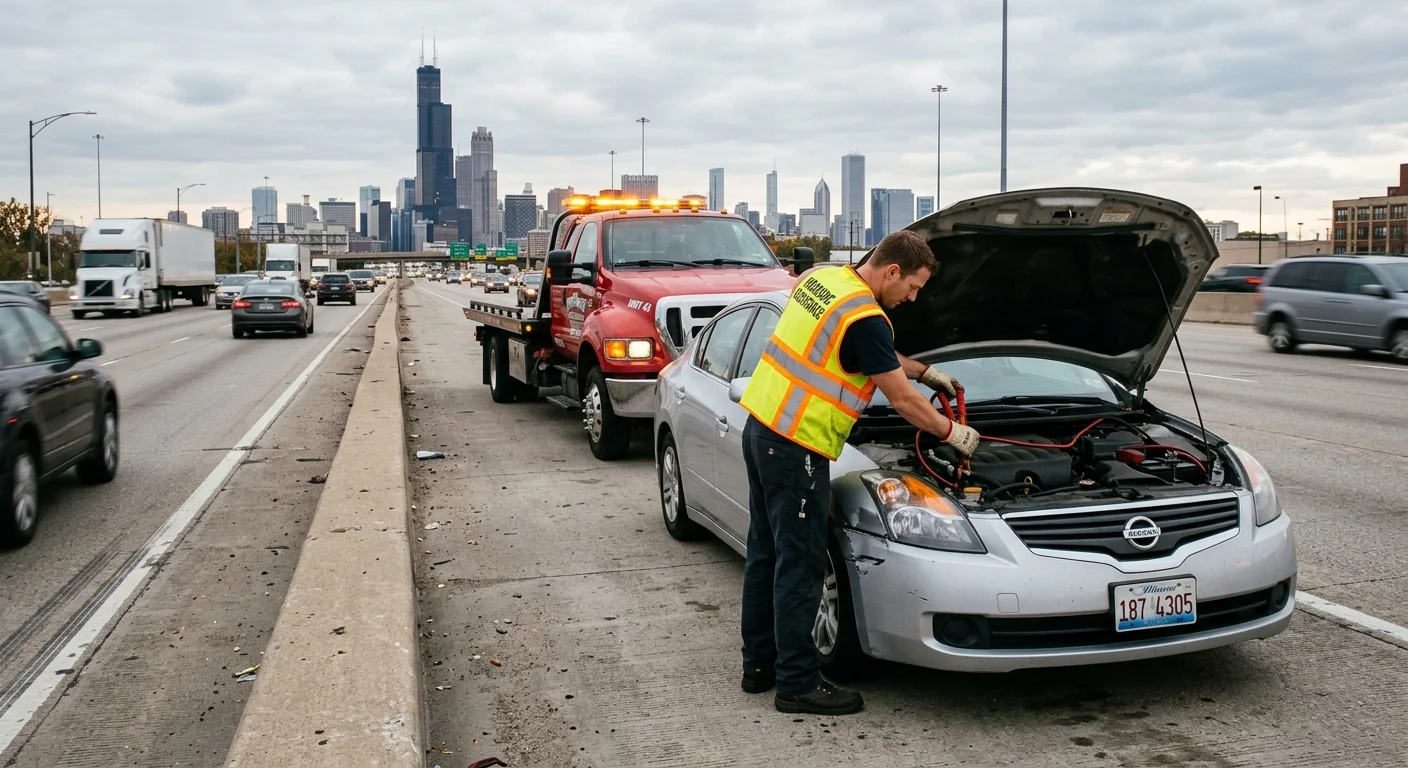
A car breakdown in Chicago traffic demands calm, simple decisions. Move out of a live lane if the car can still roll, turn on the hazard lights, and request roadside help or towing based on what failed.
Reduce your exposure first
Get as far from moving traffic as the car allows. A shoulder is better than an active lane, but it still leaves little room beside fast traffic. Stop on the right when possible, set the parking brake, and leave the hazard lights on.
Stay belted inside if the car is fully off the roadway and the cabin isn’t threatened. Avoid standing beside the car or opening a door toward traffic. Don’t inspect the engine, change a tire, or attach cables while part of your body extends into a live lane.
Smoke, fire, rising water, or a car stopped in traffic changes the situation. Call 911 and clearly describe the lane, direction, and nearest visible marker. If you must leave the vehicle, use the side away from traffic when possible. Move behind a barrier rather than standing in front of or behind the car.
IDOT’s Chicago-area Emergency Traffic Patrol responds to traffic disruptions involving crashes, disabled vehicles, and road debris. Its workers are also called Minutemen. They can establish emergency lane closures and protect the scene, but they don’t repair vehicles or tow them away. IDOT doesn’t publish a public call-out number for the patrol.
That means you’ll still need roadside assistance or a tow operator for the disabled car. The person helping should know whether the car is protected on a shoulder or exposed to moving traffic.
Pin down your location on I-55 or I-90
“I’m on the highway near Chicago” isn’t enough detail for a dispatch. I-55 and I-90 cross different parts of the metro, and both cover long distances.
I-55 is the Stevenson Expressway through Chicago and the southwest suburbs. It continues toward the Joliet area, where the region’s major intermodal complex sits south of the city. A caller near Chicago may be close to the city, a southwest suburb, or much farther down the corridor.
I-90 follows the Kennedy Expressway between downtown and the O’Hare area. The Jane Byrne Interchange is a useful landmark near downtown. Farther northwest, O’Hare and the Elk Grove Village industrial area create a very different location description.
Start with the route and direction. Chicago drivers often say inbound or outbound, but add a compass direction when you can. Then give the nearest exit, interchange, overpass, or mile marker. Say whether you’re on the right shoulder, left shoulder, ramp, or an active lane.
Use your phone’s map pin if signs are hard to read. Confirm that the pin marks your car, not a nearby frontage road. Expressways, ramps, and local streets can appear close together on a map while requiring different approaches.
Also mention visible landmarks. An airport entrance, major interchange, recognizable building, or numbered exit can remove doubt. If you crossed an exit just before the breakdown, say so and name the next exit shown ahead.
Drivers on the Kennedy can also use our guide to breaking down on the Kennedy or Dan Ryan for more corridor-specific guidance.
Decide between roadside help and a tow
The warning lights and symptoms help determine what kind of operator you need. Describe what happened without diagnosing the car yourself.
A dead battery, a flat tire with a usable spare, or keys locked inside may call for roadside service. Tell the operator about damaged wheels, missing lug nuts, a shredded tire, or a car sitting too close to traffic. Those details can change whether work should happen at the roadside.
Request towing when the car can’t roll, steer, brake, or start after basic assistance. Towing also makes sense when there’s collision damage, leaking fluid, severe overheating, or no safe working space around the vehicle. Don’t keep driving a car that can’t be controlled normally.
Tell dispatch if the car is an electric vehicle, motorcycle, lowered car, large SUV, or heavily loaded vehicle. Mention an attached trailer. Give the operator enough information to choose suitable equipment. Some situations may call for flatbed towing, while others can be handled with a different towing setup.
Don’t promise yourself that the next exit is close enough. If the car is losing power, steering, braking, or visibility, focus on reaching the nearest protected stopping point.
Quick Tow Chicago is a referral service. We match stranded drivers with independent local operators. We don’t own trucks, employ drivers, operate a storage yard, or set the operator’s price. The price is quoted before anyone is dispatched.
No arrival window can be promised here. Traffic, road closures, weather, equipment needs, and the exact shoulder location all affect how an operator reaches the scene.
Give the operator the whole picture
A clear first message reduces back-and-forth. Begin with your route, direction, nearest exit, and shoulder position. Then describe the vehicle and the problem.
Include these details:
- Vehicle year, make, model, and color
- Current road, direction, and nearest exit
- Right shoulder, left shoulder, ramp, or active lane
- Whether the car rolls, steers, and brakes
- Any collision damage or leaking fluid
- Flat tires, damaged wheels, or low clearance
- Passengers, children, pets, or mobility needs
- An attached trailer or unusual load
- Police, fire, or IDOT personnel already at the scene
Say whether traffic can pass without entering your space. Don’t say the location is safe if you aren’t sure. Describe what you see and let the operator evaluate the access.
The destination matters too. You may want the car taken to your home, a repair shop, or another agreed location. Confirm that the destination can receive the vehicle. An after-hours shop may have a designated drop area, but you shouldn’t assume one exists.
Remove essential personal items only when you can do so without entering traffic. Keep your identification and destination information available. If collision damage prevents a door or trunk from opening, mention that before the operator arrives.
If a tow is needed from an exposed lane or damaged position, emergency towing is the appropriate service request. Quick Tow Chicago will need accurate scene details before matching you with an operator.
A breakdown tow isn’t the same as an impound
Chicago-area towing falls into different legal categories. A tow you request for your own disabled car isn’t the same as a City of Chicago impound, a suburban municipal impound, or a private-property relocation.
City tows inside Chicago can send vehicles into the city pound system. Suburban municipalities run their own impound processes and set their own administrative fees. The City of Chicago’s published pound schedule doesn’t apply to a village impound.
Private-property relocation is another separate system. In Cook, DuPage, Kane, and Will counties, these relocations are handled by commercial vehicle relocators licensed by the Illinois Commerce Commission. The ICC’s relocation towing guidance explains that this law doesn’t apply to disabled vehicles, public-street vehicles, repossessions, or police-directed towing.
That distinction matters if you leave the car and return to find it gone. Inside Chicago, check the city’s Find Your Towed Vehicle tool and contact 311 before reporting the car stolen. The city may have impounded it or relocated it for street work.
Outside Chicago, contact the police department serving the place where the car was left. A suburban village impound doesn’t follow Chicago’s pound schedule. Ask the municipality which lot received the car and what documents it requires.
If the vehicle disappeared from private property, record the posted sign and contact information. Don’t assume a consensual roadside tow, a city impound, and a private relocation carry the same rules. Our guide to impounds versus relocations in Chicago explains those separate systems.
When to call us
When a boost, tire service, or simple roadside check won’t get the car moving, the situation has become a job for an operator. Quick Tow Chicago’s line is taking calls 24/7, and calls are recorded after a notice. Leave the vehicle and location details so we can match you with an independent local operator, with the price quoted before dispatch.
Call us at (773) 830-6930.