Your car won’t move, and you need Schaumburg towing arranged now. Dispatch needs your exact location, vehicle details, its condition, and the destination before matching you with an independent local operator.
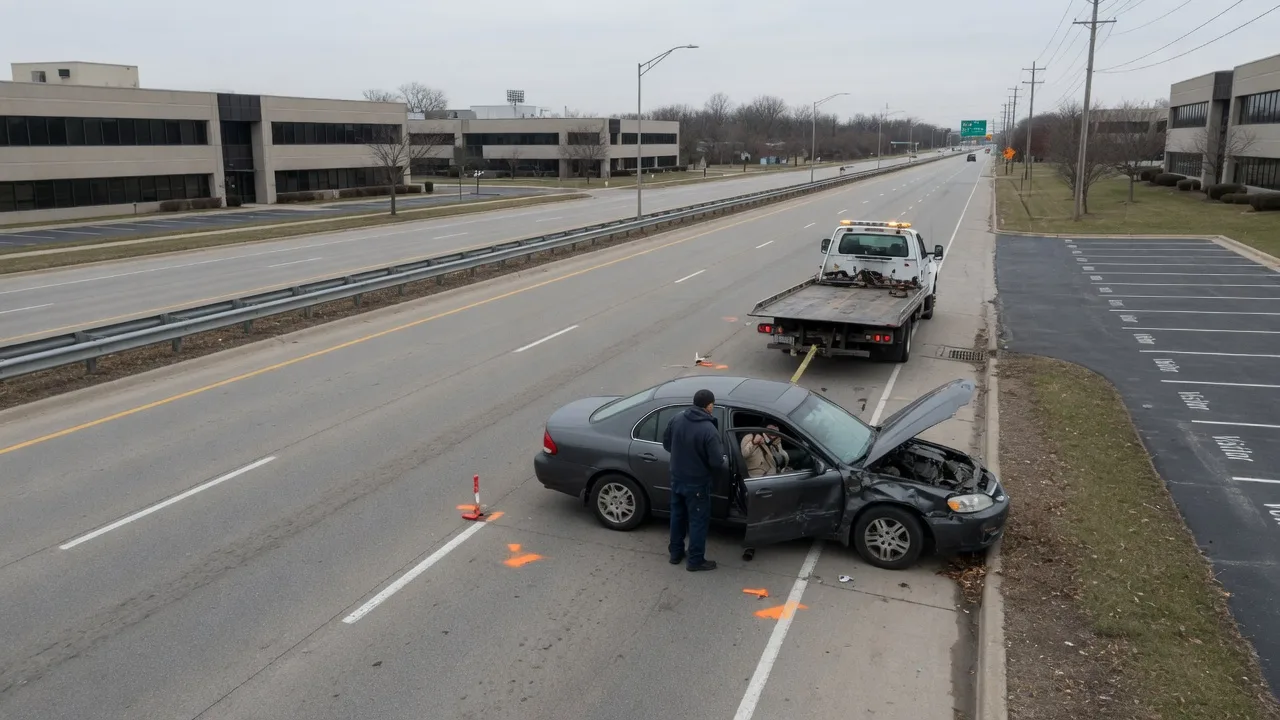
Pin down your Schaumburg street, lot, or highway location
Start with more than “I’m in Schaumburg.” The operator needs a precise pickup point. Send a map pin when possible, then confirm the street or property name.
On a village street, give the nearest cross street and your direction of travel. Golf Road at Meacham Road is much clearer than “near Woodfield.” Higgins Road, Roselle Road, Schaumburg Road, and Barrington Road cover long stretches. A nearby business entrance can help distinguish one block from another.
For a parking lot, name the property and describe your section. Mention the nearest entrance, building, or visible sign. Tell dispatch whether the car is in a garage, loading area, narrow aisle, or underground space. Low clearance or a tight turn can affect which equipment fits.
On I-90 or I-290, share the highway, direction, and nearest exit. A phone map pin is especially useful because the mailing address may not match your actual position. Say whether the car is on a shoulder, ramp, or another place exposed to traffic. If anyone faces an immediate danger, call 911 first.
IDOT’s Emergency Traffic Patrol helps manage Chicago-area expressway disruptions and hazards. Its workers don’t repair vehicles or tow them away, so you may still need an operator.
Don’t walk along an expressway to find a sign. Use your phone’s map, stay where you’re protected, and report what you can see safely. Accurate location details prevent the operator from searching the wrong frontage road, entrance, or side of the highway.
Say what happened to the car in one sentence
A short, factual description helps dispatch separate a tow from a roadside call. Try: “The engine shut off and won’t restart,” or “The front tire is flat, and I don’t have a usable spare.”
Other useful descriptions include:
- The battery appears dead.
- The keys are locked inside.
- The car starts but won’t move.
- The vehicle was in a collision.
- One wheel is damaged or missing.
- The car is stuck in snow, mud, or a ditch.
- Warning lights appeared before the engine stopped.
Don’t diagnose a problem you can’t confirm. “It made a grinding sound and stopped moving” is more helpful than guessing that the transmission failed. The operator can prepare around the symptoms you actually observed.
Some calls may be handled through roadside assistance instead of a tow. A jump start, lockout, fuel delivery, or tire change may get the car moving. Tell dispatch if you have a spare tire, wheel lock key, accessible battery, or unusual starting procedure.
Request emergency towing when the car can’t be driven or roadside help isn’t suitable. Report collision damage, leaking fluid, deployed airbags, smoke, or a wheel sitting at an unusual angle. Don’t try to start or move a vehicle when doing so appears unsafe.
If the vehicle has disappeared from a Schaumburg lot, this is a different problem. Read our guide to a Schaumburg village impound or private-property tow before requesting another truck. A dispatch operator can move a vehicle you possess. It can’t retrieve a vehicle without first locating the lot holding it.
Report size, drivetrain, and whether it rolls
Give the year, make, model, and body style. “A white Toyota” leaves too many possibilities. “A white Toyota Sienna minivan” gives dispatch a better starting point.
Mention anything that changes the vehicle’s size or weight. That includes a loaded pickup, commercial van, roof equipment, trailer, oversized tires, or modifications. Don’t estimate the weight if you don’t know it. The model and configuration let the operator check the proper specifications.
Tell dispatch whether the vehicle is front-wheel drive, rear-wheel drive, all-wheel drive, or four-wheel drive. If you’re unsure, say so. Don’t choose towing equipment based on a guess. The operator should confirm the setup that fits the vehicle and its condition.
The next question is whether the car rolls, steers, and brakes. Answer each part separately:
- Does it shift into neutral?
- Can the steering wheel turn?
- Are all wheels attached?
- Are any wheels locked?
- Does the parking brake release?
- Are the keys present?
- Can someone access the passenger compartment?
A vehicle that won’t roll may need different loading equipment. The same applies when a wheel is folded inward, the suspension is down, or the car sits very low. Photos can help the assigned operator understand the position, but don’t step into traffic to take them.
Access matters too. Report whether another car blocks the disabled vehicle. Mention a narrow garage opening, low ceiling, steep driveway, soft ground, or curb pressed against a wheel. If the car is nose-first in a tight parking space, say that before equipment is assigned.
Electric vehicles and some newer cars have model-specific transport settings. Tell dispatch the exact model, battery condition, and whether you can access the controls. The operator can then confirm the needed loading method instead of relying on assumptions.
Choose a shop or home destination in the northwest suburbs
A towing request needs both ends of the trip. Decide where the vehicle should go before the operator is assigned. That may be your home, a repair shop, a dealership, or another property that has agreed to receive it.
Confirm the destination address directly. Similar business names can lead to the wrong location. If you’re choosing between Schaumburg and a nearby northwest suburb, check which location will accept the vehicle.
Call the destination before dispatch when you can. Ask whether it accepts after-hours drop-offs and where the operator should leave the keys. Confirm that the shop services your vehicle and the problem you described. Quick Tow Chicago can arrange transportation, but it doesn’t select a repair facility or confirm that a shop will accept your car.
If you’re going home, check the parking situation. Tell dispatch about a steep driveway, gated entrance, assigned space, narrow alley, or apartment access restriction. Make sure you have permission to leave the vehicle there.
Distance also changes the job details. A trip within Schaumburg differs from a tow toward Arlington Heights, Elk Grove Village, Hoffman Estates, Palatine, or farther across the metro. Give the full destination so the operator can quote the actual request.
Don’t ask the driver to decide the destination after loading. That can create confusion about route, access, and price. If you haven’t chosen a shop, a safe authorized location may be the clearer first destination.
For broader guidance on what to share during a local search, see our guide to finding a tow truck near you in Chicago. The same core details matter in Schaumburg: pickup point, vehicle condition, access, and destination.
What a referral line can and cannot promise
Quick Tow Chicago is a referral service. We take the details from your call and match you with an independent local tow operator. We don’t own trucks, employ drivers, run a storage yard, or set the operator’s price.
The line can help organize the information needed for dispatch. That includes your location, vehicle, problem, access conditions, destination, and contact details. The operator confirms whether the requested equipment and job are within its capabilities.
No arrival time or response window is promised. Traffic, weather, operator availability, highway access, and the required equipment can all affect the assignment. Ask for current timing when the operator contacts you, but treat it as current information rather than a guarantee.
The price must be quoted before the truck is dispatched. Confirm what the quote covers, including the pickup, destination, vehicle condition, and any special loading needs you reported. If the job details change, ask whether the quote changes before work proceeds.
Quick Tow Chicago doesn’t set suburban impound charges or private-property relocation rates. It also can’t release a car held by a village, police agency, or private relocator. Suburban municipalities set their own procedures and administrative fees. Private-property relocation charges must follow Illinois Commerce Commission rates. If your car is already in a lot, identify who has it before arranging transportation.
Before assignment, repeat the four essentials: exact pickup point, exact vehicle, current condition, and exact destination. Then confirm the equipment and operator’s quote. Those details make the request clear without promises that nobody can verify.
When to call us
Call when the car can’t be driven safely, roadside help won’t solve the problem, or you need an operator to move it. The line takes calls 24 hours a day, and calls are recorded after a notice. Once the job details and quote are confirmed, we can match you with an independent local operator. Call us at (773) 830-6930.