To find a tow truck near you in Chicago, share your exact location, vehicle details, problem, and destination. Quick Tow Chicago can then match you with an independent local operator. Clear information gets the request moving without confusion about the vehicle or pickup point.
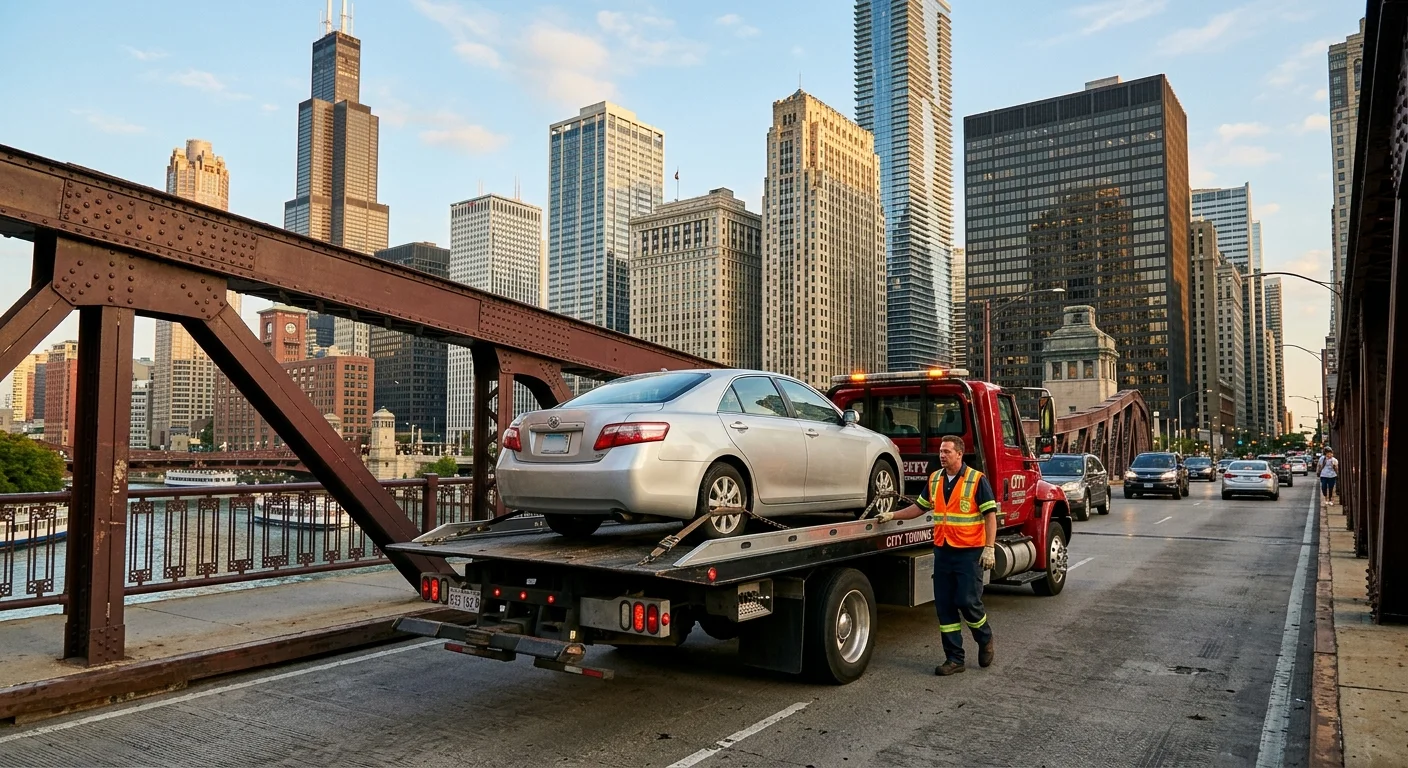
Start with your exact location
Chicago roads are long, crowded, and often split by express lanes. “The Kennedy” doesn’t give an operator enough information. The same applies to the Dan Ryan, Eisenhower, Stevenson, Edens, Bishop Ford, and Tri-State.
Start with the roadway name and your direction of travel. Add the nearest exit, cross street, or visible landmark. If you’re on a ramp, say whether it leads onto or off the expressway. Mention whether you’re before or after the exit.
Your phone’s map can provide a dropped pin. Check it before sharing. Elevated roads, lower streets, and overlapping ramps can make automatic locations confusing. Downtown drivers should specify whether they’re on an upper or lower level.
In a parking garage, give the facility name and entrance street. Add the floor, clearance information, and whether the vehicle rolls. In a large industrial area near Elk Grove Village or Joliet, include the business name, gate, and dock area.
Suburban locations need the same care. A pickup in Naperville, Aurora, Cicero, or Joliet shouldn’t be described only as “near Chicago.” Name the municipality because local boundaries affect both routing and towing rules.
Keep your phone available after placing the request. An operator may need clarification about the entrance, shoulder, or vehicle position. For a disabled vehicle, our emergency towing service connects drivers with operators serving Chicago and communities across Cook, DuPage, Kane, and Will counties.
Describe the vehicle and what happened
The operator needs to know what must be moved. Share the year, make, model, and approximate vehicle size. Mention whether it’s a motorcycle, passenger car, pickup, commercial vehicle, RV, or trailer.
Then describe the condition. Say whether the vehicle starts, rolls, steers, and shifts into neutral. Report damaged wheels, locked steering, missing keys, collision damage, or a blocked transmission. Tell the operator if the car is in a ditch, against a curb, or stuck in snow or mud.
This information helps the operator select suitable equipment. Some vehicles may need flatbed towing. Others may be suitable for a wheel-lift. Recovery from a ditch, median, soft shoulder, or collision scene may require accident recovery and winch-out equipment.
Access matters too. A low-clearance garage isn’t the same as an open street. A vehicle wedged between parked cars presents different conditions than one sitting in an empty lot. Don’t leave those details for the operator to discover at pickup.
You’ll also need a destination. That might be a repair shop, dealership, secure parking area, or another approved location. Confirm that the destination can receive the vehicle, especially outside normal business hours. Quick Tow Chicago doesn’t operate a yard or storage lot.
Don’t diagnose the mechanical failure if you aren’t sure. “The engine stopped and won’t restart” is more useful than a guessed repair. Describe what you can see, hear, and control.
Decide whether the car needs towing
A disabled car doesn’t always need a tow. The right request depends on what failed and where the vehicle stopped.
A drained battery may call for a jump start. A locked car may need lockout help. A tire problem may require roadside assistance if the spare and vehicle condition allow it. Fuel delivery may resolve a simple empty-tank situation. Our roadside assistance service covers those requests through independent operators.
Towing becomes the clearer choice when the vehicle can’t be safely driven to its destination. It may also be needed after collision damage, steering trouble, or a wheel problem. Give the operator the symptoms and let them assess the requested service.
Location can change the immediate priority. A breakdown in a parking lot differs from a stop beside the Jane Byrne Interchange. If the vehicle is in a live traffic lane, anyone is injured, or the scene presents an immediate danger, call 911 first. Follow instructions from police or traffic personnel at the scene.
The IDOT Emergency Traffic Patrol operates on Chicago-area expressways. Its workers are also called Minutemen. They manage hazards, warn approaching drivers, and protect responders. They don’t repair vehicles or tow them away.
Drivers facing an expressway breakdown can also review our guide to breaking down on the Kennedy or Dan Ryan. It explains what information helps when lanes, ramps, and shoulders make the location harder to describe.
Check whether the car was towed already
A missing car calls for a different process. Don’t request a roadside tow until you know where the vehicle went. Chicago has three separate towing regimes, and their rules can’t be treated as one system.
A City of Chicago tow sends a vehicle into the city pound system. The city operates four auto pounds. A missing vehicle may also have been relocated to another street because of emergency work or another street-clearing operation.
The city advises drivers to use its Find Your Towed Vehicle tool and contact the city’s non-emergency service before reporting a car stolen. Our guide to finding a towed car in Chicago walks through that distinction.
A suburban municipal impound is different. Cicero, Berwyn, Naperville, Aurora, Joliet, and other municipalities administer their own impound processes. They don’t use the City of Chicago fee schedule. Each municipality sets its own administrative fee, and no suburb-specific amount has been confirmed for this page. Check directly with the municipality holding the vehicle.
Private-property relocation is the third regime. In Cook, DuPage, Kane, and Will counties, that work must be performed by a commercial vehicle relocator licensed by the Illinois Commerce Commission. The ICC relocation towing page provides consumer guidance and complaint information.
Quick Tow Chicago isn’t an ICC-licensed relocator and doesn’t perform private-property removals. We can connect property managers with independent relocators who hold the required license. Drivers dealing with a parking-lot removal should review the Chicago private towing laws guide before treating it like an ordinary roadside tow.
Confirm the quote before dispatch
Quick Tow Chicago doesn’t set towing prices. The independent operator sets the price based on the requested work. You’ll receive that price before anyone is dispatched.
Be ready to provide the pickup location, destination, vehicle type, condition, and access details. Those facts define the job being quoted. A disabled sedan on an open street isn’t the same request as a damaged truck in a garage or a vehicle down an embankment.
Repeat the important details before accepting the quote. Confirm the vehicle, pickup point, destination, and requested service. If the condition changes, tell the operator. A car that no longer rolls or steers may require different equipment than first described.
Don’t compare a voluntary roadside quote with a city pound charge. They come from different systems. City impound fees are set by the City of Chicago. Suburban administrative fees are set by the municipality involved. Private-property relocation rates fall under the Illinois Commerce Commission’s system. The current maximum ICC relocation rate couldn’t be confirmed from the agency materials reviewed for this page. Drivers should check the Commission’s relocation towing page rather than rely on a number circulating elsewhere.
You can also ask what payment methods the operator accepts. Don’t assume every operator or destination uses the same options. Keep the vehicle keys and any destination instructions ready when possible.
Quick Tow Chicago is the referral point. It doesn’t own trucks, employ tow drivers, run a repair shop, or control a storage yard. The operator handles the towing work and provides the applicable service details.
When to call us
Call when the vehicle can’t be safely driven or roadside help won’t solve the problem. The line takes calls 24/7, and we’ll match your request with an independent local operator after the recorded-call notice. Call us at (773) 830-6930.