You need accident recovery when a damaged car must be repositioned or extracted before transport. A routine tow may be enough when the vehicle remains accessible and can be loaded normally. The operator makes that decision using the crash location, wheel condition, vehicle position, road access, visible leaks, and police involvement.
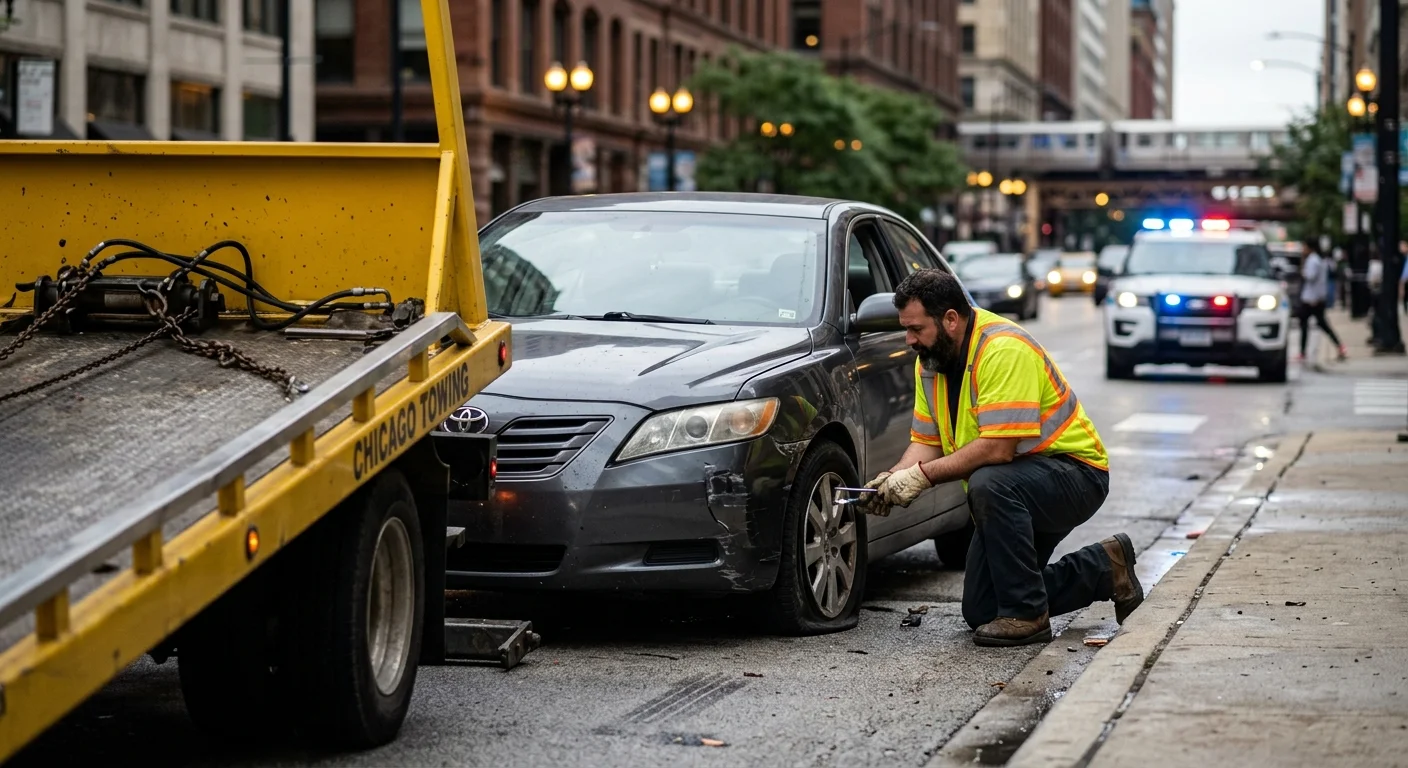
Start with the exact crash location
A street name alone usually isn’t enough in Chicago. Start with the nearest intersection, direction of travel, and visible landmark. On an expressway, add the route, direction, nearest exit, and whether you’re on the main lanes, an entrance ramp, or an exit ramp.
That detail matters around the Jane Byrne Interchange, where the Kennedy, Eisenhower, and Dan Ryan meet. “Near downtown” leaves too much ground to cover. “Inbound Kennedy, before the Jane Byrne Interchange” gives the dispatched operator a clearer starting point.
The same applies beyond the city. A crash on I-88 near Aurora isn’t handled from the same location as one on I-80 south of Joliet. A suburban street also falls under a different local jurisdiction than a City of Chicago street. Give the municipality even when the mailing address or nearby landmark says Chicago.
Share these details:
- The road, cross street, or expressway
- Your direction of travel
- The nearest exit, ramp, or mile marker
- The city or suburb
- Whether the car is on pavement, a shoulder, grass, or another surface
- Any gate, height restriction, alley, garage, or tight access point
- Whether police or another public agency is already present
If the collision happened on the Kennedy or Dan Ryan, our guide to breaking down on those expressways explains why direction and exit information matter. The same location details help with a crash recovery request.
When a simple tow may not be enough
Routine towing generally begins with a vehicle that an operator can approach and load from an accessible position. Accident recovery adds another step. The damaged vehicle may need to be brought back into a workable position before it can be transported.
That can happen when a car leaves the pavement, settles into soft ground, rests against a curb or barrier, or stops at an angle that blocks normal loading. A bent wheel can also change the job. So can damaged steering, locked wheels, collapsed suspension, or loose body panels.
Tell us what you can see without trying to diagnose the car. “The front passenger wheel points inward” is more useful than “the axle is broken” unless a mechanic has confirmed that diagnosis. Mention whether the wheels appear attached, whether the car sits upright, and whether any part rests on the pavement.
Visible fluid also matters. Describe its location, color, and approximate spread without guessing what it is. The operator can use that description when assessing the request.
The terms sometimes overlap in everyday conversation. A winch-out service in Chicago may mean pulling a drivable car from snow or soft ground. Crash recovery towing may involve a damaged vehicle that still needs transport afterward. Our accident recovery and winch-out service covers both kinds of referrals, but the dispatched operator decides what the scene requires.
If the car remains accessible and needs transport without extraction, emergency towing may be the closer fit. Accurate details help us route the request correctly.
How police-directed towing changes the next step
Police involvement can change who arranges the first tow and where the vehicle goes. If an officer says a truck has already been ordered, confirm that before requesting another operator. Ask which agency directed the removal, where the vehicle is going, and whether an investigation hold applies.
On Chicago-area expressways, IDOT’s Emergency Traffic Patrol responds to disruptions caused by crashes, disabled vehicles, and hazardous debris. Its workers, also called Minutemen, can establish emergency lane closures and protect responders. IDOT states that they don’t repair vehicles or tow them away.
A police-directed crash tow isn’t the same as a private-property relocation. The Illinois Commerce Commission’s relocation towing guidance says that relocation law doesn’t apply to disabled vehicles, vehicles on public streets, or police-directed towing. That distinction matters after a collision in a store lot, apartment lot, or public roadway.
A vehicle taken through the City of Chicago pound system may also be held for investigation. The city’s Common Towing Questions states that a pound can’t release a vehicle while a police hold remains. The pound staff also require specific ownership and identity documents before release.
Don’t assume the body shop, insurer, or owner can redirect a vehicle while that hold remains. First confirm its status with the agency involved. Once the vehicle can be released, a separate transport request may be needed.
What to tell the dispatched operator
The operator needs a scene description, not a perfect mechanical report. Start with the year, make, model, and vehicle type. Mention whether it’s a sedan, pickup, motorcycle, van, SUV, RV, or trailer.
Then describe the damage that affects movement or loading:
- Which wheels appear damaged, turned, locked, or missing
- Whether the steering responds
- Whether the vehicle is upright
- Whether airbags deployed
- Whether glass or body panels are loose
- Whether fluid is visible beneath the vehicle
- Whether the car can roll, shift into neutral, or start
- Whether the keys are available
- Whether another vehicle or fixed object blocks access
Explain the surrounding space too. An operator approaching a car against a concrete barrier faces a different setup than one approaching a car beside an open curb. Parking garages, alleys, loading docks, medians, embankments, and fenced lots can each affect access.
Be precise about police involvement. Say whether officers are still present, whether a tow has already been ordered, and whether they gave you a destination. If you received paperwork or an incident number, keep it available for the operator and the location receiving the car.
Photos can help document wheel position, vehicle angle, and available clearance when the referral process allows them. Wide photos show access. Closer photos show visible wheel and body damage. They don’t replace an on-scene assessment.
Finally, tell us who will approve the destination and payment. The independent operator sets the price, and you get that price before anyone is dispatched. Our guide to tow costs in Chicago explains why the scene, vehicle, access, and destination all matter. Quick Tow Chicago doesn’t set the operator’s rate.
Where the damaged vehicle should go
Choose the destination before dispatch when possible. Common choices include a collision repair shop, mechanical shop, insurer-designated inspection location, dealership, storage facility, or private property that accepts the vehicle.
Call the destination through its published contact channel first. Confirm that it accepts crash-damaged vehicles and can receive yours when it arrives. Ask where the operator should enter and where the car should be left. A large repair complex may use a separate gate for damaged vehicles.
The right destination depends on the next decision. A repair shop makes sense when repairs are already planned. An insurer may want the vehicle at an inspection location. A private destination may work only if the property owner permits it and the car can be placed there without blocking access.
Don’t send the car to a random shop because it’s nearby. A second tow may be needed if that location refuses the vehicle or can’t perform the required work. Distance alone doesn’t tell you whether a destination fits.
If police direct the vehicle to a Chicago pound or another agency-controlled lot, that destination comes first. Record the lot name and the agency that ordered the tow. Also ask whether the vehicle has a hold. Those facts will shape the next transport request.
Before dispatch, provide the complete destination address and any access instructions. If the destination isn’t settled, say so. We can still collect the crash details, but the operator needs a confirmed endpoint before transporting the vehicle.
When to call us
A crash stops being a do-it-yourself job when the car needs extraction, repositioning, or professional transport. Our line takes calls 24/7 and records after a notice, then we use your details to line up an independent local operator. Call us at (773) 830-6930.