Chicago doesn’t have one price that covers every kind of tow. A requested roadside tow is quoted by the operator before dispatch, while city impounds, suburban impounds, and private-property relocations follow different rules. Identify who ordered the tow before comparing any charges.
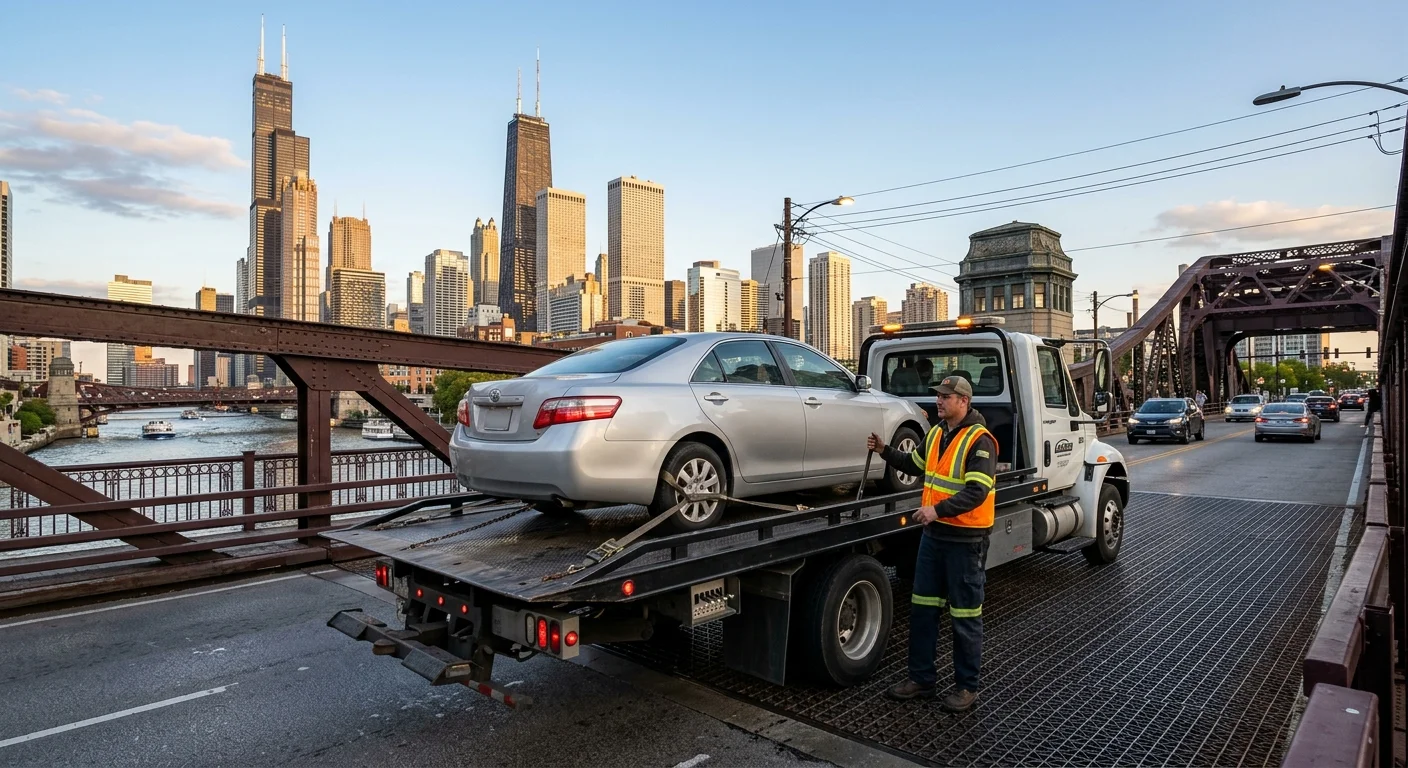
What a requested roadside tow costs
Quick Tow Chicago doesn’t set a flat towing rate. We match drivers with independent local operators, and the operator provides a price before anyone is dispatched. No verified operator rate card is available for us to publish, so quoting a typical Chicago price would mean guessing.
The quote can reflect the details of the job. Tell us where the vehicle sits, where it needs to go, and what happened. A disabled sedan beside the Kennedy isn’t the same job as a damaged SUV below street level near Lower Wacker. A vehicle blocked inside a garage may also need different equipment than one parked in an open lot.
Give the operator these details before accepting the quote:
- The exact pickup and destination locations
- The vehicle’s year, make, model, and approximate weight
- Whether the wheels roll and the steering works
- Whether the vehicle is damaged, stuck, or blocked
- Whether a flatbed, wheel lift, or winch may be needed
- Any garage height, loading-zone, or access restrictions
Ask what the quoted price includes before the truck rolls. If the condition changes after inspection, ask the operator to explain any revised charge before work continues.
Drivers stranded on the Kennedy, Dan Ryan, Eisenhower, or Stevenson can request 24/7 emergency towing. The line is available at any hour, but we don’t publish an arrival window. Traffic, location, equipment, and operator availability can all affect dispatch.
What a City of Chicago pound tow costs
The City of Chicago publishes its own pound fees. These aren’t Quick Tow Chicago prices, and they don’t apply automatically to suburban impounds or private-property relocations.
Under the schedule cited by the city’s Common Towing Questions page, towing costs $250 for a vehicle under 8,000 pounds. The fee is $350 for a vehicle weighing 8,000 pounds or more. Storage costs $50 per day under 8,000 pounds and $100 per day at or above that weight.
The city accepts cash, Visa, Mastercard, Discover, American Express, or Diners Club. It doesn’t accept checks or money orders. All charges and fines must be paid before release.
Every person claiming the vehicle needs valid photo identification. The claimant also needs proof of ownership. The city accepts a valid title, current registration card, or a bill of sale no more than 30 days old. Lessees need the lease agreement. A representative needs an original notarized letter from the owner. Anyone driving the vehicle out needs a current valid driver’s license.
Current state plates and a Chicago Vehicle Sticker are required where applicable. A police investigation hold can also prevent release. Certain offence-related holds must be handled through the Vehicle Impoundment Office rather than at the pound.
Chicago operates four auto pounds, all open around the clock. Use the city’s vehicle lookup before travelling to one. Our guide to Chicago impound fees explains the payment and redemption process in more detail.
Why winter parking-ban charges look different
Chicago publishes a separate fee set for winter parking-ban tows. The city’s Winter Snow Parking Restrictions page lists a minimum $150 towing fee, a $60 ticket, and storage at $25 per day.
Those figures shouldn’t be merged with the standard pound schedule. Both sets come from City of Chicago pages, but each page describes a different situation. Confirm why the vehicle was removed before deciding which published schedule appears relevant.
The Winter Overnight Parking Ban covers 107 miles of arterial streets. It runs from 3 a.m. to 7 a.m., December 1 through April 1, even when no snow is falling. Vehicles removed under that ban go to Pound 2 at 103rd and Doty or Pound 6 on Sacramento.
Chicago also has a separate Two-Inch Parking Ban. It covers another 500 miles of main streets and becomes active when at least two inches of snow are on the street. It can apply at any time of day and on any calendar date. A vehicle there may receive a ticket or be relocated.
Read the permanent signs carefully before leaving a car overnight. Our guide to the Chicago winter overnight parking ban explains how that restriction differs from the two-inch rule.
What private-property relocation may cost
A private-property relocation is neither a requested roadside tow nor a City of Chicago impound. In Cook, DuPage, Kane, and Will counties, this work is performed by commercial vehicle relocators licensed by the Illinois Commerce Commission.
The current maximum relocation rate couldn’t be confirmed from an official published source reviewed for this page. Don’t rely on an unsourced figure from a forum or an old receipt. The Illinois Commerce Commission relocation towing page is the authority to check for current rate information and complaints.
Where signs are required, Illinois law says they must display the relocator’s name, address, telephone number, and the towing charge a person may face. The sign must be conspicuous, measure at least 24 by 36 inches, sit between four and eight feet above the ground, and be illuminated or reflective. Residential property clearly reserved for residents or their vehicles has a notice exception.
The relocator must follow Commission-set rates. It must also provide a complete Relocation Towing Invoice with complaint instructions. Accepted payment methods include cash, money orders, cashier’s or certified checks, and major credit cards without added fees.
No storage fee may be charged if the vehicle is claimed within 24 hours with proper identification and payment. Storage also can’t be charged for days or hours when the relocator is closed to the public.
Review our explanation of Chicago private towing laws if a vehicle disappeared from an apartment, retail, or commercial lot.
How suburban impound costs differ
A Cicero, Berwyn, Naperville, Aurora, or Joliet municipal impound doesn’t use Chicago’s published pound schedule. Each municipality sets its own administrative fee. None of those local fee schedules was verified for this page, so the correct amount must be confirmed with the municipality and the storage facility holding the vehicle.
Illinois law requires a municipal administrative fee to be reasonable and related to administrative and processing costs. The state statute doesn’t establish one statewide dollar cap. That means a Chicago fee can’t be copied onto a suburban case, even when the tow happened only a few blocks beyond city limits.
The vehicle owner has a right to an administrative hearing. Notice must be sent within 10 days of impoundment. The initial hearing must be scheduled and held no later than 45 days after that notice is mailed.
If the hearing officer finds that the vehicle was stolen or hijacked when it was impounded, the municipality, county, or Illinois State Police must refund administrative fees already paid. This rule concerns municipal administrative fees. It doesn’t establish a no-fee rule for an ordinary City of Chicago pound tow.
Start by reading the impound notice and identifying the agency named on it. Contact that municipality for its current administrative charge, hearing instructions, and payment requirements. Then contact the listed yard to confirm its towing and storage charges before travelling.
Our guide to impound versus relocation in Chicago can help when it isn’t clear whether the government or a private property owner ordered the removal.
When to call us
Call when your vehicle is disabled and you need an independent local operator dispatched, rather than help locating or redeeming an impounded car. The line takes calls 24/7, and calls are recorded after a notice. Call us at (773) 830-6930.