A Chicago winter can pin a car in a drift, a plowed windrow, or a packed alley even when the engine still runs. The decision is not whether you own AWD. It is whether an operator can pull the vehicle back onto pavement, or whether it has to leave on a truck.
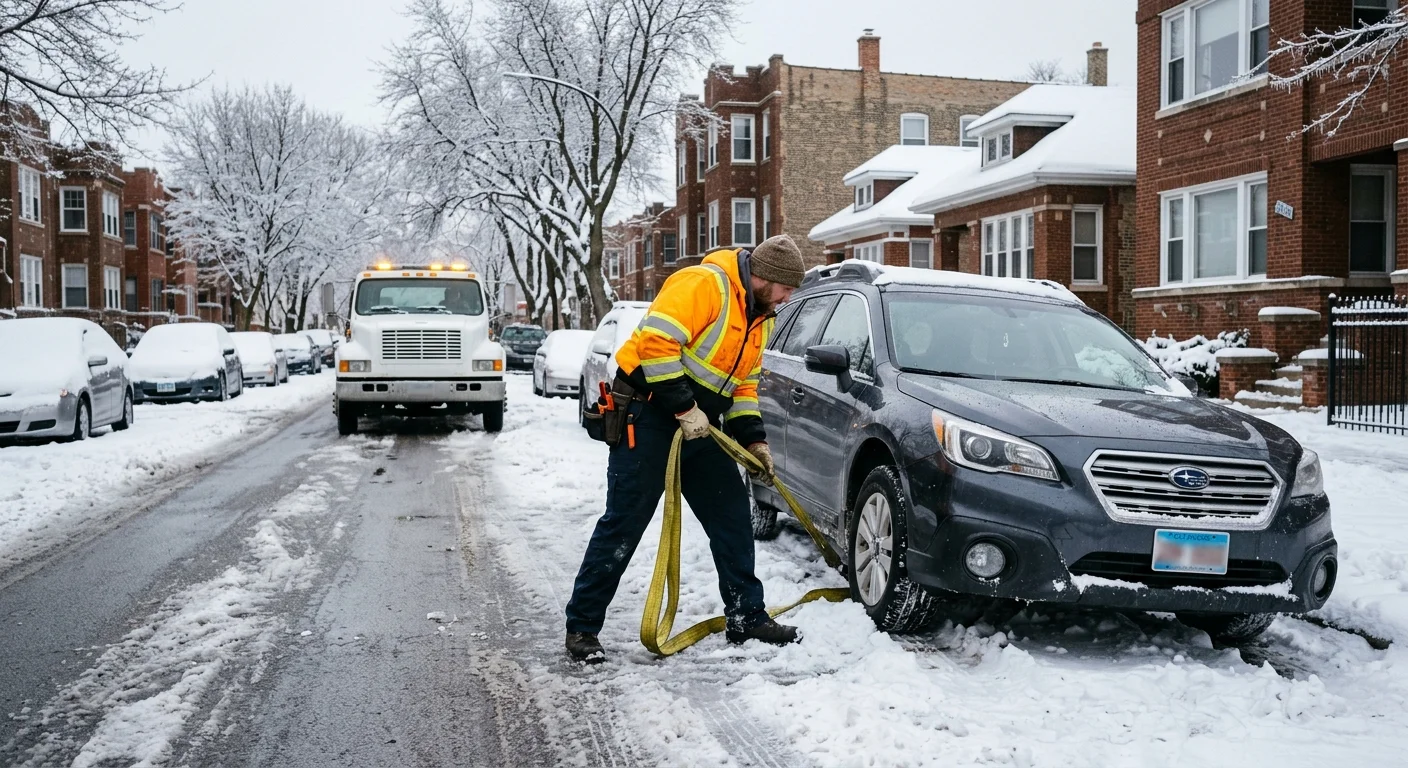
Put personal safety ahead of moving the car
If you are on the Kennedy, the Dan Ryan, the Eisenhower, the Stevenson, or Lake Shore Drive, the live lane is the danger, not the snow. Stay in the car with the seat belt on while traffic is moving around you. Put the hazards on. Call 911 if you are sitting in a travel lane or someone is hurt.
Do not step out to push. Do not shovel in a live lane. Do not wave a passerby into the roadway. Do not stand in front of the bumper or behind the trunk. A plow, a CTA bus, or a sliding sedan will not see you in time.
IDOT’s Chicago-area Emergency Traffic Patrol, the crews people call Minutemen, patrols expressway disruptions from disabled vehicles and debris. They set up emergency lane closures and protect responders. They do not repair cars. They do not tow them away. If they are already on scene, wait for their direction before you open a door.
A buried tailpipe is a reason not to sit with the engine running inside a closed drift. If you need heat, keep a window cracked and make sure exhaust can leave the car. If you feel dizzy or sleepy, shut the engine off and call 911.
This is not the moment to rock the car, dump sand, or hook a strap to a friend’s SUV. Those moves are what generic snow articles sell. On a Chicago arterial they put you in traffic, and they can tear a bumper or a subframe. You first. The car second.
On a residential block in Gage Park, Brighton Park, Little Village, or Cicero, still treat the street as live. Plow ridges steal the shoulder. Parked bumpers steal the pull path. Look from the sidewalk side, then get back in the car to make the call.
Cook County logged 164,559 crashes in 2024, about 54 percent of all crashes in Illinois. Snow nights add ice you cannot see. You do not need to become the next spinout while trying to self-recover.
Describe where and how the vehicle is stuck
The operator needs a picture, not a shrug. Name the street, the nearest cross street, and which way the car faces. “I’m on 26th near Kedzie, nose in a plow ridge” is usable. “I’m stuck in snow” is not.
Name the surface under the tires. Packed powder in an alley is one job. Glare ice on a Lake Shore Drive ramp is another. A high-center, where the belly of the car sits on a berm and the wheels spin free, is a third. Two tires in a drift and two still on pavement is a fourth.
Say whether any wheel is still on a cleared path. Say whether the car is against a parked bumper, a hydrant, a fence, or a CTA shelter. Say if the frame is sitting on ice. AWD and 4WD cars get stuck the same way when all four tires polish a hole, or when the chassis hangs on a ridge. All-wheel drive is not a winch.
If you are on an expressway, name the route and the nearest exit or mile marker. “Northbound Dan Ryan at 63rd” or “Eisenhower west of Austin” is enough. Do not walk the shoulder hunting a better landmark.
Take photos from a safe place: the whole vehicle, the snow height at the bumper, and the path in and out. Do not crawl under the car. Do not attach anything. A photo of the scene is how dispatch knows whether this is a snow winch-out or a full tow.
The same word, stuck, covers three different Chicago problems. One is a private recovery: the car is still yours, still on the street or a lot, and you want it moved. Two is a City of Chicago snow-ban tow, which is an impound, not a pull. Three is a suburban village impound, which uses that village’s own lot and fee, not the city’s. If the car is gone, that is not this page. Use the city’s vehicle lookup and Common Towing Questions before you assume theft.
Chicago enforces a Winter Overnight Parking Ban on 107 miles of arterial from 3am to 7am, December 1 through April 1, whether it snowed or not. A separate Two-Inch Parking Ban covers about 500 miles of main street once two inches of snow sit on the street, any date, any hour. Cars on those routes can be ticketed or relocated. Both bans exist, the city says, to avoid a repeat of the 1967 and 1979 standstills. Read the winter snow parking restrictions if the car vanished overnight. It may already be in a pound, not buried on the block.
When a winch-out may fit the situation
A winch-out is a pull back onto pavement, not a ride to a shop. It may fit when the car still runs, the steering still works, and the vehicle is close to a surface it can drive on once the wheels have traction again.
Typical cases: the rear end slid into a parkway snowbank on a side street in Berwyn. A front-wheel-drive car climbed a plow windrow on a residential block in Cicero and high-centered. A driver in Naperville eased into a cul-de-sac drift and cannot reverse without burying the tires deeper.
It may also fit in an open lot, if the operator can stage the truck on solid ground and there is a clear pull path. Tight garages and underground ramps are a different problem. Snow packed against a bumper in a wide lot is not.
Nothing here promises that a winch-out will work. Ice under all four tires, a broken axle, a locked parking pawl, or a car sitting over a deep culvert can turn a pull into a lift. The operator on scene decides the method after looking at the car, not after hearing the call.
Once an operator is on scene, a straightforward pull on soft ground often takes fifteen to thirty minutes of work. A deeper recovery can take one to two hours. Those are job times after arrival, not a clock for how soon a truck shows up. We do not quote arrival windows. We do not own the trucks.
Do not ask a neighbor to yank you with a recovery strap. Hooking a bumper, a control arm, or a hitch ball is how cars get written off. The operators we dispatch bring their own recovery gear and choose the attach points. Quick Tow Chicago is a referral service. We line up an independent local operator. We do not winch. We do not own wreckers.
If the stuck car is from a spinout that hit a barrier or another vehicle, treat it as accident recovery, not a snow pull. Airbags, a bent wheel, or leaking fluid change the plan.
Snow is also not mud. A car in a thawed parkway in April and a car in a January drift are not the same job. Ice, freeze-thaw crust, and overnight bans are why we wrote a separate mud versus winch-out guide. Use that page for spring muck. Use this one for snow.
When the vehicle may need a tow
A tow is the right call when the car cannot drive once it is free, or when it cannot be freed without lifting it.
You need a tow if a tire is off the rim, the car will not start, the transmission will not go into gear, or the undercarriage is sitting on a ridge the winch cannot slide it off. You need a tow if the car is in a live lane and the only safe move is to load it and leave. You need a tow if the destination is a shop, not the next block.
Expressway snow is often a tow. Windrows from plows on the Kennedy and at the Jane Byrne Interchange leave little room to stage a pull. IDOT patrol can shield the scene. They still will not haul the car. An independent operator has to load it.
AWD does not change this. Four driven wheels still spin on ice. They still high-center. They still snap a CV joint if someone floors it in a drift. If you already tried to drive out and heard a clunk, say that on the call. That is a tow conversation, not a winch conversation.
Owner’s-manual tricks such as switching traction control off belong in the book that came with the car, not in a live lane. Manuals differ by make. Spinning a tire to “dig down to pavement” is how you bury the rotor in ice and cook a clutch. If the car has not moved after a gentle attempt from inside the cabin, stop. Forcing it is how a stuck car becomes a broken car. We will not walk you through that.
If the car was parked on a posted arterial and is gone, you are not calling for a snow winch. You are looking up an impound or a relocation. City pound fees under Municipal Code 9-92-080 are $250 to tow a vehicle under 8,000 pounds and $350 at 8,000 pounds or more, plus $50 or $100 a day in storage. The city’s winter-ban page publishes a different set: a minimum $150 towing fee, a $60 ticket, and $25 a day in storage. Those are the city’s numbers, from two city pages. They are not our price. They are not a suburban village’s price. The operators we dispatch quote before anyone is sent.
Suburban lots are their own regime. A municipal administrative fee has to be reasonable under 625 ILCS 5/11-208.7. The statute sets no dollar cap, and we have not confirmed any village’s figure, so we will not invent one. Ask that village, not a Chicago pound.
Share access and destination details before dispatch
Before we send an operator, say where the truck can stand. A two-way street with a plow ridge down the middle is not the same as a one-way in Pilsen. An alley behind a two-flat in Hermosa may be too tight for a wrecker until the mouth is cleared. A cul-de-sac in Naperville may leave only one way in.
Tell us if a gate, a parking boot, a low garage beam, or a HOA arm is in the way. Tell us if the car is in a visitor stall that a relocator already posted. Private-property tows in Cook, DuPage, Kane, Will, and Winnebago counties are ICC-licensed relocator work. We are not that relocator. If a lot is removing a car against the owner’s wishes, that is a different service. This page is for the owner who wants the car out of the snow.
Say where you want the car to go. Around the corner onto a cleared street is a winch-out destination. A shop on Irving Park, a driveway in Elk Grove Village, or a lot by O’Hare is a tow destination. If you do not know yet, say so. The operator still needs a plan for the wheels once they leave the drift.
Mention the vehicle: make, drivetrain, and whether it is an EV. Some cars need a flatbed. Some need transport mode. Do not guess the method. Describe the car and let the operator pick.
You will get the price before anyone is dispatched. The number you hear is the number on the invoice. We do not publish a snow rate because we do not set operator rates.
Chicago O’Hare normals show 38.4 inches of snow a year, 121.3 nights at or below 32F, and 6.5 nights at or below 0F. January averages a 31.6F high and an 18.8F low. The snowiest winters on record hit 80.6 inches in 1978-79. That is why this decision comes back every year, and why winter breakdowns in Chicago sit next to this page. Dead batteries, no-starts, and stuck cars travel together after the first real freeze.
If you are still on an expressway, ask for emergency towing so the operator knows the scene is a live roadway, not a quiet block. We serve the 35 places across Cook, DuPage, Kane, and Will counties on this site. Northwest Indiana is not in that list.
When to call us
If the car has not moved after a careful try from inside, or if you are on a live street, this is no longer a shovel job. Call us at (773) 830-6930. The line takes calls 24 hours a day, a notice plays, the call is recorded, and we dispatch an independent local operator. Stay in a safe place until that operator is on scene.