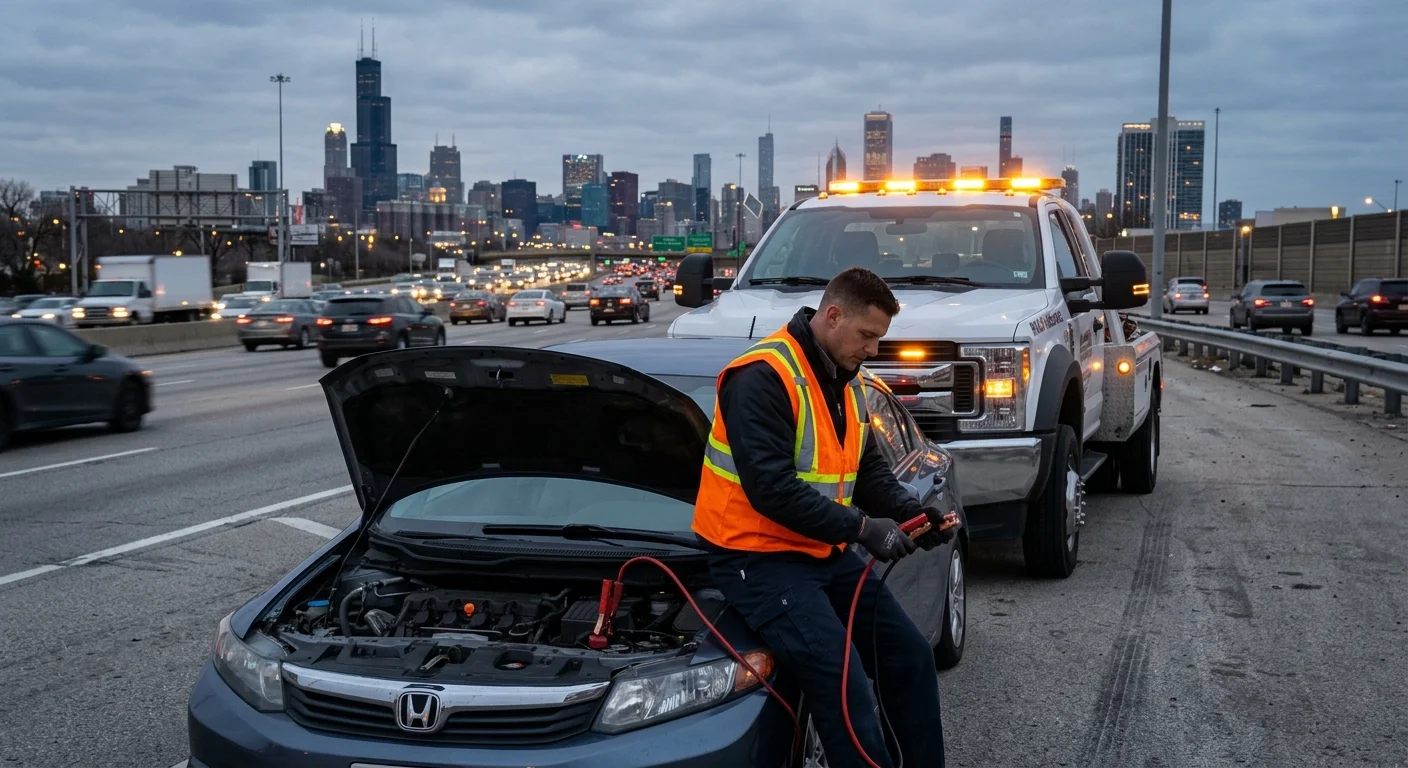
A January breakdown in Chicago needs two decisions fast. Get clear of moving traffic, then decide whether the car needs roadside help or a tow. If your car broke down in Chicago, turn on the hazard lights and identify your road, direction, nearest exit, or cross street.
Why January finds the weak point
Chicago cold doesn’t cause every breakdown. It often exposes a part that was already struggling.
The National Weather Service’s O’Hare climate normals put January’s average high at 31.6°F and average low at 18.8°F. The normals also include 121.3 nights each year at or below freezing. Another 6.5 nights reach zero or below. Annual snowfall averages 38.4 inches.
That combination is hard on a marginal battery. Cold slows the battery’s internal chemical process, leaving less power available for starting. Meanwhile, cold engine oil resists movement more than warm oil. The starter must work harder while the battery has less to give.
A weak battery may produce rapid clicking, dim lights, or no crank. Dirty or loose battery connections can create similar symptoms. A failing starter may sound like one heavy click. If the engine turns normally but doesn’t start, the problem may involve fuel, ignition, or another system.
Cold air also lowers tire pressure. A tire that looked acceptable in October may trigger a warning during a January cold snap. Potholes, packed snow, and stiff rubber can then expose damage that wasn’t obvious before.
Short drives can add to the problem. The heater, lights, defroster, and heated seats all draw power. A battery that never fully recovers between trips may eventually refuse the next cold start.
What to do on a Chicago road
Your location changes the next move. A breakdown on a quiet neighborhood block isn’t the same as one near the Jane Byrne Interchange.
Turn on the hazard lights first. If the car still steers, brakes, and rolls normally, move away from a live lane when possible. Don’t force it onward if you smell fuel, see smoke, notice steam, or lose steering or braking control.
On the Kennedy, Dan Ryan, Eisenhower, Stevenson, Edens, or Bishop Ford, give precise location details. “I’m on the expressway” isn’t enough. State whether you’re inbound or outbound. Name the last exit, upcoming exit, and any visible sign. On I-80, I-88, or the Tri-State, include the direction and nearest interchange.
If smoke, fire, a collision, or traffic creates immediate danger, contact 911. Don’t stand in a traffic lane or between stopped vehicles. Follow instructions from police, fire crews, or traffic patrol workers at the scene.
IDOT’s Chicago-area Emergency Traffic Patrol responds to crashes, disabled vehicles, and road debris. Its workers are also called Minutemen. They establish emergency lane closures and warn approaching drivers. They don’t repair disabled cars or tow them away.
On a city street, share the full block and nearest cross street. Mention whether you’re on an upper or lower roadway downtown. That detail matters around Lower Wacker Drive, where the same street name can describe very different access points.
Read the symptoms before acting
A breakdown symptom is a clue, not a complete diagnosis. Notice what happened before you try a jump or request a tow.
-
Rapid clicking or dim lights: The battery may be weak, or a connection may be poor. Check whether the terminals look loose or heavily corroded. Don’t touch leaking or damaged battery components.
-
One solid click: The starter or its electrical circuit may be involved. Repeatedly turning the key usually won’t reveal which part failed.
-
Normal cranking without a start: The battery is turning the engine. A jump may not solve the actual problem. Tell the operator that the engine cranks normally but won’t fire.
-
The engine starts after a jump, then dies: The charging system may not be supporting the car. Don’t assume one successful start makes the car ready for expressway traffic.
-
A temperature warning, steam, or coolant smell: Shut the engine off once you’re safely stopped. Don’t remove a hot cooling-system cap. A roadside jump won’t correct an overheating problem.
-
A tire warning, visible flat, or strong shaking: Stop before the wheel or surrounding parts suffer more damage. Our guide to flat tire help in Chicago explains what information to gather.
Before connecting jumper cables, read the vehicle owner’s manual. Some vehicles use designated jump points rather than direct battery access. If the battery case is swollen, cracked, or leaking, don’t connect cables. If you can’t identify the correct terminals, request help.
Electric vehicles and hybrids require model-specific handling. Don’t touch orange high-voltage cables or assume a familiar underhood component is a jump point. Follow the manual and tell the operator the exact year, make, model, and drivetrain. For battery-start problems, see our Chicago jump-start guide.
Roadside help or a tow
Roadside assistance fits a limited problem that can be addressed where the car sits. That may include a conventional jump-start, help with an accessible spare tire, or a vehicle lockout. The operator still needs to assess the car and location.
A tow is the better request when the vehicle can’t roll safely. That includes severe overheating, visible fluid loss, collision damage, steering trouble, brake trouble, or a wheel that won’t turn. A car stuck in snow, mud, or beside the pavement may need recovery equipment rather than ordinary roadside service.
Tell us what the car did before it stopped. Mention warning lights, sounds, smells, leaks, and any impact. Also share the vehicle’s drivetrain if you know it. An all-wheel-drive car, electric vehicle, lowered car, or vehicle with damaged wheels may change the equipment an operator selects.
The operators we dispatch may use a wheel-lift or flatbed based on the vehicle and its condition. Our flatbed towing page explains the service without assuming every disabled car needs the same truck.
Have a destination ready when possible. That could be your home, a repair shop, or another legal drop-off point. Confirm that the destination can accept the car. If you’re unsure whether the problem can be handled at the scene, start with roadside assistance.
Quick Tow Chicago is a referral service. We match drivers with independent local operators. We don’t own trucks, employ drivers, or set towing prices. The operator quotes the price before dispatch.
If you have to leave the car
Leaving a disabled car on a Chicago street creates another problem. January includes parking rules that don’t apply during most of the year.
Chicago’s Winter Overnight Parking Ban covers 107 miles of arterial streets. It runs from 3 a.m. to 7 a.m., December 1 through April 1, regardless of snowfall. A separate Two-Inch Parking Ban covers another 500 miles of main streets. That restriction activates when at least two inches of snow are on the street, regardless of the date or time.
Check the signs and the city’s Winter Snow Parking Restrictions before leaving the vehicle. The city page doesn’t publish a general exception for a disabled car. Confirm current instructions with the city if the car can’t be moved.
If the car later disappears, don’t immediately assume it was stolen. Chicago says vehicles may be relocated for street work, sometimes during emergencies when signs couldn’t be posted. Check the city’s Find Your Towed Vehicle tool and contact the city before making a theft report.
The towing regime also depends on where the car was left:
- A City of Chicago tow follows the city’s pound system.
- A suburban municipal impound follows that village’s rules and fees.
- A private-property relocation in Cook, DuPage, Kane, or Will County must involve an Illinois Commerce Commission-licensed commercial vehicle relocator.
Those aren’t interchangeable. Chicago’s pound rules don’t set a suburb’s administrative fee. A private-property relocation isn’t the same as a voluntary tow requested for a breakdown. Our guide to impound versus relocation in Chicago explains the distinctions.
Before walking away, photograph the vehicle, its location, nearby signs, and visible damage. Remove valuables only when doing so is safe. Record the cross street or highway marker so you can give an operator an exact location.
When to call us
Call when a jump isn’t safe, the car won’t roll, or warning signs point beyond a simple roadside fix. The line takes calls 24 hours a day and connects callers with independent local operators. The operator’s price is quoted before dispatch. Call us at (773) 830-6930.