A spinning tire on wet grass can turn a parking shortcut into a recovery call. If the car only needs help reaching firm ground, ask about a winch-out. If it can’t be driven afterward, tell dispatch you may need recovery and towing.
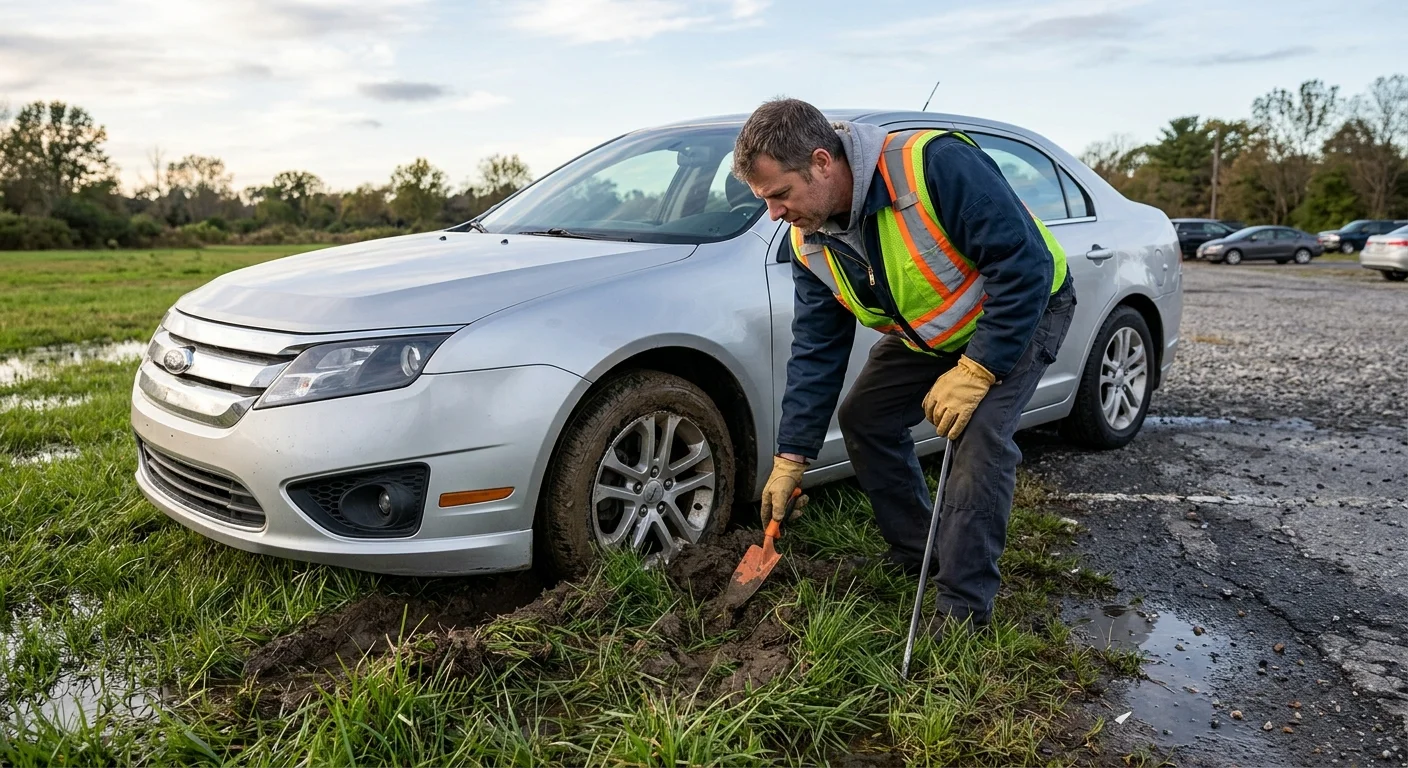
Describe where the vehicle is stuck
Start with the location, then describe the surface around the car. A street address alone may lead to a large property with several entrances. Give the nearest road, driveway, lot entrance, building, or marked section. A map pin can add useful detail when the address covers an industrial yard or open parking area.
Chicago-area mud calls don’t all look alike. The car might be on wet grass beside a paved lot in Tinley Park. It could sit on a softened gravel margin in Elk Grove Village’s industrial area. Near Joliet, the vehicle may be along an unpaved edge by the intermodal complex. In Cicero or Pilsen, the same problem might happen behind a narrow gate or inside a tight yard.
Tell dispatch how the car reached that spot. It may have rolled straight from pavement onto grass. It may be angled across a gravel edge. Perhaps one side is on pavement while the other has settled into soft ground. Those descriptions give an operator more useful information than simply saying the car is stuck.
Include the car’s position relative to firm pavement. Say whether pavement is directly behind it, across the lot, or beyond another soft patch. Mention nearby walls, fences, parked cars, posts, landscaping, loading docks, and drainage areas. If the vehicle is beside the Kennedy, Dan Ryan, Stevenson, I-57, or I-80, include the direction of travel and nearest exit.
Weather context also helps. Say whether the ground softened after late-summer rain, melting snow, or standing water. Don’t guess how deep the mud is. Describe what you can see, including the visible tire track and whether water has collected around it.
Explain what the wheels and ground are doing
Dispatch doesn’t need a mechanical diagnosis. Clear observations are more useful. Explain what happened when the driver tried to move and what the vehicle looks like now.
Useful details include:
- Which wheels are on grass, mud, gravel, or pavement
- Whether one wheel or several wheels have sunk
- Whether the tires turned while the car stayed in place
- Whether mud built up behind or in front of a tire
- Whether the underside appears to touch the ground
- Whether the car starts, shifts, and responds normally
- Whether any warning lights appeared after it became stuck
A vehicle stuck on wet grass may leave only shallow tracks. Another vehicle may settle until the lower body sits close to the surface. Loose gravel can also shift beneath a tire without creating an obvious mud hole. Tell dispatch exactly what you’re seeing instead of choosing a recovery method yourself.
If someone already tried moving the car, include that information. Say whether the car moved several inches, changed angle, or settled farther. Report any object already placed near a wheel, but don’t assume it solved the underlying problem. The operator needs the vehicle’s current position, not only its starting point.
Mention anything else that changed during the attempt. That includes a newly locked wheel, an unusual sound, visible body contact, or fluid on the ground. These details may affect whether the request remains a simple car winch-out service or also involves transportation afterward.
Photos can support the description when available. One wider view can show the approach and nearby pavement. A closer view can show the tires and ground. Dispatch can pass those details to an independent operator, who decides how to assess the vehicle at the scene.
When recovery differs from a routine tow
A winch-out and a tow solve different parts of the problem. A winch-out request focuses on moving the vehicle from soft ground to an accessible surface. A tow request includes transporting it to another destination. Some calls involve only the first step, while others may require both.
If the car was running normally before entering the mud, tell dispatch that. Also explain what you plan to do after it reaches pavement. You may only want the vehicle placed on firm ground. If it won’t run, has visible damage, or shouldn’t continue to its next stop, provide a towing destination too.
Mud adds a recovery decision before transportation can begin. That’s why a tow truck for a car stuck in mud isn’t the same request as a disabled car already sitting in an open paved lot. Our accident recovery and winch-out service covers the information needed to match these situations with an independent local operator.
A collision changes the description again. If the car left the road after an impact, tell dispatch about the crash instead of describing it as an ordinary parking-area problem. Our guide to what happens after a Chicago crash explains that separate recovery situation.
Expressway incidents also involve a public traffic response. On Chicago-area highways, the IDOT Emergency Traffic Patrol responds to disruptions involving crashes, disabled vehicles, and hazardous debris. Its workers, also called Minutemen, establish emergency lane closures, warn approaching traffic, and protect responders. They don’t repair vehicles or tow them away.
The operator makes the final recovery decision after reviewing the scene. Quick Tow Chicago doesn’t own trucks or promise that one truck type fits every muddy location. We take the request and match it with an independent local operator.
Share access and clearance details with dispatch
A clear description of the car isn’t enough. Dispatch also needs to know how an operator can reach it. An open paved lot presents a different approach from a fenced yard, narrow alley, parking structure, or soft field.
Before requesting dispatch, share these details:
- The exact entrance an operator should use
- Whether the approach is paved, gravel, grass, or mud
- Any gate, overhead bar, low branch, or covered area
- Parked vehicles or fixed objects near the entrance
- The space between the stuck car and firm pavement
- Whether the vehicle faces toward or away from the exit
- Any property contact controlling access to the area
Give measured clearance when you already know it. Otherwise, describe the obstruction and say the measurement hasn’t been confirmed. A photo showing both sides of a narrow entrance can be more useful than an uncertain estimate.
For underground garages or covered lots, include the posted clearance exactly as shown. For gated properties, confirm how the operator will enter. If the car is behind a business, identify the correct service drive. In Chicago alleys, mention dumpsters, loading areas, parked vehicles, and the direction with the clearer approach.
Vehicle details matter too. State whether it’s a passenger car, SUV, pickup, motorcycle, or vehicle with a trailer. Mention visible modifications or anything being carried outside the normal body. Don’t assume the operator already knows these details from the make and model.
When you’re searching for a tow truck near you in Chicago, the useful match is based on the actual scene. Quick Tow passes your description to an independent operator. The operator sets the price, and you receive that quote before anyone is dispatched. No arrival time or equipment capability should be assumed from a short location description.
Confirm the destination before an operator arrives
Decide where the vehicle should end up before dispatch whenever possible. If the request is only a winch-out, identify the firm area where the car should be placed. That might be a paved section of the same lot, an approved driveway, or another accessible spot on the property.
Confirm that the property contact agrees with the placement. Moving the vehicle onto pavement doesn’t settle a dispute about where it may remain. If a manager, security employee, police officer, or property owner is directing the move, tell dispatch who gave that direction.
When the car also needs towing, provide the full destination. It may be a repair shop, dealership, home, or another address chosen by the vehicle owner. Confirm the entrance and any access instructions. Don’t assume a repair facility can receive the vehicle simply because its name appears in a map result.
If you haven’t selected a destination, say so before dispatch. Our emergency towing service guide explains the information used to match a roadside request. The operator needs the planned transport details when preparing the quote.
The destination may also depend on what happened before the car became stuck. A running vehicle that slid into a soft parking edge creates one decision. A nonrunning vehicle that left I-55 or the Tri-State creates another. A collision, locked wheel, visible damage, or property-directed move should be disclosed from the start.
Don’t treat reaching pavement as proof that the vehicle can continue. Tell dispatch what you observed and what destination you want. The independent operator can then evaluate the vehicle and scene without relying on assumptions made during the call.
When to call us
Once the wheels are buried, the underside is touching the ground, or the car can’t reach pavement without recovery help, the situation has moved beyond a simple do-it-yourself attempt. Quick Tow Chicago takes calls 24/7, records them after a notice, and matches the request with an independent local operator. Call us at (773) 830-6930.