A dead battery near Northwestern usually begins as a jump-start request. Different symptoms or difficult garage access may make a tow the better choice. For roadside assistance in Evanston, IL, share your location, symptoms, access details, vehicle information, and preferred repair destination.
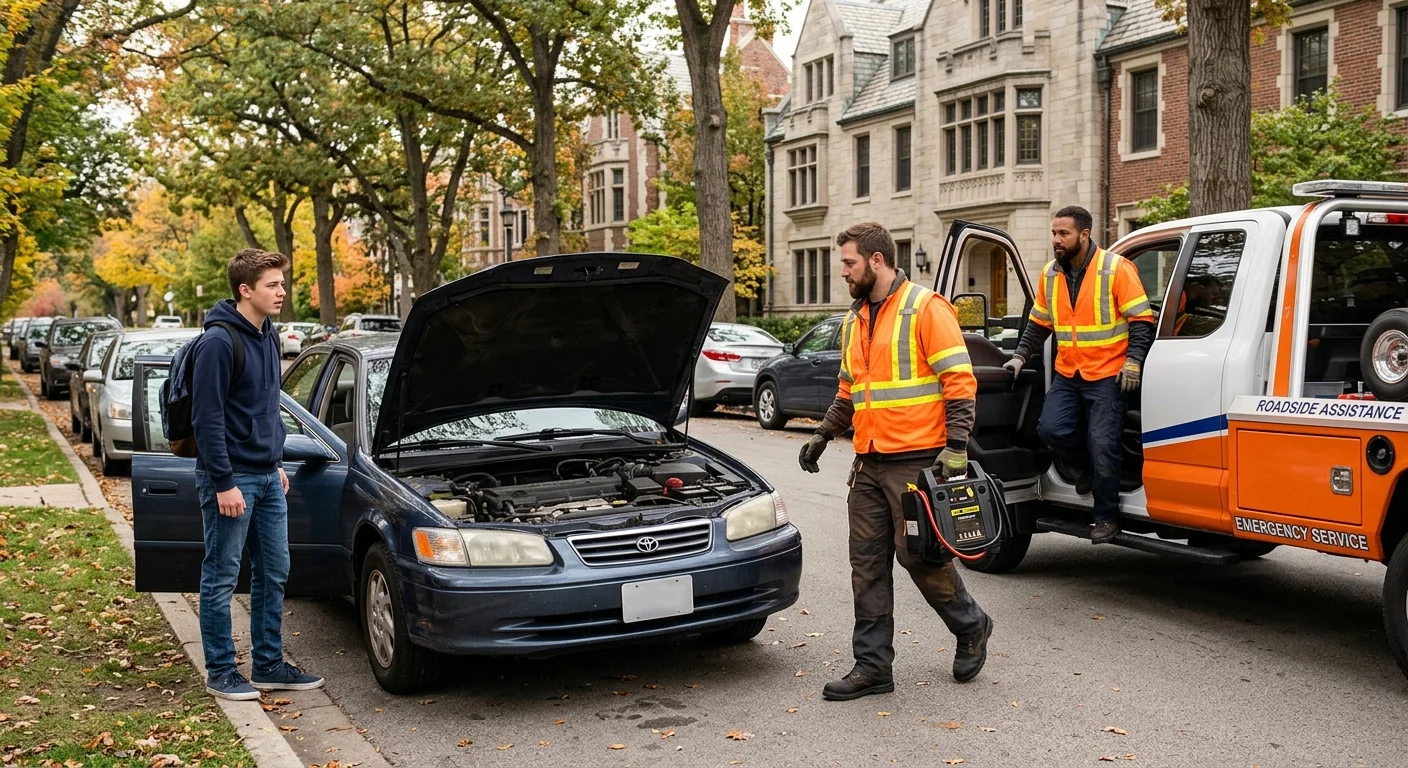
Share your exact Evanston location
“Near Northwestern” covers several very different pickup settings. You might be along Sheridan Road, west of campus, near downtown Evanston, or inside a garage. An operator needs more than a campus building name.
Start with the full street address or a map pin. Add the nearest cross street and describe where the car sits. A pin can land on the wrong side of a large building. Written details help confirm the correct entrance.
Useful location notes include:
- The street name and nearest intersection
- The garage, lot, or building entrance
- The floor, row, or marked parking area
- Whether the car is at a curb or inside a gated space
- Whether traffic, another vehicle, or a wall blocks access
- Your car’s color and visible position
Around downtown Evanston, distinguish Davis Street from Church Street or Clark Street. Along Sheridan Road, say whether you’re north or south of the main campus area. If you’re west near Ridge Avenue or Green Bay Road, include that detail.
Never assume an operator can enter a Northwestern or private garage. We haven’t confirmed a universal campus access policy or garage rule. Ask the property, parking, or campus office that controls the space. Tell the operator about any gate, permit check, ticket, attendant, or locked entrance.
If you’re stopped on the Edens rather than near campus streets, report the direction and nearest exit. IDOT’s Emergency Traffic Patrol responds to Chicago-area traffic disruptions. Its workers protect scenes and clear hazards, but they don’t repair or tow vehicles. You’ll still need separate roadside or towing help.
Describe what happens when you try to start
“Dead battery” is a useful starting point, not a diagnosis. Tell the operator what happened during the first attempt. Then explain what the car does now.
The most helpful descriptions are plain and specific:
- Nothing happens when you turn the key or press start
- You hear one click
- You hear repeated clicking
- The engine turns over but doesn’t start
- Dashboard lights appear dim, bright, or absent
- Interior lights or accessories still work
- A battery, charging, or key warning appears
- The engine started earlier, then stopped again
An engine that turns over normally but won’t start may have another problem. A jump supplies electrical power, but it doesn’t correct every no-start condition. Sharing the exact symptom helps avoid sending an operator prepared only for the wrong task.
Mention anything that happened shortly before the failure. Useful context includes a recent jump, a long period parked, a warning light, or another roadside visit. Tell the operator if the car was running and then stalled. Don’t hide a burning smell, smoke, leaking fluid, collision damage, or water exposure. Those details can change the appropriate response.
You don’t need to identify the failed part. Avoid guessing that the battery, alternator, starter, or key system is definitely responsible. Describe what you see and hear instead.
Our Chicago jump-start guide explains what information helps with a battery call. Drivers without a membership plan can also review roadside assistance without AAA before requesting service.
When a jump start may not solve the problem
A jump-start request makes sense when the car appears to have lost battery power. Still, the symptoms may point toward a tow. The operator can make a better decision when the full situation is known before dispatch.
A tow may need consideration when:
- The car still won’t start after a prior jump
- It starts and then stops again
- The engine turns normally but never starts
- There’s visible battery or cable damage
- Smoke or a burning smell comes from the vehicle
- The car has collision, flood, or underbody damage
- A wheel, tire, steering, or transmission problem prevents movement
- The keys are missing or the vehicle can’t be shifted
If there’s smoke, fire, or an immediate traffic danger, move away from the vehicle when you can do so safely. Contact emergency services before arranging ordinary roadside help. Don’t open, touch, or experiment with a damaged battery.
When the cause remains unclear, say that directly. Ask for an operator prepared to assess a possible jump-start request and discuss towing if the vehicle won’t run. That gives the referral service a clearer picture without promising an onsite diagnosis.
It also helps to explain what “success” means for your situation. A car starting once may not settle the underlying problem. If it can’t remain running or move normally, continuing the trip may not be practical.
Our roadside assistance service covers the request and referral process. If the car clearly can’t move, review the emergency towing service instead. In both cases, Quick Tow Chicago matches callers with independent local operators. The operator decides what work and equipment fit the actual vehicle.
Report garage access and vehicle details
A tow truck near Northwestern needs enough room to reach the vehicle. A street pickup and a covered-garage pickup aren’t the same job. Low ceilings, tight turns, gates, ramps, and blocked parking spaces can affect equipment access.
Read the posted clearance marker exactly. Don’t estimate it. A photo of the entrance sign can help the operator compare the available space with the proposed equipment. We haven’t confirmed the clearance of any Northwestern or Evanston garage, so the property operator remains the authority.
For a garage pickup, share:
- The garage name and exact entrance
- The posted clearance
- The parking level and stall location
- Whether a gate, ticket, code, or attendant controls entry
- Whether the car points into or away from the aisle
- How much room exists in front, behind, and beside it
- Whether another vehicle blocks the path
- Whether the keys are available
Vehicle details matter too. Provide the year, make, model, and body style. Say whether it’s gasoline, diesel, hybrid, or fully electric. If you know the drivetrain, include that. Mention low ground clearance, modified suspension, locked wheels, steering trouble, or visible damage.
Don’t guess about neutral, tow mode, or manufacturer procedures. Check the owner’s manual and describe what the car currently allows. An operator may request more information before choosing equipment.
September move-ins can add another complication. Boxes or luggage may limit access inside the vehicle. Tell the operator if the trunk, cabin, or surrounding parking space is packed. If a trailer, bike rack, or other attachment is present, report it before dispatch.
Choose a repair destination before dispatch
Pick a destination before the operator starts toward Evanston. It can be a dealership, independent repair shop, or another place willing to receive the vehicle. The important part is confirming that the destination can accept it.
Contact the repair facility first. Confirm its exact address, correct vehicle entrance, and current receiving instructions. If the business will be closed, ask whether it accepts unattended drop-offs. Get its key procedure directly from the business. Don’t assume a storefront entrance is also the tow entrance.
Share the destination address during the initial request. Distance and access affect the work being requested. The operator sets the price, and you get that price before anyone is dispatched. If the destination or vehicle condition changes, ask the operator to restate the updated price before the vehicle moves.
Also decide whether you want a jump attempt, a tow, or a jump assessment with towing discussed as a possible next step. Clear wording helps the operator prepare. It doesn’t lock the operator into work that turns out to be unsuitable onsite.
A voluntary roadside tow in Evanston isn’t a City of Chicago pound tow. Chicago’s published pound fees don’t set the price for an Evanston roadside call. Quick Tow Chicago doesn’t set operator prices either.
Keep your destination contact available during pickup. A wrong entrance or closed gate can interrupt delivery. If a parent is arranging help for a student, make clear who has the keys, who is with the car, and who can approve the destination.
When to call us
Call when the car won’t start, a jump has already failed, or access makes the next step unclear. The line takes calls 24/7, and calls are recorded after a notice so we can match you with an independent local operator. Call us at (773) 830-6930.