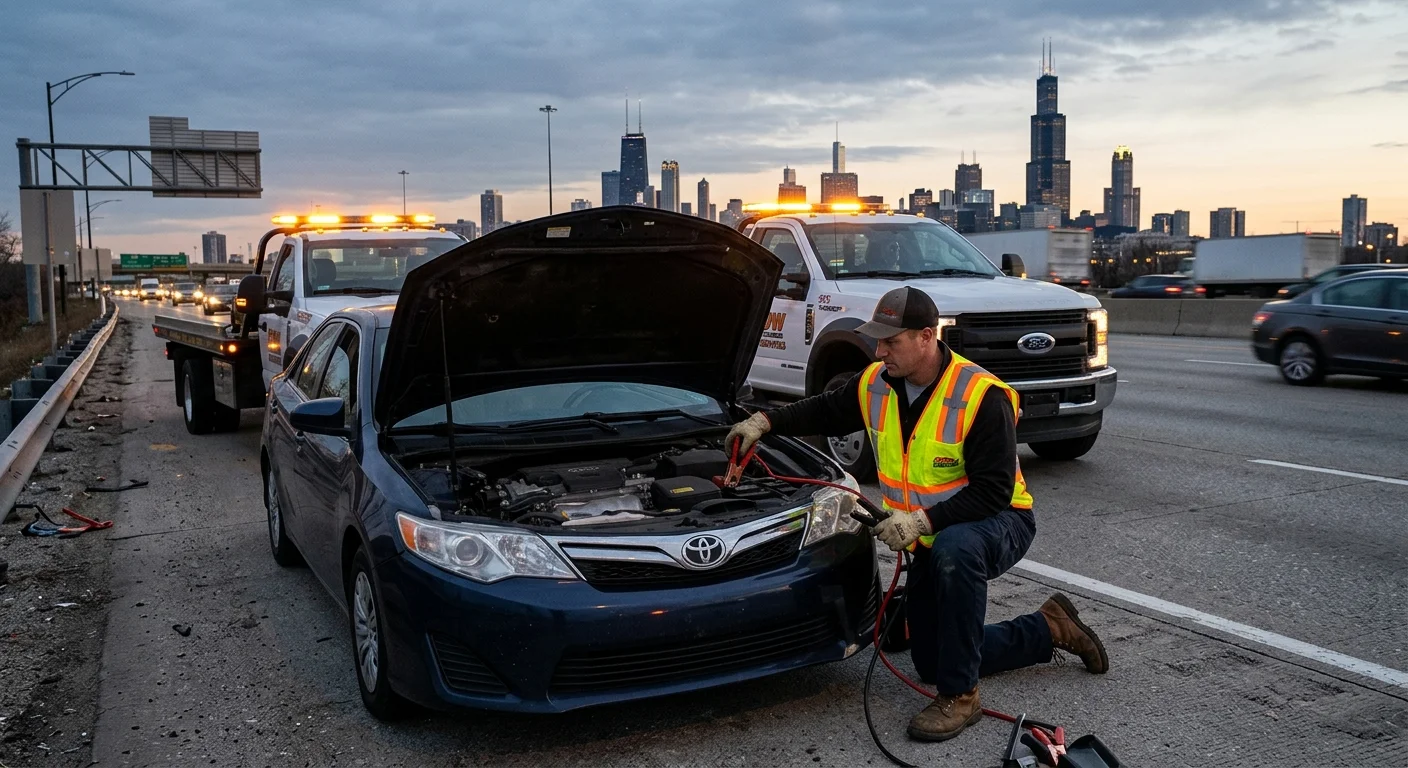
A Chicago jump start can help when a weak battery can’t crank the engine. It won’t repair a failed starter, alternator, damaged battery, or another mechanical problem. If the car remains dead or stalls again, you may need a tow instead.
First, check what the car is doing
Start with the sound and behavior when you turn the key. On a push-button car, watch what happens after pressing Start. Those clues help an operator bring the right equipment.
Rapid clicking can point toward a weak battery. A slow, labored crank can do the same. Dim interior lights or a weak dashboard may also support that diagnosis. None of these signs proves the battery is the only problem.
A completely quiet car is less clear. The issue could involve the battery connection, ignition system, starter, or another electrical component. If the engine cranks at its normal speed but won’t fire, adding battery power may not change anything.
Check whether anything obvious drained the battery. Headlights, cabin lights, or accessories left running can explain a one-time failure. Cold weather can also expose a battery that was already struggling.
Chicago gives batteries plenty of cold-weather stress. National Weather Service climate normals for O’Hare show 121.3 freezing nights each year. The area also averages 6.5 nights at or below zero. That doesn’t identify the fault, but it makes winter battery trouble unsurprising.
Tell the operator exactly what you see and hear. Mention whether the lights work, whether the engine clicks, and whether it cranks. That description is more useful than saying only that the car won’t start.
When a jump usually helps
A jump supplies temporary power to the vehicle’s starting system. It can work when the battery lacks enough charge to crank the engine, but the rest of the starting system still functions.
This commonly follows a simple drain. The car may have sat with a light or accessory running. It may also have been parked for an extended period. A battery can lose enough charge that the dashboard lights work while the starter still can’t turn the engine.
Once an operator is on scene, a routine jump takes about five to ten minutes. That figure describes the work itself, not travel or arrival time. The operator still needs to inspect the situation and connect equipment suited to the vehicle.
A successful start doesn’t prove the battery is healthy. It only shows that added power allowed the car to start at that moment. If the battery can’t hold a charge, the same problem may return after the engine stops.
Keep the car’s history in mind. A single drained battery after leaving the lights on differs from repeated no-starts. Trouble returning after several boosts points toward a fault that needs testing.
Connection points also vary by vehicle. Some batteries sit beneath covers or in less obvious locations. Hybrids and electric vehicles have model-specific procedures. Follow the owner’s manual instead of guessing where equipment should connect.
If you want an operator to handle the boost, our roadside assistance service covers battery-related calls across Cook, DuPage, Kane, and Will counties. We line up an independent local operator based on your location and vehicle.
When a boost isn’t the answer
A jump won’t solve every no-start condition. The strongest clue is often an engine that already cranks normally. If it turns over at its usual speed but doesn’t start, the battery may not be the main issue.
A failed starter can also resemble a dead battery. So can a connection problem or another electrical fault. A boost may produce no change because the missing piece isn’t battery power.
Pay attention after a successful start. A car that stalls again may have a charging-system problem. Warning lights or repeated electrical trouble also deserve diagnosis. Continuing to request boosts doesn’t repair the cause.
Visible battery damage changes the decision too. Don’t improvise around a battery that appears damaged or has an unusual odor. Check the vehicle manufacturer’s instructions and let an operator assess it. The goal isn’t merely to make the starter turn once.
Sometimes towing is the practical next step. That includes a vehicle that won’t respond to a proper boost, can’t stay running, or shows a separate mechanical problem. An operator may recommend transport after checking the car on scene.
The destination depends on what you need next. It could be your regular repair shop, a dealership, or another location you choose. If the vehicle needs special handling, the operators we dispatch can determine whether flatbed towing fits the vehicle.
Don’t keep guessing if several systems seem affected. Our guide to roadside assistance in Chicago without AAA explains how to request help without a membership plan.
Chicago changes the roadside decision
Location matters as much as the battery. A dead car in a Pilsen parking lot creates a different problem from one sitting beside the Kennedy.
Traffic exposure comes first on the Dan Ryan, Eisenhower, Stevenson, Edens, Bishop Ford, Tri-State, I-57, I-80, or I-88. If the vehicle stops in a live lane or another unsafe position, call 911. A jump attempt can wait until the immediate traffic risk is handled.
IDOT’s Chicago-area Emergency Traffic Patrol responds to disruptions involving crashes, disabled vehicles, and hazardous debris. Its crews are often called Minutemen. They establish emergency lane closures and protect responders, but IDOT says they don’t repair vehicles or tow them away.
A shoulder breakdown may therefore require both scene protection and separate roadside service. Share the expressway name, direction of travel, nearest exit, and any visible marker. “Kennedy outbound near Irving Park” is far more useful than “somewhere northwest of downtown.” Our Chicago expressway breakdown guide covers the first decisions.
A dead battery at the curb has another Chicago wrinkle. The winter overnight parking ban covers 107 miles of arterial streets from 3 a.m. to 7 a.m., December 1 through April 1, regardless of snow. A separate two-inch ban covers another 500 miles when at least two inches are on the street. The city explains both on its winter parking restrictions page.
If your car won’t start on a restricted street, don’t assume the battery problem pauses enforcement. Check the posted signs and the city’s current restriction information.
What a service call looks like
Quick Tow Chicago is a referral service. We answer the line and match drivers with independent local operators. We don’t own trucks, employ drivers, run a repair shop, or operate a storage yard.
Have a few details ready. Give the vehicle’s year, make, model, and location. Describe the sound it makes when you try starting it. Mention whether the dashboard lights appear and whether the engine cranks.
Also explain the setting. An operator needs to know whether the car is in a garage, parking structure, alley, driveway, surface lot, or expressway shoulder. Clearance and access can affect which service vehicle fits the call.
The operator sets the price. It is quoted before anyone is dispatched. Quick Tow Chicago doesn’t publish a jump-start price because no operator rate card has been confirmed for this metro.
A requested jump start is roadside assistance. It isn’t a City of Chicago impound, a suburban municipal impound, or a private-property relocation. Those are three different towing regimes.
If your parked car is missing, don’t request a jump until you locate it. The city may have impounded or relocated it. A suburban village may use its own impound process. A private-property removal in Cook, DuPage, Kane, or Will County falls under Illinois relocation rules. Our guide to impound versus relocation in Chicago explains the distinction.
We serve listed communities across Cook, DuPage, Kane, and Will counties. Northwest Indiana isn’t included, so confirm which side of the state line you’re on near Calumet City.
When to call us
Call when the engine won’t crank, a proper boost hasn’t worked, or the car can’t stay running. The line takes calls 24/7, and calls are recorded and transcribed after a notice so we can line up an independent local operator.
Call us at (773) 830-6930.