You can get roadside assistance in Chicago without an AAA membership. A local operator may handle the problem at your car, or tow it when a roadside fix won’t work.
Get clear on what happened
Start with the immediate problem. A dead battery, flat tire, empty fuel tank, lockout, collision, and mechanical failure need different equipment. The operator needs that information before anyone is dispatched.
Share your exact location first. Chicago has repeated street names, upper and lower roadways, and closely spaced expressway exits. “Downtown” isn’t enough. Name the street, direction of travel, nearest cross street, ramp, exit, or visible business.
On an expressway, say whether you’re on the Kennedy, Dan Ryan, Eisenhower, Stevenson, Edens, Bishop Ford, or Tri-State. Include your direction and nearest exit. If you’re near the Jane Byrne Interchange, identify the ramp when possible.
Next, describe the vehicle. Give its make, model, approximate size, and drivetrain if known. Mention whether it’s an EV, motorcycle, pickup, work van, or vehicle pulling a trailer. Tell the operator if a wheel is damaged, the steering is locked, or the car can’t shift into neutral.
Don’t diagnose what you can’t confirm. “The engine stopped and won’t restart” is more useful than guessing that the alternator failed. Describe the warning lights, sounds, smells, or visible damage instead.
Our roadside assistance service connects drivers with independent local operators. The price comes from the operator and is quoted before dispatch. Quick Tow Chicago doesn’t own trucks, employ drivers, or set roadside service rates.
What roadside assistance may cover
Roadside assistance focuses on problems that might be handled where the vehicle stopped. The available service depends on the car, its condition, the location, and the operator sent.
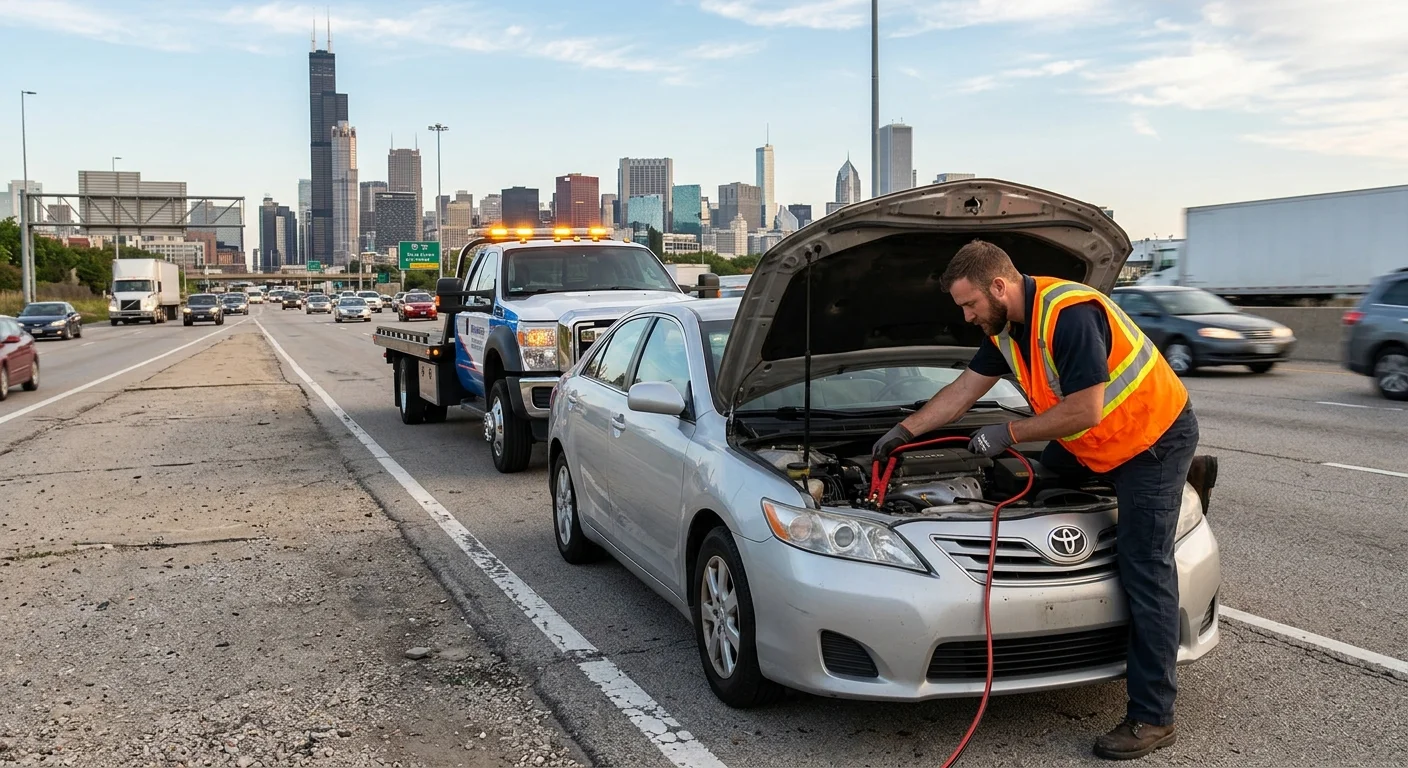
A jump-start may help when the battery lacks enough power to start the engine. Tell the operator if the dashboard lights still work or if the vehicle is completely unresponsive. EVs and hybrids can have separate low-voltage battery procedures, so identify the vehicle before attempting anything.
A tire change may be possible when the vehicle has a usable spare and the wheel area isn’t damaged. Tell the operator if the spare is under the cargo floor, mounted beneath the vehicle, or missing. Some cars carry sealant or an inflator instead of a spare.
Fuel delivery may get a conventional vehicle moving after it runs out. The operator still needs the correct fuel type. If the car stopped for another reason, adding fuel won’t solve the underlying problem.
Lockout help depends on the vehicle and key system. Share whether the key is inside the car, lost, broken, or trapped in the trunk. Newer electronic keys can change what the operator can do on scene.
These services aren’t substitutes for mechanical repair. An operator may get the car moving or determine that it needs towing. Avoid repeated restart attempts or improvised repairs when you can’t identify the problem.
Roadside assistance also isn’t accident recovery. A car that left the pavement, entered a ditch, or became pinned against a barrier may need accident recovery and a winch-out. Give a plain description so the correct operator and equipment can be considered.
Chicago expressways change the plan
A breakdown on a Chicago expressway isn’t the same as a dead battery in a grocery store lot. Lane position, traffic, ramps, barriers, and access points all affect the response.
State your direction before the nearest exit. “Kennedy eastbound near Addison” gives an operator a better starting point than the road name alone. On I-55, I-57, I-80, or I-88, include a mile marker when one is visible.
Say where the car stopped. A right shoulder, left shoulder, gore area, travel lane, and exit ramp present different access conditions. Mention concrete barriers, construction zones, narrow shoulders, and traffic blocking the vehicle.
If the car is stopped in moving traffic or someone faces immediate danger, call 911 first. Roadside dispatch doesn’t replace emergency response.
IDOT operates a Chicago-area Emergency Traffic Patrol. Its workers are also called Minutemen. They patrol for crashes, disabled vehicles, and hazardous debris. They establish emergency lane closures, warn approaching traffic, and protect responders.
IDOT’s patrol isn’t a public roadside repair or towing service. Its crews don’t repair vehicles and don’t tow them away. You may still need an independent operator after the traffic hazard is addressed.
Weather can add another layer. O’Hare’s climate normals show 38.4 inches of annual snowfall and 121.3 freezing nights each year. Ice, snowbanks, and deep slush can turn a simple breakdown into a recovery problem. Describe the vehicle’s position rather than calling every winter problem a standard tow.
Our guide to breaking down on the Kennedy or Dan Ryan covers the location details that matter on those routes.
Know when a tow makes more sense
A roadside fix is useful only when the car can leave under its own power afterward. Towing makes more sense when the vehicle has collision damage, a failed wheel, serious fluid loss, steering trouble, or another condition that prevents normal movement.
The operator decides what equipment fits the vehicle and scene. A standard passenger car may have different needs than an EV, lowered car, motorcycle, heavy pickup, or loaded work van.
Flatbeds keep the vehicle fully supported on the truck’s deck during transport. Wheel-lift trucks raise one end while the other wheels remain on the road. The right choice depends on vehicle design, damage, access, and the operator’s assessment.
Tell the operator if the car has all-wheel drive, low ground clearance, aftermarket bodywork, or damaged suspension. For electric vehicles, share the exact model and whether it can enter its required transport setting. Our EV flatbed and transport mode guide explains why model-specific instructions matter.
The destination matters too. Decide whether the car should go to your home, a repair shop, a tire shop, or another lawful location. Confirm that the destination can receive the vehicle before dispatch when possible.
A breakdown outside Chicago may require different routing. Quick Tow Chicago serves communities across Cook, DuPage, Kane, and Will counties. A disabled car near O’Hare, in Cicero, beside the Elk Grove Village industrial park, or south of Joliet may be handled by different local operators.
Ask for the quoted price before the truck rolls. Quick Tow Chicago doesn’t promise a flat rate or set the operator’s invoice. There’s also no approved arrival-time estimate for this service.
A breakdown isn’t an impound or relocation
Roadside assistance starts because a driver wants help with a disabled vehicle. An impound or private-property relocation starts under a different process. Mixing them can send you to the wrong service.
Inside Chicago, a missing car may have been impounded or relocated for street work. The city recommends checking its Find Your Towed Vehicle tool before reporting the car stolen. A referral line can’t release a vehicle from a city pound.
The city system has four auto pounds. Its published tow, storage, payment, and redemption rules apply to City of Chicago tows. Those rules aren’t a price list for roadside assistance, and they don’t control suburban impounds. The City of Chicago’s towing questions page explains its pound process.
Suburban municipal impounds follow the municipality’s process. Each village sets its own administrative fee, so the Chicago schedule shouldn’t be applied to Berwyn, Cicero, Naperville, or another suburb. No individual suburban fee has been confirmed for this page. Check the municipality’s current ordinance and impound instructions.
Private-property relocation is another category. In Cook, DuPage, Kane, and Will counties, that work is performed by commercial vehicle relocators licensed by the Illinois Commerce Commission. The ICC relocation towing page provides its consumer guide and complaint process.
Quick Tow Chicago isn’t an ICC-licensed relocator and doesn’t perform private-property removals. It’s a referral service for drivers seeking local roadside or towing help. If the vehicle vanished from a private lot, contact the relocator identified on the posted sign or review the ICC process.
When to call us
Call when the car won’t start, can’t move normally, or needs equipment you don’t have. The line takes calls 24 hours a day and connects callers with independent local operators. The operator’s price is quoted before dispatch.
Call us at (773) 830-6930.