The right choice depends on your vehicle, its condition, pickup access, and destination. Request a flatbed when your owner’s manual requires one or damaged wheels can’t roll. Consider a wheel-lift only after the operator confirms the drivetrain, wheels, steering, clearance, and site access.
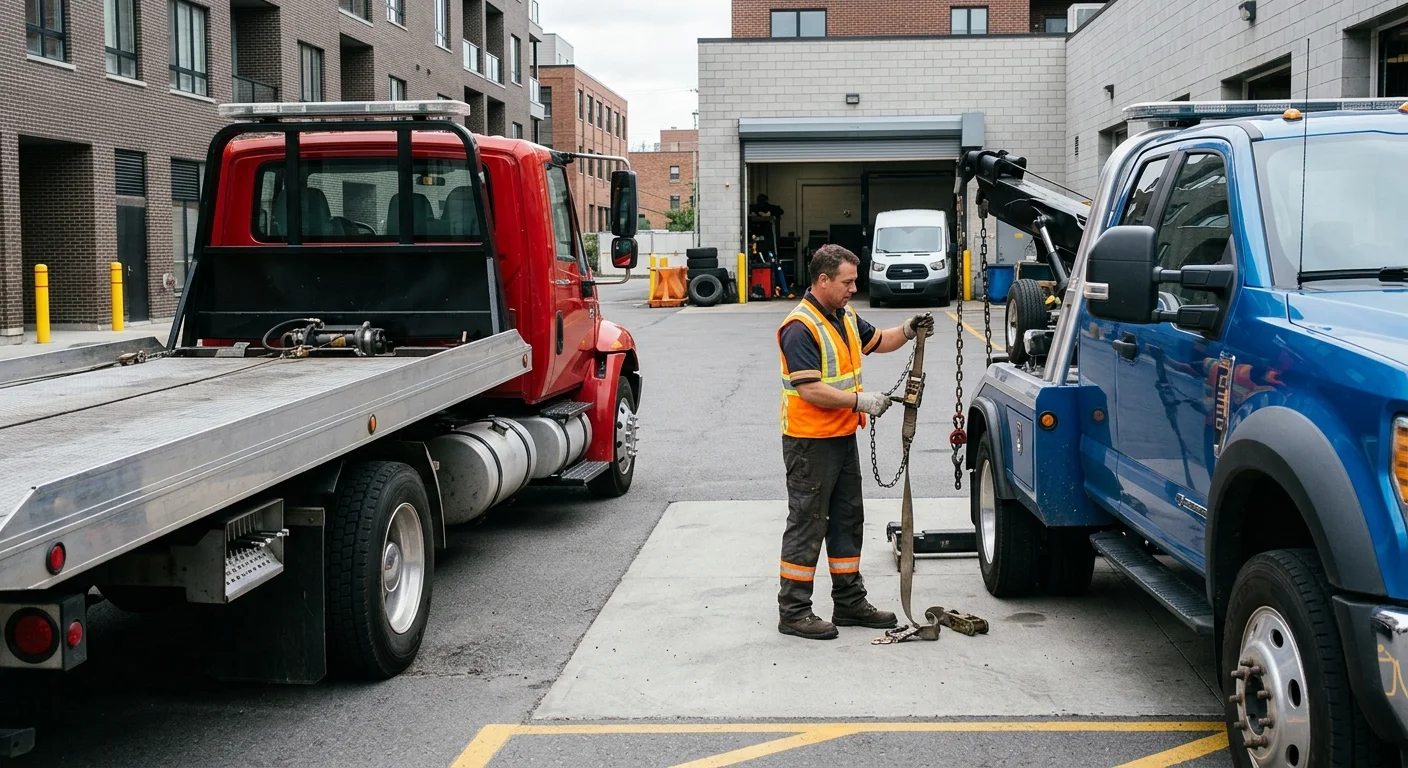
How flatbed and wheel-lift towing differ
The visible difference is the car’s position during the tow. A flatbed carries the vehicle on a platform. A wheel-lift raises one end while the other tires remain at road level.
Neither name answers the whole question. The operator still needs the year, make, model, drivetrain, and current condition. That information matters more than whether one truck looks larger or more specialized.
Our flatbed towing referrals are useful when a vehicle’s instructions call for that loading method. A flatbed request may also make sense when the car has damaged wheels or can’t roll normally. The operator must confirm the actual loading plan after reviewing the vehicle and pickup area.
Wheel-lift towing may be considered when the vehicle, wheel condition, access, and destination allow it. That doesn’t mean every running sedan automatically fits a wheel-lift. It also doesn’t mean every all-wheel-drive vehicle receives the same answer. The owner’s manual and operator’s assessment control the decision.
Chicago access can narrow the options before the operator arrives. A street-level pickup in Pilsen isn’t the same as a stalled car inside a Loop garage. A shoulder on the Kennedy presents different conditions from a parking space in Cicero. Tell dispatch where the car sits, not only the nearest address.
The practical answer to flatbed vs wheel lift towing is conditional. Match the loading method to the specific vehicle and scene. Don’t choose from appearance, habit, or a rule copied from another model.
Start with the drivetrain and damaged wheels
Begin with the exact vehicle, not a broad label like “SUV.” Give dispatch the model year, manufacturer, model, and trim when known. If the car has selectable drive modes, mention those too.
Check the owner’s manual for its towing instructions. Search the index for “towing,” “transport,” or “roadside assistance.” Read the section for your exact drivetrain. If the manual names a loading method, repeat that wording to dispatch.
Don’t guess whether the vehicle is front-wheel drive, rear-wheel drive, or all-wheel drive. A badge may help, but the registration, manual, or manufacturer information is better. If you still can’t confirm it, say that plainly. The operator can account for the uncertainty before selecting equipment.
Electric vehicles need the same model-specific approach. Some models also require a transport setting or another preparation step. Our guide to Tesla and EV flatbed towing and Transport Mode explains what information to gather without treating every EV alike.
Next, describe each wheel. Say which corner is affected and what you can see. Useful details include a flat tire, a wheel sitting at an unusual angle, or a tire that won’t rotate. Mention loose bodywork near the wheel as well.
Steering condition belongs in the same report. Tell dispatch whether the steering wheel turns and whether the front wheels respond. Also say whether the transmission shifts and the parking brake releases. Don’t force any control just to produce an answer.
A collision adds more unknowns. Identify visible wheel damage, leaking fluid, deployed airbags, or parts touching the ground. The referred operator decides what loading approach fits those conditions.
Check clearance before choosing equipment
Vehicle clearance is only part of the access check. Dispatch also needs the space around the car and the route leading to it.
Start with the pickup level. Say whether the car is outdoors, under a building, or inside a parking structure. For a garage, report the posted height limit exactly as shown. Mention low pipes, sharp ramp changes, tight turns, gates, and ticket arms. Don’t estimate a measurement you can’t verify.
Location details matter across Chicago. Lower Wacker isn’t the same access problem as an open lot near the Stevenson. River North garages can present a different loading area from a residential street in Gage Park. An Elk Grove Village loading zone near O’Hare also differs from a driveway in Naperville.
Describe how the car faces and what blocks it. Note walls, parked vehicles, curbs, columns, snowbanks, locked gates, or a narrow alley. Tell dispatch whether there’s open space in front, behind, or beside the vehicle. Photos can help the operator understand the layout before equipment is selected.
On an expressway, lead with the road and direction. Name the nearest exit or visible marker. Our guide to finding a tow truck near you in Chicago covers the location details worth collecting on the Kennedy, Dan Ryan, Eisenhower, and other area routes.
IDOT’s Emergency Traffic Patrol responds to Chicago-area traffic disruptions. Its workers protect scenes and address hazards, but IDOT says they don’t repair or tow vehicles. A separate towing operator is still needed when the car must leave.
When the destination changes the decision
Tell dispatch where the car needs to go before equipment is assigned. A nearby repair shop, dealership, body shop, home driveway, and storage facility can present different unloading conditions.
Give the complete destination address when you have it. Then describe what awaits there. Is the entrance inside another garage? Does the shop accept vehicles after hours? Is there an open lot, a marked drop area, or a locked gate? Those answers let the operator consider both ends of the trip.
Confirm that the destination will accept the vehicle. Don’t assume a dealership or repair shop has approved an unattended drop. Ask the destination where the vehicle should be placed and how keys should be handled. Share those instructions with dispatch.
Distance can also change the planning. A tow from the Dan Ryan to a nearby South Side shop is one route. Moving a vehicle from Chicago to Aurora, Joliet, or Naperville is another. Provide the real destination instead of requesting one method based only on the pickup.
A voluntary tow to a repair destination is separate from a City of Chicago impound. It’s also separate from a suburban municipal impound or a private-property relocation. Those are different towing regimes, and the driver usually isn’t choosing the equipment or destination.
The city explains that a missing vehicle may have been relocated or impounded. Its Common Towing Questions page covers that distinction and the city pound system. If your parked car disappeared, identify what happened before arranging another tow.
For a service call, Quick Tow Chicago doesn’t set the towing method or price. We collect the vehicle, scene, and destination details. An independent operator reviews them, and the price is quoted before dispatch.
What to tell dispatch about your vehicle
A clear description helps the referred operator evaluate a flatbed or wheel-lift tow. You don’t need mechanical vocabulary. Report what you know, what you see, and what remains uncertain.
Have these details ready:
- The model year, make, model, and trim
- The drivetrain stated in the manual or vehicle information
- Any towing method named in the owner’s manual
- Whether the engine starts
- Whether the transmission shifts
- Whether the parking brake releases
- Whether the steering wheel and front wheels turn
- Which tires or wheels appear damaged
- Any visible collision damage or loose bodywork
- Whether the vehicle sits unusually low
- The pickup address, level, entrance, and posted clearance
- Nearby curbs, walls, columns, gates, or parked vehicles
- The complete destination and its drop instructions
Photos are useful when they show the whole vehicle and nearby access. Include the damaged wheel, surrounding obstacles, and garage clearance sign when relevant. Don’t place yourself in traffic to take one.
Avoid vague phrases such as “it won’t move.” Explain what happened immediately before it stopped. Say whether the car stalled, struck something, lost a tire, became stuck, or displayed a warning. If you don’t know the cause, state that instead of diagnosing it.
Chicago location details should be equally precise. “On I-80” covers too much road. Add the direction, nearest exit, and whether you’re near Joliet, Tinley Park, or another identifiable place. Inside the city, provide the street, cross street, and side of the road when possible.
Dispatch may ask follow-up questions before choosing equipment. That isn’t a delay estimate or a promise about the final method. It’s how the operator avoids planning around missing or incorrect information.
Don’t request wheel-lift towing only because a previous car used it. Don’t request a flatbed only because it appears preferable. Start with the manual, the vehicle’s current condition, both locations, and the operator’s assessment.
When to call us
When the car can’t move under its own power, a wheel is damaged, or the manual names a specific towing method, stop trying to reposition it yourself. Our line takes calls 24/7, and calls are recorded after a notice; we use your details to dispatch an independent local operator, with the price quoted before dispatch. Call us at (773) 830-6930.