EV towing for a Tesla starts with a flatbed request and precise vehicle details. Identify the exact car, explain whether it powers on, and describe every damaged or blocked wheel. Transport Mode steps vary by model and software, so check the current owner’s manual for that vehicle instead of guessing.
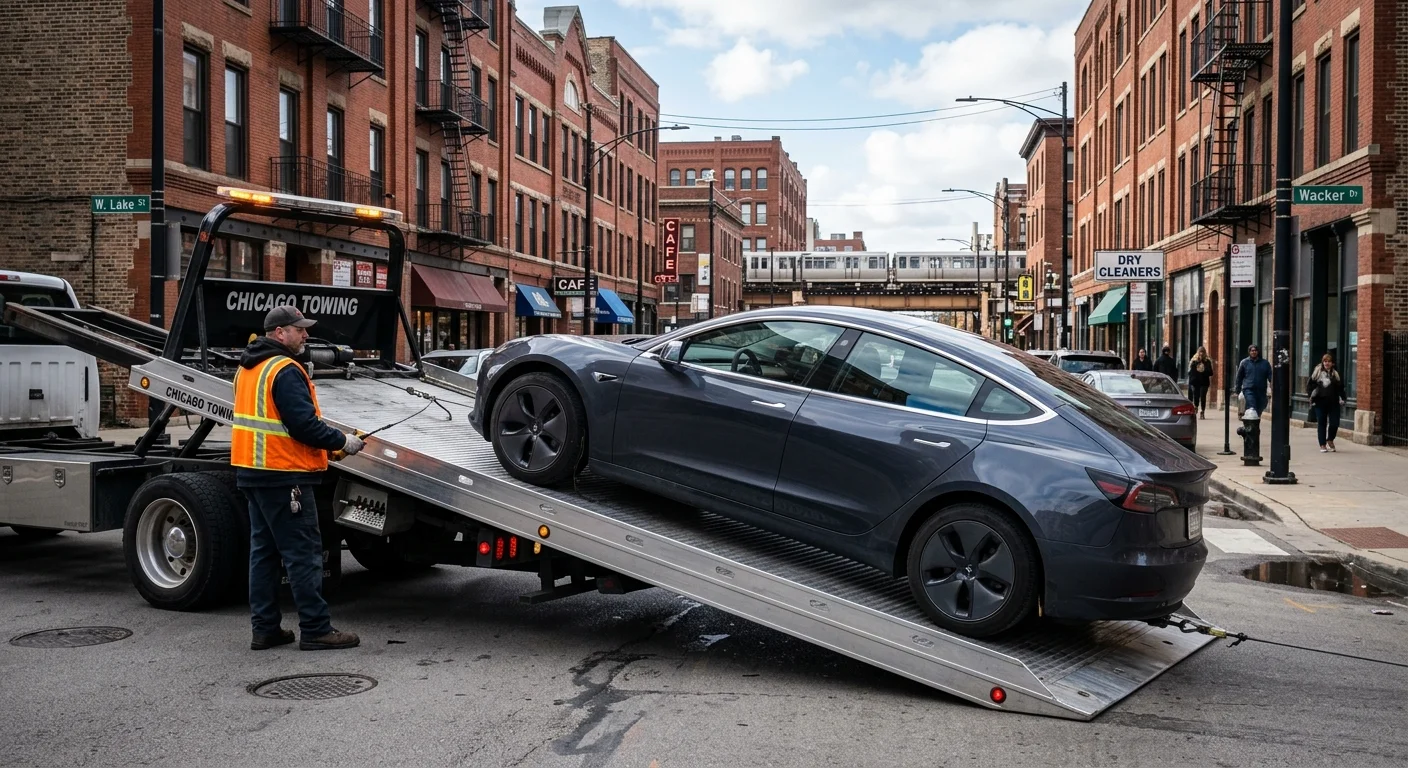
Start with a clear flatbed request
Tell the dispatch line that the disabled vehicle is electric. Then request flatbed towing and name the exact make and model. A flatbed carries the vehicle on its deck with all four wheels supported.
The words “my Tesla won’t start” leave important gaps. Explain what happened just before it stopped moving. Say whether the center display works, the doors open, and the car recognizes its key. Describe warning messages exactly as they appear.
The operator also needs the wheel condition. Mention any flat tire, bent wheel, collision damage, or wheel that won’t turn. Don’t describe a damaged wheel as merely “stuck.” That word can hide several different loading problems.
Give the pickup setting with equal care. A shoulder on the Kennedy differs from a garage in the Loop. A narrow alley in Pilsen differs from an open lot in Schaumburg. Tell the line about gates, ramps, low entrances, tight turns, and posted clearances.
Quick Tow Chicago is a referral service. We match drivers with independent local tow operators. We don’t own flatbeds, employ drivers, or perform the loading ourselves. The operator evaluates the vehicle and sets the price. You’ll receive that price before anyone is dispatched.
If the car was damaged in a crash, explain that during the first message. A simple flatbed pickup and accident recovery aren’t always the same assignment.
Verify Transport Mode for the exact Tesla
Transport Mode isn’t a phrase to interpret from memory. The current owner’s manual for the exact vehicle is the authority for its controls. Software, vehicle condition, and available power can affect what the driver sees.
The Chicago claims ledger supplied for this page contains no verified Tesla button sequence. That means this page won’t invent one. A video recorded for another model or software version isn’t a substitute for the instructions provided with your vehicle.
Use this process before loading begins:
- Confirm the exact model and model year.
- Find the current owner’s manual provided for that vehicle.
- Search the manual for “Transport Mode” and towing instructions.
- Read the relevant steps while the operator is present.
- Tell the operator immediately if a screen or control doesn’t respond.
Don’t keep repeating a control sequence that isn’t working. Report what the vehicle actually does. A blank display, locked steering, or wheel that won’t move gives the operator useful information.
Transport Mode also shouldn’t be treated as a complete dispatch plan. The operator still needs to know the car’s position, wheel condition, available space, and destination. Those details determine how the operator approaches the pickup.
If the car lacks enough power to show its instructions, say that clearly. Don’t claim Transport Mode is active unless the vehicle confirms it. The dispatched operator can then compare the vehicle’s condition with the current manual and the equipment brought to the scene.
The goal is simple: match the car in front of you with its own instructions. Don’t borrow a procedure from another Tesla or a different EV.
Give the operator the full loading picture
A good dispatch description covers the vehicle, its surroundings, and its destination. Gather the details you can observe without changing the vehicle’s condition.
Start with access. Tell the line where the car sits and which direction it faces. Mention a curb, wall, gate, loading dock, concrete divider, or parked vehicle that limits the approach. In a garage, provide the posted clearance and the floor where the car stopped.
Next, describe the wheels and body. Identify visible collision damage and the side where it appears. Say whether a tire is flat or a wheel sits at an unusual angle. If part of the car touches the pavement, report its location instead of trying to diagnose it.
Explain the power condition in plain words. “The display turns on, but the car won’t move” is more useful than “the battery is dead.” If nothing responds, say which controls you already tried.
Have the destination ready before dispatch. Provide the full address and the name of the repair facility, service center, home, or other approved drop point. Confirm that someone there can receive the vehicle. For a trip outside the immediate area, review the long-distance towing details before booking.
Finally, keep the vehicle key or authorized access method available. Tell the operator if access depends on a phone, card, or physical key. Don’t assume every operator will arrive knowing which one you have.
These details reduce uncertainty before the flatbed arrives. They also help the operator decide whether the requested assignment matches the vehicle and pickup setting.
Account for the Chicago pickup location
Chicago road conditions change block by block. A Tesla stopped near the Jane Byrne Interchange presents a different access problem than one parked in a residential alley. The same applies across the Kennedy, Dan Ryan, Eisenhower, Stevenson, Edens, Bishop Ford, and Tri-State.
Name the roadway and direction of travel. Include the nearest exit, cross street, or visible landmark. If the vehicle is on an expressway, distinguish a shoulder from a travel lane. Follow directions from police, fire crews, or highway personnel already controlling the scene.
IDOT’s Chicago-area Emergency Traffic Patrol responds to crashes, disabled vehicles, and road hazards. Its workers are also called Minutemen. They establish emergency lane closures and protect responders, but IDOT says they don’t repair or tow vehicles away.
That distinction matters when you’re waiting beside a disabled EV. A public patrol vehicle at the scene doesn’t mean a tow operator has been dispatched. Tell the referral line which agency is present and what instructions you’ve received.
Off the expressway, describe local access carefully. Lower-level streets, parking structures, service alleys, and loading areas can limit how a flatbed approaches. A pickup near O’Hare may involve a garage or controlled entrance. An industrial pickup in Elk Grove Village or south of Joliet may require gate directions.
Winter adds another layer. Snow can cover curbs, wheel damage, and pavement edges. Report what you can see without guessing about hidden conditions. Don’t promise that the car rolls merely because the visible tires look intact.
Quick Tow Chicago serves communities across Cook, DuPage, Kane, and Will counties. Northwest Indiana isn’t part of the service area.
Treat a missing Tesla as a different problem
A missing Tesla doesn’t automatically need roadside dispatch. Inside Chicago, the vehicle may have been impounded or relocated. The city says relocations can clear streets for agency work, including emergencies when signs couldn’t be posted.
Check Chicago’s Find Your Towed Vehicle tool before treating the car as stolen. Confirm whether the result identifies a relocation or a city pound. Those outcomes require different next steps.
The distinction becomes wider outside city limits. A suburban municipal impound isn’t governed by Chicago’s pound schedule. Each municipality handles its own administrative process and sets its own fee. Don’t use a Chicago figure for a vehicle held by Cicero, Naperville, Joliet, or another suburb.
A private-property relocation is different again. In Cook, DuPage, Kane, and Will counties, that work is performed by commercial vehicle relocators licensed by the Illinois Commerce Commission. The ICC relocation towing page provides its consumer guide and complaint process.
Quick Tow Chicago isn’t an ICC-licensed relocator. We don’t remove vehicles from private property or operate an impound lot. We can connect drivers with independent operators for roadside towing after the vehicle’s location and release status are clear.
Transport Mode doesn’t resolve an impound or relocation issue. First identify who has the vehicle and what release process applies. Then arrange transportation if the released car still can’t move under its own power.
This prevents three separate Chicago-area systems from getting flattened into one. A city pound, a village impound, and a private relocation aren’t interchangeable.
Confirm the handoff before departure
Once the operator arrives, repeat the vehicle details before loading starts. Point out damaged wheels, body contact, warning messages, and controls that didn’t respond. Show the operator the exact owner’s-manual instructions you found for that vehicle.
Confirm the destination again. Check the street address, entrance, and receiving contact. If a repair facility has separate customer and service entrances, identify the correct one. Don’t assume the operator knows where that location accepts disabled vehicles.
Review the quoted price before the truck rolls. Quick Tow Chicago doesn’t set operator rates, and this page doesn’t publish an estimated Tesla towing price. The independent operator provides the quote before dispatch.
Keep the key or authorized access method available throughout loading. If the vehicle uses a phone for access, tell the operator before anyone begins. Report any loss of connection or change in the display instead of trying an unverified workaround.
Before departure, confirm who will receive the car. Make sure that person knows an electric vehicle is arriving by flatbed. Share any access details already discussed with the operator.
A clear handoff is especially useful on longer trips across the metro. The pickup may begin near the lake and end at a facility in Aurora or Joliet. Repeating the destination prevents a street name, suburb, or entrance from being misunderstood.
When to call us
Call when the Tesla or other EV can’t move normally, Transport Mode won’t engage, or damage complicates loading. The line takes calls 24/7, and Quick Tow Chicago can match you with an independent local operator after the vehicle details are confirmed. Call us at (773) 830-6930.