A dead car on Joe Orr Road, a stall in a lot off Dixie Highway, and a box truck on I-394 are three different jobs. The operators we dispatch can’t guess which one you’re sitting in. Tell us the street type, the vehicle class, and the drop, and we match an independent local operator to that call.
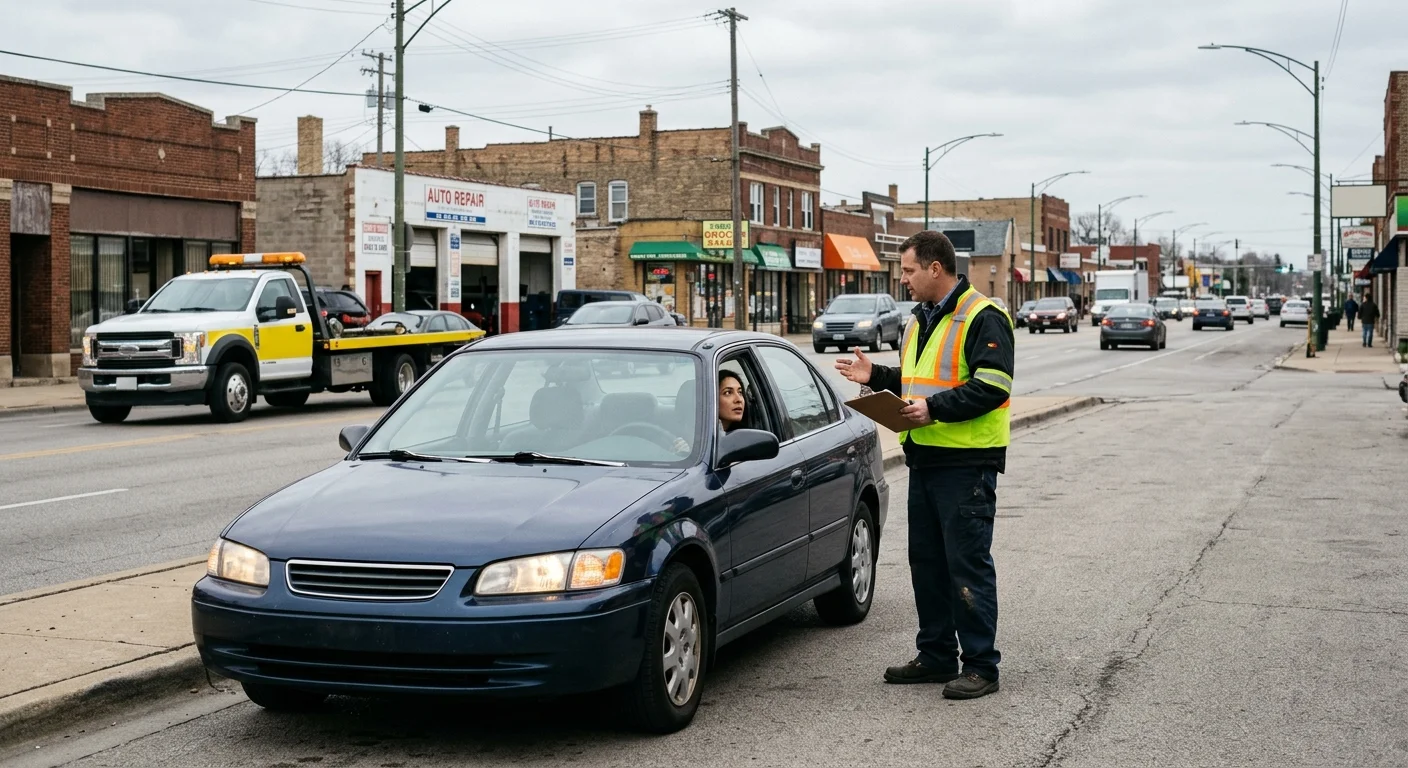
Say whether you are on a city street, a lot, or near I-394
Chicago Heights sits in southern Cook County, near I-394, US-30, and the Indiana line. I-394 is the short freeway that ends at IL Route 1 on the city’s east side. Joe Orr Road, Lincoln Highway, Dixie Highway, Western Avenue, and Sauk Trail are the arterials people actually stall on. A shoulder on I-394 is not a stall in a store lot off Dixie, and a stall on a city street is not a car in a private apartment lot. For towing Chicago Heights IL, say which of those three you’re in, in the first sentence.
If you’re on I-394, tell us the direction of travel and the nearest mile marker or exit. Name the town if you’ve already rolled into South Chicago Heights, Glenwood, Ford Heights, or Lansing. If IDOT’s Emergency Traffic Patrol is already on scene, say so. Those Minutemen crews don’t repair cars and they don’t tow them away.
If you’re on a Chicago Heights city street, name the cross streets. If police are already there, say that too. A police-directed tow is a different job from a voluntary breakdown.
If you’re in a parking lot, say whether it’s a store lot, an apartment lot, or a workplace lot, and whether a property manager already called someone. Private-property removals in Cook County are a licensed activity under 625 ILCS 5/18a. We connect property managers with relocators who hold the Illinois Commerce Commission license. We don’t perform those relocations.
Chicago Heights is not the City of Chicago. If your car vanished from a Chicago street, use the city’s Find Your Towed Vehicle tool and the city’s non-emergency channel before you report it stolen. If it vanished from a Chicago Heights lot or a village street, start with the property and with Chicago Heights police. Each suburb sets its own administrative fee under 625 ILCS 5/11-208.7. We could not confirm a published Chicago Heights impound figure, so don’t treat a Chicago pound receipt as what this city charges.
Separate a passenger car from a commercial truck
A Civic on Western Avenue and a loaded box truck on Lincoln Highway need different equipment. Say passenger car, SUV, pickup, van, box truck, or tractor. Make, model, and year help. All-wheel drive matters because it changes how the operator loads it. If you called looking for a tow truck in Chicago Heights, start with the vehicle class, not with a request for the nearest truck.
If it’s a passenger car or a light pickup, say so first. That’s the job this page is for. Chicago Heights towing is mostly that mix: commuter cars, work vans, and the occasional landscape truck on US-30. If it’s a medium-duty box truck, a dump body, a roll-off, or anything with air brakes, say that in the first sentence. We’ll point that call at heavy-duty towing rather than a light-duty rollback.
Don’t guess GVWR if you don’t know it. The door sticker is the source. If you can’t read it, describe the body: dual rear wheels, a liftgate, a fifth wheel, a loaded trailer still hooked. A half-ton pickup and a straight job are not the same dispatch.
Motorcycles, cars with air suspension, and low-profile sports cars often need a flatbed. We don’t promise a specific truck type until the operator is assigned. We match the class you describe.
Joliet is a different corridor. The inland port and the I-80 yards south of Joliet are a freight market. Chicago Heights is the south-suburb passenger and light-commercial mix along I-394, US-30, and Dixie. If you’re actually on I-80 near Joliet, use the Joliet dispatch notes instead of this page.
Report weight, load, and whether the vehicle rolls
Does it roll. Does it steer. Are the wheels free. Is it in park with a locked transmission. Those four answers decide a simple hook versus a winch versus a full load onto a bed.
If it’s a pickup or a van, say whether it’s empty or loaded. Payload changes the work. If a trailer is still attached, say so. Unhooking is a separate decision, and the operator needs that before they leave.
Weight: if you have the door-jamb GVWR, read it. If you don’t, don’t invent one. “It’s a loaded F-250 with a plow” is useful. A round number you guessed is not.
Does it sit on all four tires, or is a corner in a ditch, a curb, or a snowbank. Soft ground along Sauk Trail after a thaw is a recovery, not a simple hook. Cook County logged 164,559 crashes in 2024, about 54 percent of all Illinois crashes. If this is a crash scene, say that, and say whether anyone is hurt. Hurt people are a 911 call first. Towing waits. Once an operator is on scene, a jump takes five to ten minutes. A soft-ground winch takes fifteen to thirty. A deep recovery can take one to two hours. Those are job durations, not travel times. We don’t publish arrival windows because this brand holds no trucks to measure them with.
Keys: with you, locked inside, or lost. A car without keys still moves, but the operator needs to know. Fuel leaks, deployed airbags, or a hybrid or EV: say it. An EV often needs transport mode and a flatbed. The operators we dispatch still quote before anyone is sent.
Choose a shop, yard, or home destination
Towing in Chicago Heights only works if the drop is a real address, not somewhere in the south suburbs. Tinley Park, Park Forest, Steger, and Oak Forest are close, but they are not Chicago Heights. Say the city on the invoice line.
Name the shop if you have one. An address in Chicago Heights, Homewood, Flossmoor, or Olympia Fields beats a chain name. Home is fine if you can take it there. A storage yard, if one is used, is the operator’s lot. It isn’t ours. Quick Tow Chicago is a referral service. We own no trucks, we run no yard, and we store nothing.
If you want the car at a dealer, say the dealer and the city. Long tows into Chicago, out toward Joliet, or across the county line change the quote. Northwest Indiana is outside our service area. Don’t ask us to send an operator into Hammond or Munster as if it were Illinois.
If insurance is directing the tow, say the carrier and whether they already opened a claim. The operator still quotes before dispatch. We don’t bill a number we haven’t stated.
If the car was already towed and you’re trying to find it, that isn’t this call. For a City of Chicago tow, use the lookup tool above. For a Chicago Heights village impound, start with the police department. For a private lot, the sign should name the relocator. Relocator complaints go to the Illinois Commerce Commission.
What to confirm before the operator is assigned
You should hear the price before anyone is dispatched. The number on that quote is the number on the invoice. We don’t publish a rate for this brand because we don’t set one. The operator does.
There’s no approved average towing fee on this site. People search for an average, or for a Chicago tow fee, and get city-pound numbers mixed with suburb jobs. Those are not the same. The City of Chicago publishes a $250 tow for a vehicle under 8,000 pounds and $350 at 8,000 pounds or more, plus $50 or $100 a day in storage, under Municipal Code 9-92-080. Payment at a city pound is cash, Visa, Mastercard, Discover, American Express, or Diners Club. Checks and money orders are not accepted. That is a city pound. It isn’t a Chicago Heights village impound, and it isn’t our price.
An 80 percent rule for towing shows up in search results. We could not confirm any such rule in Illinois towing law, and we don’t dispatch on it. What we need is the actual vehicle class, whether it rolls, and the drop address.
Confirm the callback number. Confirm you’ll be with the vehicle, or that someone will. Confirm the operator’s name when we assign one. The line takes calls 24 hours a day. A greeting and a recording-consent notice play first. Illinois is treated as an all-party consent state, so that notice isn’t optional. There’s no published email. Written contact goes through the contact page.
If you’re still deciding who to call, tow truck near me in Chicago walks the city versus suburb split. For a south-suburb breakdown that is a true emergency, start with emergency towing.
When to call us
Once the car will not roll to a safe spot on its own, this is no longer a push you should try from a travel lane. Get off the roadway if you can, then call. Call us at (773) 830-6930. The line takes calls 24 hours a day, a notice plays before recording starts, and we dispatch an independent local operator to you.