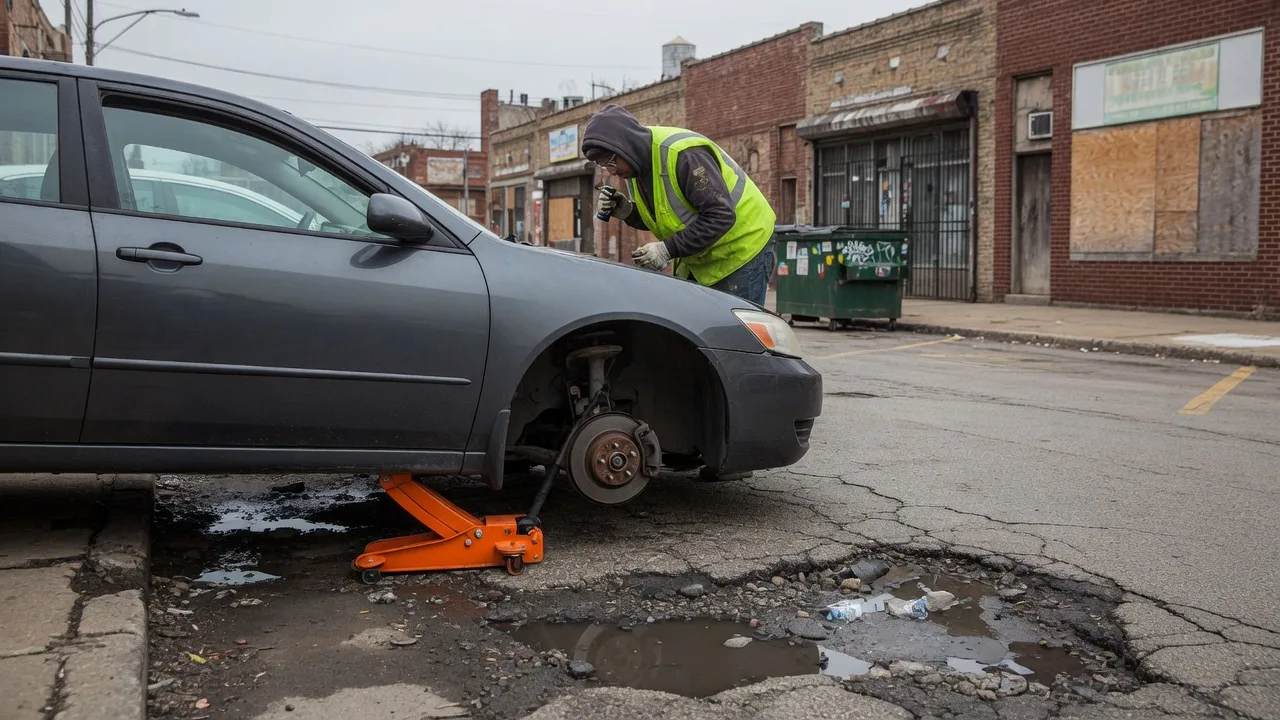
The wheel is off the hub, or it came off while you were moving. Do not drive on the rotor. Get out of the live lane if the car can still be pushed or rolled a few feet onto a shoulder or a curb cut. Then request a flatbed. This is not a spare-tire call.
Do not treat this as a flat tire
A flat tire in Chicago assumes the wheel is still on the car and a spare might work. A missing wheel, a wheel lying in the street, or a hub on the pavement is different. Lug nuts, a broken axle, a failed bearing, or a pothole strike can leave the corner unable to roll. Putting a spare on a damaged hub is how a second failure happens in traffic.
If any part of the car is in a live lane, call 911. Cook County logged 164,559 crashes in 2024, about 54 percent of Illinois crashes. A car sitting on a rotor in a travel lane is an immediate hazard. Hazard lights on if the electrical system still works. Do not stand between the car and approaching traffic. Do not chase the loose wheel into a lane.
On an expressway, the IDOT Emergency Traffic Patrol may close a lane. Those Minutemen protect the scene. They do not repair the corner and they do not tow the car away. You still need a private operator after the scene is held.
Name the street and the cross, or the expressway, direction, and last exit. Western and 18th is a different job from the Dan Ryan local lanes. A pin helps. The sentence still has to name the road.
Why this usually needs a flatbed
A wheel-lift that leaves a damaged corner on the ground can make the damage worse. A flatbed takes all four corners off the pavement. The assigned operator decides the equipment after you describe what you see: wheel gone, wheel bent under the fender, axle visible, or car sitting on a rotor.
Say whether the other wheels still roll. Say whether the car will shift into neutral. Say year, make, model, and whether it is AWD. All-wheel-drive with a damaged corner is a poor candidate for a two-wheel hook. Our AWD wheel-lift page explains why that setup matters. This page is the missing-wheel emergency, not the AWD equipment choice in general.
Do not crawl under the car to “see if it is the CV joint.” From a safe position, describe the visible corner. Fluid on the pavement, a wheel in the gutter, and a hub on the asphalt are enough.
The operator quotes the price before dispatch. Quick Tow Chicago is a referral line. We do not own trucks and we do not perform the tow. The number you hear before anyone rolls is the number on the invoice.
Winter and potholes stack. O’Hare averages 38.4 inches of snow and 121.3 freezing nights. Freeze-thaw wrecks pavement. That is context for why this call happens here. It is not a diagnosis of your car.
After the scene is stable
Pick a destination that can take a car that may not roll onto a lift the usual way. Call the shop before the truck leaves. If the shop is closed, ask the operator where the vehicle can legally sit.
If police are on scene, ask who is taking the car and where. Record the operator’s business name. If you leave and the car is gone, use Find Your Towed Vehicle and 311 before reporting it stolen, if you were inside Chicago. A suburban street uses that village’s process. A private lot uses an ICC relocator under 625 ILCS 5/18a.
City pound fees under 9-92-080 apply only if the City of Chicago has the car. They are not this operator’s quote.
Keep the loose wheel if you can do that without stepping into traffic. It may matter to the shop. It does not change the need for a bed.
When to call us
Call when a wheel is off, the car cannot be driven, and you can name the Chicago-area street or expressway. The line takes calls 24/7. Call us at (773) 830-6930.