For semi truck towing in Joliet, IL, call with your exact location, travel direction, truck configuration, load status, and planned destination. Those details help us match the breakdown with an independent local operator equipped for the situation. If anyone may be hurt or the truck is exposed to moving traffic, contact 911 first.
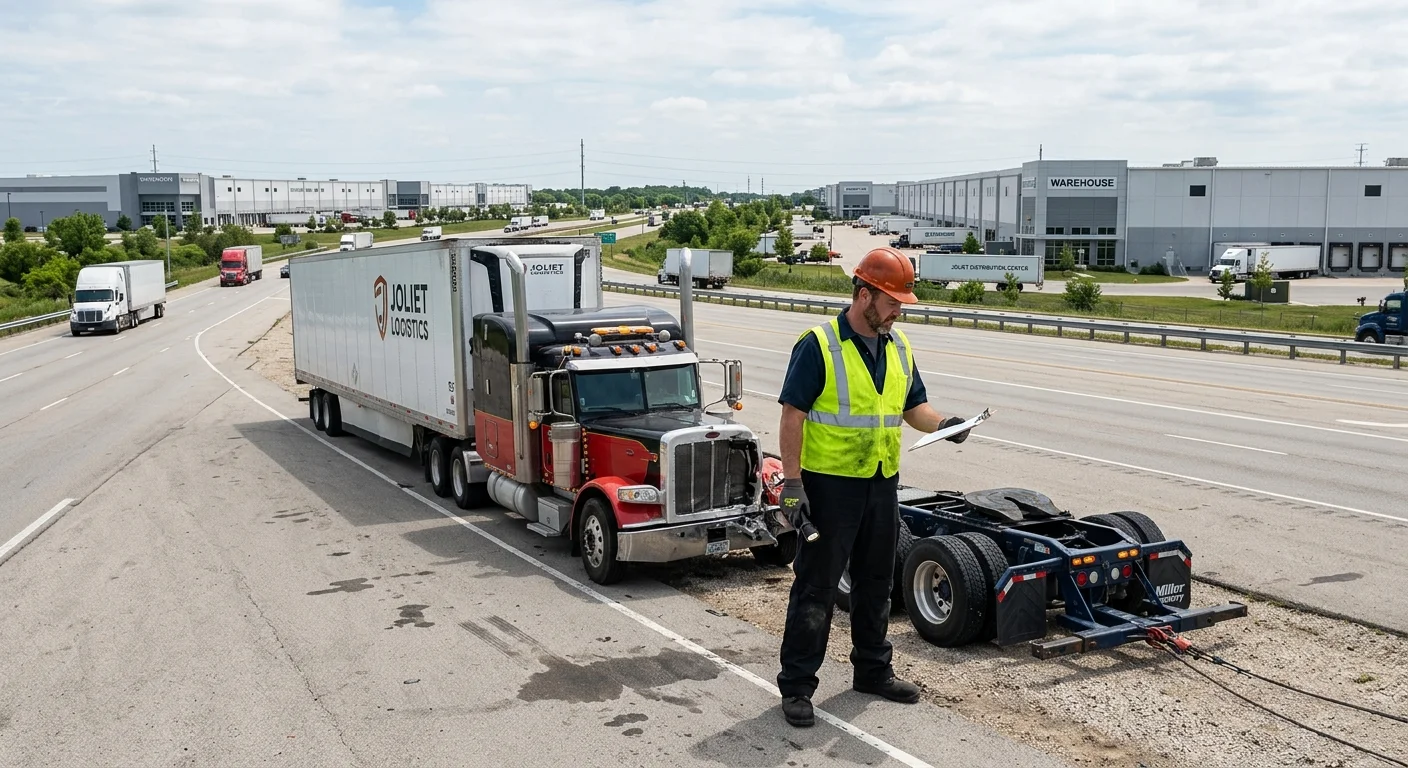
Report the truck’s location and direction
“Near Joliet” covers several very different working areas. A truck beside I-80 presents a different access problem than one near I-55. A tractor inside the intermodal complex south of Joliet may sit behind a gate, in a staging lane, or beside a loading area.
Start with the road name and travel direction. Say whether you’re on I-55 northbound, I-80 westbound, a ramp, or private industrial property. Give the nearest exit, mile marker, cross street, terminal, or visible business. A shared map pin can help when road signs aren’t visible.
Describe the truck’s exact position. Tell us whether it’s fully off the road, on a shoulder, blocking a ramp, inside a lot, or stopped at a gate. Mention barriers, soft ground, tight corners, low entrances, and anything limiting access from the front or rear.
Don’t assume your phone’s location alone tells the whole story. Opposite sides of an interstate may require different approaches. A pin without the travel direction can place an operator across divided lanes.
If the truck is affecting moving traffic, emergency authorities control the roadway response. IDOT’s Emergency Traffic Patrol, also called the Minutemen, manages hazards and emergency lane closures in the Chicago area. It doesn’t repair or tow vehicles away, so a patrol response doesn’t replace a towing request.
Drivers facing a passenger-vehicle breakdown can also read our I-55 and I-90 breakdown guide. A semi call needs more detail because the tractor, trailer, and cargo must be considered together.
Describe the tractor, trailer, and load
A useful semi towing request begins with the complete combination. Give the tractor make and model if known. Then identify the trailer type, such as a dry van, reefer, flatbed, tanker, chassis, or another configuration. Say whether the tractor and trailer remain connected.
Report the number of trailers and the approximate overall configuration. Tell us about visible damage around the steering axle, drive axles, trailer axles, landing gear, kingpin area, wheels, or tires. Don’t diagnose the failure if you aren’t certain. Describe what you can see, hear, or read on the dashboard.
Load information matters too. Say whether the trailer is loaded, empty, or carrying an unknown weight. Share the cargo type and documented weight when they’re available. Mention shifted cargo, an uneven trailer, leaking material, or any load restriction already identified by emergency personnel. Don’t open, enter, or disturb cargo just to answer the call.
Clearance can change access to the truck. Report low roofs, dock canopies, gate widths, overhead lines, nearby trailers, and parked equipment. If you’re at a terminal, provide the gate procedure and a site contact through the call instead of publishing private contact information online.
These details help us choose among operators in the local network. Our heavy-duty towing service explains the referral process for tractors, trailers, buses, and other large vehicles. Quick Tow Chicago doesn’t own wreckers or employ recovery crews. We line up an independent operator based on the information you provide.
Heavy duty towing in Joliet starts with an accurate scene description. Missing details can lead to a poor equipment match or another round of questions before dispatch.
Tell dispatch what still rolls
The operator needs to know what the truck can still do. Start with the tractor. Does the engine start? Can the transmission select neutral? Does the steering respond? Are the brakes released? Are the wheels and tires intact enough to roll?
Then cover the trailer separately. Say whether its wheels roll, its brakes release, and its landing gear appears usable. Report damaged axles, locked wheels, loose body panels, hanging components, or a trailer leaning to one side. If the tractor and trailer can’t be separated, say that plainly.
Only report conditions you already know or can observe without entering traffic. Don’t crawl under the truck or test a visibly damaged system. An honest “I can’t confirm that” is more useful than a guess.
Dashboard messages also help. Read the warning exactly or share a clear photo when requested. Note whether the failure followed a collision, tire problem, loss of power, mechanical noise, or another event. If another repair provider has inspected the truck, relay that provider’s findings without changing the wording.
Be clear about what “disabled” means in your case. A running engine doesn’t mean the truck can move safely. A tractor that rolls doesn’t mean its loaded trailer does. Likewise, a trailer problem may still affect how the entire combination must leave the scene.
For semi towing near I-55, the initial call should separate known facts from uncertain ones. That lets the operator assess the combination before accepting the dispatch. It also gives the operator a chance to request photos, measurements, cargo documents, or other information needed for the match.
When recovery differs from a standard tow
A routine disabled truck and a recovery scene aren’t the same request. A tractor-trailer sitting upright on firm pavement may need transport. A truck off the pavement, down an embankment, leaning, jackknifed, overturned, or carrying shifted cargo may require a recovery assessment first.
Use plain descriptions instead of trying to select the equipment yourself. Tell us where each axle sits and whether the tractor or trailer has left the paved surface. Describe the slope, ditch, median, mud, snow, guardrail, debris, and visible damage. Photos taken from a safe location can show details that are hard to explain by phone.
Truck recovery on I-80 near Joliet may involve roadway control beyond the towing referral. Police, fire personnel, IDOT, property managers, cargo owners, or terminal staff may control access or set conditions at the scene. Tell us which authorities are present and what they’ve said. The operator can then determine whether the job fits its equipment and current access conditions.
Don’t ask for a standard tow when the truck must first be stabilized, separated, unloaded, or brought back to firm pavement. Instead, describe the current position and let the operator classify the work. The same applies when collision damage prevents wheels from turning or leaves part of the combination obstructing traffic.
Quick Tow Chicago doesn’t perform the recovery. We pass the scene details to independent local operators and work to line up an appropriate match. No arrival time can be promised. Access, roadway control, vehicle condition, cargo, and the operator’s assessment all shape what happens next.
The operator also sets the price. You’ll receive that price before anyone is dispatched. We don’t publish an estimated heavy-recovery price because no verified operator rate card supports one.
Plan the destination before equipment arrives
Know where the truck should go before dispatch when possible. The destination may be a repair facility, fleet yard, terminal, dealer, secure lot, or another approved site. A vague request to “take it somewhere nearby” leaves an important decision unresolved.
Confirm that the destination accepts the tractor, trailer, and cargo involved. Ask whether it can receive the truck at the expected time and whether its entrance has suitable clearance. Share the entrance address, gate instructions, after-hours process, and on-site contact during the call.
Tell us whether the tractor and trailer have the same destination. A disabled tractor may need repair while its loaded trailer must return to a terminal. That creates a different request from moving the connected combination to one facility.
Distance also matters when matching the operator. A trip within the Joliet freight corridor isn’t the same as moving equipment across the Chicago metro or beyond it. Our long-distance towing service covers referrals for planned moves beyond the immediate breakdown area. The guide to long-distance tow costs from Chicago explains why vehicle condition, route, and destination details matter without presenting an unsupported price.
Have the unit numbers, plate information, vehicle ownership details, and billing contact ready when available. If the carrier, broker, cargo owner, or insurer must approve the destination, settle that before the operator starts moving the equipment.
Finally, tell us about any limits at both ends. A narrow repair-yard entrance or locked terminal gate can matter as much as the roadside scene. Good destination information helps the operator evaluate the entire job, not just the first lift.
When to call us
Call when the tractor or trailer can’t continue safely and you need an independent local operator matched to the situation. The line takes calls 24 hours a day, and calls are recorded after a notice. Share the location, truck configuration, load status, damage, and destination so we can line up an operator and obtain the price before dispatch. Call us at (773) 830-6930.