A disabled motorcycle doesn’t automatically require a flatbed. The right setup depends on the bike, its condition, the pickup location, and the destination. Share those details before dispatch so the operator can confirm suitable equipment.
Why motorcycle towing needs different planning
Motorcycle towing starts with more than the words “it won’t start.” Dispatch needs to understand what kind of bike is waiting and what happened to it. Those details help an operator decide whether a flatbed or another motorcycle-compatible setup fits the job.
Start with the year, make, model, and general bike type. Mention whether it’s a cruiser, sport bike, touring bike, scooter, or custom build. Tell dispatch about saddlebags, a windshield, a top case, crash bars, or other accessories. You don’t need to diagnose anything. You only need to describe what you see.
Location matters just as much. A bike on the Kennedy shoulder presents a different pickup than one inside a River North parking garage. A narrow Pilsen alley differs from an open lot in Schaumburg. The operator needs the exact entrance, available space, and any height restriction.
The bike’s condition also changes the equipment decision. Report whether both wheels appear intact and can turn. Explain whether the steering moves, the key is available, and the steering lock is engaged. Mention visible fluid, damaged controls, loose bodywork, or a bike resting on its side.
Our motorcycle towing service connects riders with independent local operators. The operator confirms the equipment after reviewing the bike and pickup conditions. Don’t copy instructions from an unrelated vehicle. For example, EV flatbed towing and transport mode involve vehicle-specific steps that don’t answer a motorcycle pickup.
When a flatbed may fit the job
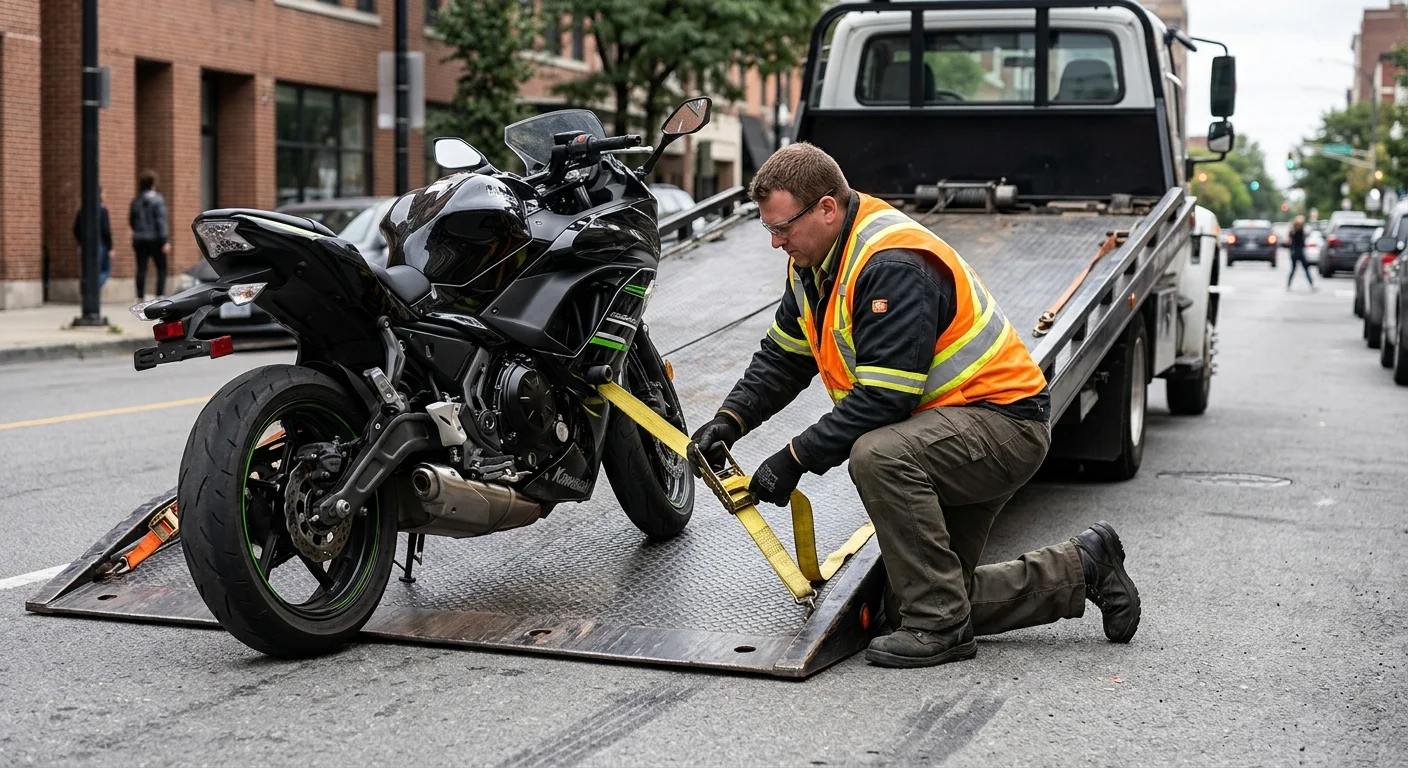
Flatbed motorcycle towing places the bike on a truck’s platform for transport. It may fit when the operator has motorcycle-compatible loading and securement equipment. It isn’t an automatic answer for every motorcycle or location.
A flatbed may be considered when a wheel is damaged or won’t turn normally. The operator may also need it when steering is locked, bent, or difficult to move. Low bodywork, custom exhaust parts, and added luggage can affect the loading plan. Tell dispatch about each item instead of assuming it won’t matter.
Access can rule a setup in or out. A flatbed needs enough room for the truck and its loading approach. That may be simple in a suburban parking lot. It may be harder inside a Loop garage, beside a tight curb, or behind a narrow gate. Give dispatch the garage clearance and pickup level when you know them.
The destination also belongs in the first conversation. Name the repair shop, dealership, home, or storage location. Tell dispatch if the receiving entrance has a gate, steep driveway, limited turning room, or indoor unloading area. The pickup and drop-off must both work for the selected equipment.
We can arrange flatbed towing when an operator confirms that configuration fits. Quick Tow Chicago doesn’t own trucks or select equipment without an operator’s assessment. We collect the facts, line up an independent operator, and provide the quoted price before anyone is dispatched.
If a flatbed can’t reach the bike, ask what motorcycle-specific alternative the operator proposes. Get a clear explanation of how the bike will be loaded, carried, and unloaded. A vague promise that the operator can “make it work” doesn’t answer the equipment question.
What securement details to ask about
Securement should be discussed before the motorcycle moves. There isn’t a verified one-size-fits-all strap count or tie-down pattern in the material for this page. Confirm the complete method with the dispatched operator for your particular motorcycle.
Ask where the operator plans to make contact with the bike. Point out painted panels, fairings, cables, brake lines, mirrors, and exposed accessories. If the motorcycle has manufacturer-designated transport points, mention them and share the owner’s manual guidance when available.
Next, ask how the front wheel and the bike’s upright position will be managed. Tell the operator about a flat, bent, or missing wheel before booking. The same applies to a steering lock that won’t release. Don’t wait until the truck arrives to reveal that the handlebars can’t turn.
Touring motorcycles need an accurate accessory list. Describe hard cases, a top box, antennas, highway pegs, and an oversized windshield. For a custom bike, mention lowered suspension, extended components, or unusual controls. Dispatch can pass those details to the operator for review.
You can ask these plain questions:
- What equipment will support the motorcycle during transport?
- Which points on this bike will the operator use?
- How will damaged wheels or locked steering affect loading?
- Could any strap or support contact painted parts?
- Does the operator need keys or steering access?
- Should any removable luggage come off before pickup?
Ask the operator to review the setup with you before departure. If the proposed method differs from the motorcycle manufacturer’s instructions, raise that concern immediately. The operator should explain the plan for the actual bike, not a generic motorcycle.
Take clear photos before loading when the surroundings allow it. Capture both sides, the wheels, controls, visible damage, and attached accessories. Those images provide a record of the bike’s condition at pickup.
How damage and access affect pickup
Damage can turn a routine motorcycle tow into a more involved loading job. Describe what happened without guessing at the repair. A bike that simply won’t start differs from one with crash damage, a jammed wheel, or loose parts.
Look at the motorcycle from a safe position. Tell dispatch whether it’s upright or on its side. Report visible wheel damage, crooked steering, detached bodywork, leaking fluid, or broken luggage. If you can’t inspect the traffic-facing side safely, say that. The operator can plan around missing information.
Don’t force the steering lock or try to straighten damaged parts for the tow. Instead, tell the operator what moves and what doesn’t. Mention whether you have the key and whether the transmission position is known. If the motorcycle was involved in a crash, share any instructions given by police or property staff.
Chicago access problems can be very specific. Lower-level garages may have posted height restrictions. Alleys in Little Village and Pilsen may offer limited turning space. Downtown loading zones can have little working room. Expressway shoulders add passing traffic and controlled access.
Give dispatch your direction of travel and nearest exit on the Kennedy, Dan Ryan, Eisenhower, Stevenson, Edens, Bishop Ford, Tri-State, I-57, I-80, or I-88. A dropped map pin can help distinguish opposite sides of the same road. Include the garage name, entrance street, floor, gate code, or parking-space number when relevant.
IDOT’s Emergency Traffic Patrol responds to Chicago-area traffic disruptions. Its workers protect scenes and help restore traffic flow, but IDOT says they don’t repair or tow vehicles away. A separate towing operator is still needed.
If traffic, fire, or another immediate danger is present, call 911. Otherwise, stay where you’re protected and follow instructions from responding authorities and the dispatched operator.
What to tell dispatch before booking
Good dispatch information reduces equipment guesswork. Have a short description ready before you call. The practical answer to how to tow a motorcycle starts with an accurate picture of the bike and both locations.
Provide these details in order:
- Your exact location and direction of travel
- The motorcycle’s year, make, model, and type
- Whether the bike is upright or on its side
- Whether both wheels are present and able to turn
- Whether the handlebars move and the steering is locked
- Whether you have the key
- Any crash damage, loose parts, or visible fluid
- Any windshield, saddlebags, top case, or custom parts
- Garage height, gate, alley, ramp, or access restrictions
- The complete destination and its unloading conditions
Photos can help when the model, damage, or access is hard to describe. Ask how the operator wants to receive them. Include a wide view of the pickup area as well as close views of the motorcycle.
Be clear about what you don’t know. “I can’t see the front wheel from this position” is useful information. Don’t report a wheel as undamaged when you haven’t inspected it. The operator can decide whether more information is needed before dispatch.
Ask for the equipment choice and loading plan in plain language. Confirm that the operator knows about every damaged or restricted part. You should also confirm the quoted price before the truck rolls. The operator sets that price, and Quick Tow Chicago doesn’t publish a motorcycle towing rate.
If you’re comparing options after a breakdown, our guide to finding a tow truck near you in Chicago explains what location details matter. For a motorcycle, add the bike-specific information above before booking.
When to call us
A motorcycle that won’t run, can’t roll normally, has visible damage, or sits in restricted access has moved beyond an improvised DIY pickup. Our line takes calls 24/7, and calls are recorded after a notice so we can line up an independent local operator. Call us at (773) 830-6930.