A wheel-lift may work for some all-wheel-drive cars, but there isn’t one rule for every model. We couldn’t confirm a universal method that applies to every AWD vehicle. Check the towing section of the owner’s manual, then ask the independent operator to explain the planned setup.
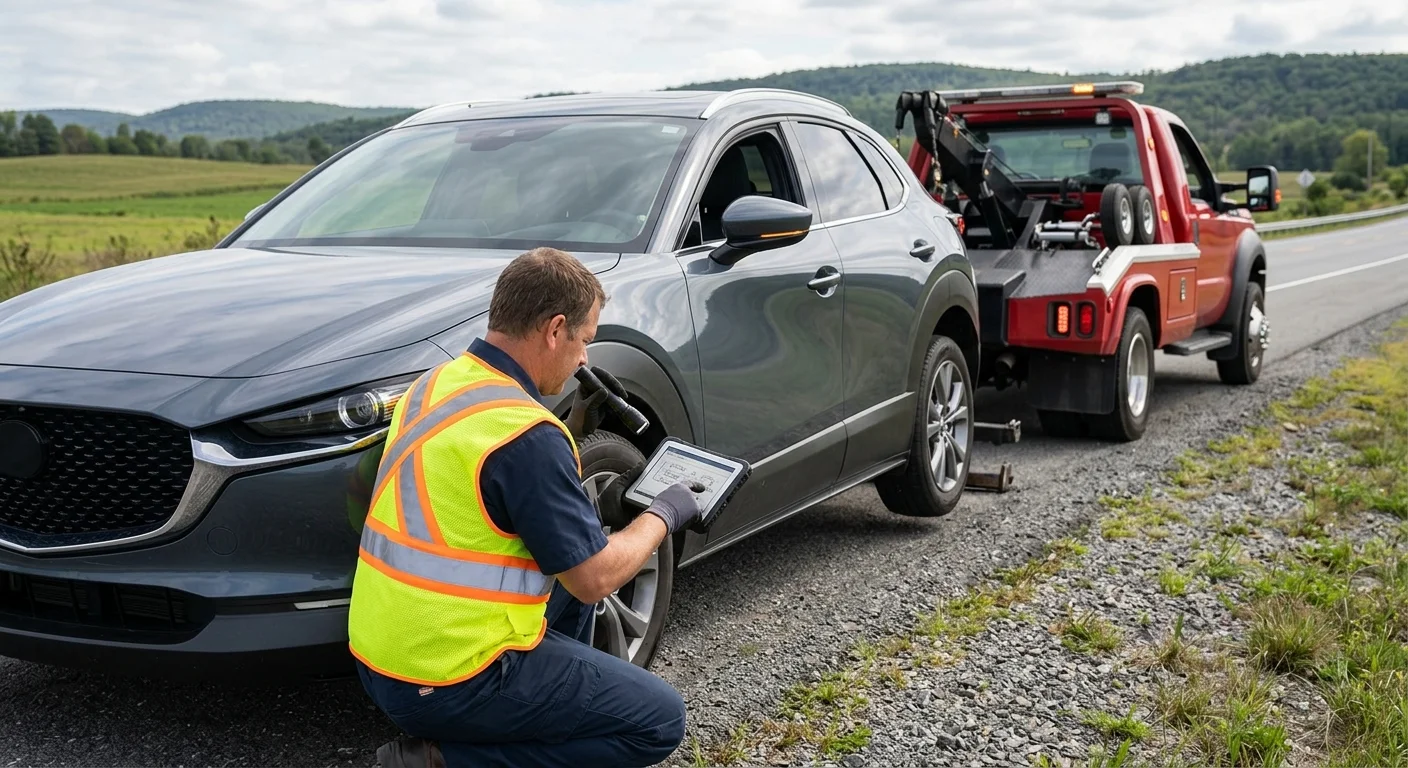
That answer matters before the operator reaches your car. “All-wheel drive” alone doesn’t settle how the vehicle should be moved. The exact car, its condition, the available loading space, and its manufacturer instructions all belong in the conversation.
Confirm the vehicle’s drivetrain before dispatch
Start with what you can verify about the car. Tell us its year, make, model, and trim. If you have the owner’s manual, find its towing or vehicle transport section. Read the relevant wording to the operator instead of relying on memory.
Don’t guess based on an exterior badge. A used car may have missing trim, replacement panels, or unfamiliar model names. Paperwork and the owner’s manual give the operator more useful information. If you’re still uncertain, say that the drivetrain hasn’t been confirmed.
Describe the situation too. Explain whether the car stopped while driving, won’t start, or was found with a warning message. Tell us if it was involved in a crash. An operator planning for a parked, intact car may choose differently when the vehicle can’t roll or steer.
This is also the time to separate two questions. The first is whether a wheel-lift can be included in the operator’s plan. The second is whether that exact plan follows your vehicle’s published instructions. Only the second answer applies to your car.
Our wheel-lift towing service page explains how to request that type of operator. It doesn’t replace the vehicle manufacturer’s directions. Quick Tow Chicago is a referral service, so we don’t approve equipment choices ourselves. We pass the details to an independent local operator who evaluates the pickup.
If the manual isn’t in the glove box, look for an official digital copy from the manufacturer. Match the model year and trim carefully. Instructions from a different year or similar-looking model shouldn’t be treated as instructions for your car.
Explain why wheel position affects equipment planning
Before pickup, ask the operator which wheels the planned setup will support. Then compare that explanation with the owner’s manual. Don’t approve a setup simply because another AWD car was moved that way.
A wheel-lift plan and a flatbed plan aren’t interchangeable descriptions. The operator should identify the actual equipment being sent. If additional equipment is part of the plan, ask what it supports and why it matches the manual’s instructions.
The wider comparison between flatbeds and wheel-lifts can help you understand the terms. Your final decision still needs to be vehicle-specific. A broad comparison can’t account for every drivetrain, wheel condition, or manufacturer direction.
Ask these questions before authorizing pickup:
- Which wheels will the equipment lift?
- What will support the other wheels?
- Does that setup match the towing section of my manual?
- Will the car be loaded differently because it can’t roll or steer?
- Is a flatbed being considered for this particular vehicle?
You don’t need to diagnose the drivetrain yourself. You do need a clear answer about the proposed setup. If the explanation conflicts with the manual, stop and point out the conflict. If nobody can confirm the instructions, say that plainly rather than filling the gap with a guess.
A flatbed towing referral is another option to discuss. That doesn’t mean a flatbed automatically fits every location or every disabled vehicle. Access, clearance, wheel condition, and the operator’s assessment still matter.
The useful question isn’t whether wheel-lifts are “good” or “bad” for AWD cars. Ask whether the operator’s specific configuration matches the instructions for your exact vehicle.
Report wheel, steering, and transmission problems
The drivetrain isn’t the only information the operator needs. Report anything that could affect loading, positioning, or unloading. Small details can change the equipment plan before the operator starts moving the car.
Tell us if any wheel is missing, bent, blocked, or visibly damaged. Mention a flat tire, a wheel turned against a curb, or a car sitting unusually low. Don’t say the wheels roll freely unless you’ve confirmed that without forcing the vehicle.
Report steering problems in plain language. Say whether the steering wheel turns, appears locked, or can’t be checked because the car has no power. Mention whether the front wheels point straight or remain turned. The operator can decide what that means for the loading plan.
Do the same with the transmission. Tell the operator whether the selector moves and whether the display shows a gear. If the car can’t be placed in neutral, say so. Don’t force a shifter or attempt an unfamiliar release procedure just to prepare for towing.
Electric and hybrid vehicles may have their own transport directions. Our guide to Tesla and EV flatbed towing and transport mode explains what information to gather for those vehicles. Follow the manual for the specific model instead of treating every EV or hybrid alike.
Photos can help describe what you’re seeing. Capture the whole vehicle, each damaged wheel, the space around the car, and any dashboard message you can safely view. Obscure personal information before sending documents or labels.
If the car was damaged in a collision, don’t minimize that detail. Describe visible changes without diagnosing them. “The left-front wheel points inward” is more useful than “the suspension is fine.” The operator needs observed facts, not a roadside mechanical conclusion.
Account for parking and loading access
A suitable setup still has to reach the car. Chicago presents very different pickup spaces, from open suburban lots to narrow city alleys. Describe the location before the operator commits to an equipment plan.
Say whether the vehicle is in a garage, underground level, driveway, alley, loading dock, or street space. Report posted height clearance exactly as shown. Don’t estimate it. Mention tight turns, steep ramps, low pipes, locked gates, concrete columns, or parked cars blocking a straight approach.
Lower Wacker isn’t the same loading environment as a surface lot near I-88. A parking structure in the Loop isn’t the same as a driveway in Naperville. Likewise, a narrow space in Pilsen or Little Village may require a different approach than an open commercial lot near Joliet.
If you’re stopped on an expressway, focus on communicating your exact location and visible conditions. IDOT says its Chicago-area Emergency Traffic Patrol handles traffic disruptions and protects responders, but it doesn’t tow vehicles away. A separate tow operator still needs enough location detail to find and assess the car.
Tell us which road you’re on, your direction of travel, and the nearest visible exit or landmark. Say whether the car is on the shoulder, in a traffic lane, or beyond a barrier. If there’s immediate danger, call 911.
Snow, standing water, mud, and curb position should also be reported. Don’t move the car simply to create a better loading angle unless the operator or an on-scene authority directs you. Send photos from a safe position when possible.
Access details aren’t secondary. They help the independent operator decide whether the proposed setup can be positioned at the vehicle.
Confirm the operator’s setup before pickup
Repeat the key facts when the operator confirms the job. State the exact vehicle, AWD status, current condition, location, and access limits. Ask the operator to name the equipment and explain the loading plan.
Keep the owner’s manual available. If it gives a warning or specific transport instruction, read that language aloud. Don’t paraphrase a sentence if one changed word could affect the meaning. You can also show the relevant page when the operator arrives.
Before the car moves, confirm these points:
- The operator knows the car is all-wheel drive.
- The operator has the correct year, model, and trim.
- The plan accounts for wheels that won’t roll normally.
- Steering or transmission problems have been reported.
- Garage clearance and approach restrictions are known.
- The proposed setup matches the owner’s manual.
Ask where the car will be delivered and how it will be unloaded there. The destination may have its own access limits. A repair shop with a clear outdoor lot presents a different situation from a gated garage or crowded curb.
Price is set by the independent operator, not Quick Tow Chicago. You should receive the price before anyone is dispatched. Make sure the quote reflects the vehicle condition, pickup access, planned equipment, and destination you described.
Don’t treat a telephone description as permission to ignore something different at the scene. If the operator finds hidden damage, blocked access, or conflicting instructions, pause and discuss the revised plan. The equipment choice may need to change.
The right outcome begins with accurate details. Confirm the drivetrain, read the manufacturer’s instructions, and get a specific equipment explanation. That gives the operator a clearer starting point than a general request for a tow truck for an AWD car.
When to call us
Call when the AWD car can’t be moved normally or the correct towing setup isn’t clear. Our line takes calls 24/7, plays a recording notice, and helps us line up an independent local operator using the details you provide. Call us at (773) 830-6930.