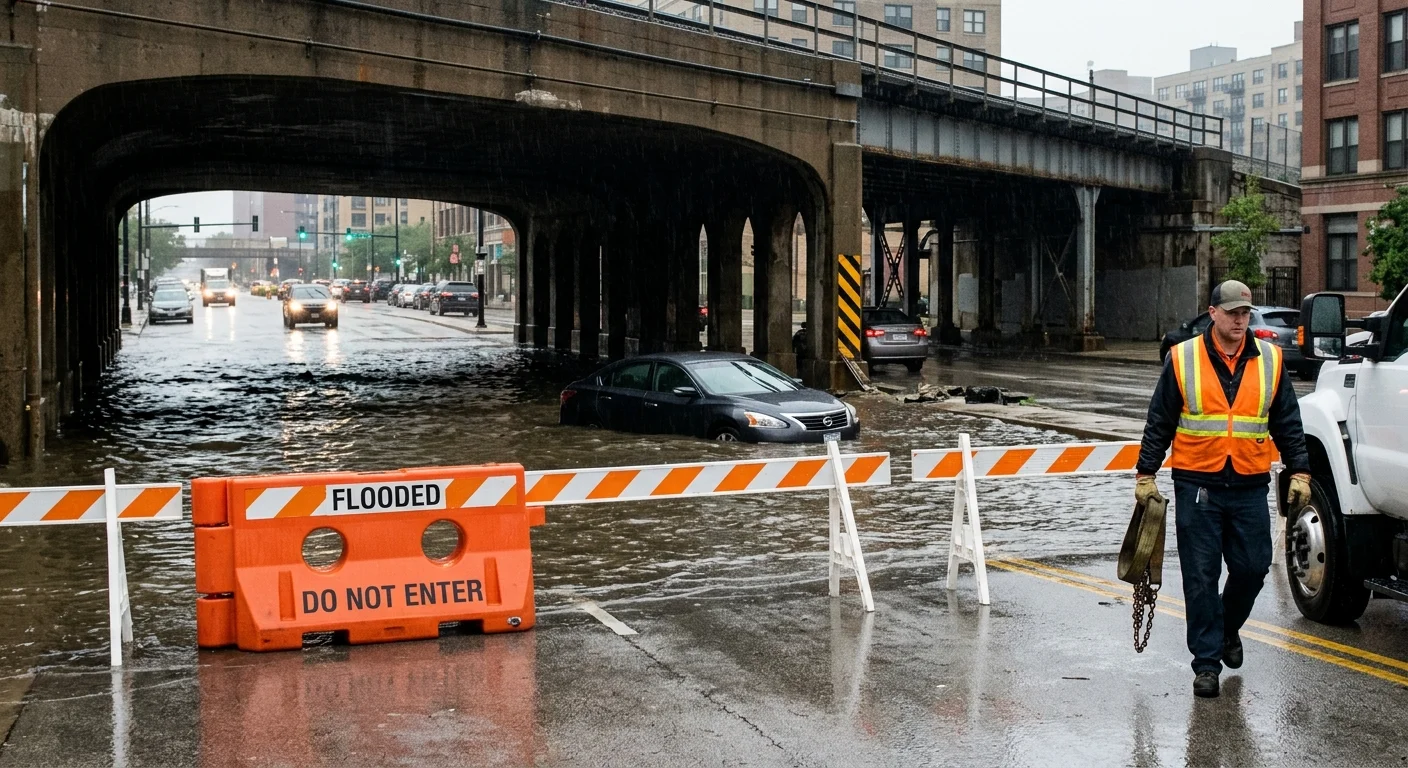
A car stuck in a flooded Chicago underpass needs a controlled recovery, not an improvised pull. Get yourself clear, report the exact location, and wait until authorities permit access. Quick Tow Chicago can then connect you with an independent operator for the recovery.
Put personal safety ahead of recovering the car
The car can wait until the scene is accessible. Stay where on-scene authorities direct you. Don’t cross a barrier or enter standing or moving water to inspect the vehicle.
If someone faces an immediate emergency, call 911. Follow the dispatcher’s instructions and describe the location as clearly as possible. Don’t return to the car for documents, keys, bags, or photographs while access remains restricted.
A tow truck for a flooded car isn’t the first step. Authorities must first decide when anyone can approach the underpass. That includes the driver, passengers, bystanders, and the recovery operator.
Don’t ask another motorist to pull the car out. Don’t connect a strap, chain, or cable from the edge of the flooded area. A recovery operator needs to inspect the position after access is allowed. That operator can then choose the setup for the vehicle and scene.
Quick Tow Chicago is a referral service. We don’t own trucks or send our own drivers. We collect the recovery details and match callers with independent local operators. Our accident recovery and winch-out service covers situations where a normal roadside hookup may not fit the scene.
No verified universal water-depth threshold was available in the approved sources for this page. We won’t invent one. Barriers and current directions from on-scene authorities control when the recovery can begin.
Share the underpass location and water conditions
Start with the street name and nearest cross street. Add the direction you were traveling and the side of the underpass where the car stopped. “Under a viaduct in Chicago” leaves too much uncertainty.
Chicago has city streets, rail viaducts, Lower Wacker, and major expressways. A location beside the Kennedy isn’t handled like a neighborhood street underpass. The same distinction matters near the Dan Ryan, Eisenhower, Stevenson, Edens, Bishop Ford, I-57, or I-80.
If you were on an expressway, share its name and direction. Include the closest exit or interchange you already passed. Near the Jane Byrne Interchange, identify the roadway and ramp if you know them. Don’t return toward traffic or floodwater to read a sign.
A dropped map pin helps, but pair it with words. Location services can place a pin on the wrong level or side of a divided road. Tell the operator whether the vehicle is beneath a bridge, beside a ramp, or on the approach to an underpass.
Describe only what you can see from a permitted, dry location. Useful details include whether barriers are present, whether responders are on scene, and whether water surrounds the entire car. Say whether the vehicle remains upright and whether another vehicle was involved.
Don’t guess the water depth. Don’t walk closer to measure it. If conditions change while you’re waiting, report the change without approaching the vehicle.
Finish with the car’s year, make, model, and color. Share the plate only if you already know it. These details help an independent operator identify the correct vehicle without relying on a vague underpass description.
Wait for authorities to clear the recovery scene
A dispatch request doesn’t override a closure. Tell us whether authorities have released the scene for recovery. If they haven’t, say that plainly so the operator understands the current limit.
On Chicago-area expressways, the IDOT Emergency Traffic Patrol responds to disruptions involving crashes, disabled vehicles, and hazardous debris. Its workers are also called Minutemen. They establish emergency lane closures, warn approaching traffic, and help protect responders.
IDOT states that those patrol workers don’t repair vehicles or tow them away. Their presence doesn’t replace the independent operator needed for a recovery. It also doesn’t mean the scene is automatically open to a tow truck.
Wait for clear permission from the authority controlling access. Don’t direct an operator around a barricade or through another entrance. If the scene hasn’t been released, the useful work is sharing accurate details and keeping your phone available.
Our emergency towing referral service can collect the vehicle and location information. An operator can be lined up once access is permitted. No arrival time or response window can be promised because conditions and operator availability vary.
A vehicle may no longer be where the driver last saw it. Inside Chicago, the city says vehicles can be relocated during emergencies without advance signs. If your car disappears after the scene clears, check the city’s Find Your Towed Vehicle tool. The city also advises calling 311 before reporting the vehicle stolen.
That process applies inside Chicago. A car in Cicero, Berwyn, Oak Park, or another suburb may fall under that municipality’s procedures instead. Give the exact town, not simply “Chicago,” when arranging the next step.
Describe whether the vehicle can roll or steer
Tell the operator what the car was doing before you left it. Don’t re-enter the restricted area to test anything. Your last safe observation is enough to begin the conversation.
Start with the vehicle’s position. Say whether it appears straight in the lane, angled against a curb, or resting near another object. Mention any collision you witnessed. If there was an impact, our guide to Chicago accident recovery after a crash explains the information an operator will need.
Next, share what you already know about the wheels and steering. Was a tire flat before the car stopped? Did a wheel appear turned sharply? Was the steering working when you last moved the car? State what you observed without diagnosing the cause.
Tell the operator whether you have the keys. Share whether the parking brake was set and whether the transmission was left in park, if known. Identify the vehicle as gasoline, diesel, hybrid, or electric when you know. Include any visible body damage that could affect access around a wheel.
Describe where the water appeared to reach while you were still safely with the vehicle. Use visible reference points, such as the bottom of a door. Don’t turn that observation into a measured depth.
The operator will decide which equipment and approach fit the released scene. Don’t request a specific hookup based only on a photograph. A flooded paved underpass also presents a different recovery setting than soft ground. Our guide to a car stuck in mud and tow or winch-out choices explains why vehicle position matters.
Be candid about missing information. “I couldn’t confirm whether it rolls” is more useful than a guess. The operator can inspect the vehicle after authorities allow access.
Confirm the recovery destination with the operator
Choose a destination before the operator begins moving the car, when possible. Give the full street address and municipality. “My mechanic in Chicago” isn’t enough when the scene may be miles from the shop.
Confirm that the destination can receive the vehicle. If it’s a repair facility, check its current instructions directly with that business. If it’s a residence or another private location, explain where the vehicle may be placed. Don’t assume an operator has a storage yard available.
Make the destination distinction clear. Chicago, Cicero, Oak Park, Elmhurst, Aurora, and Joliet aren’t interchangeable dispatch locations. The municipality can affect the route and which local operator can take the request.
The vehicle’s condition also shapes the destination conversation. Tell the operator if it can’t steer, has visible collision damage, or can’t be placed in neutral. Repeat that the car was stranded in a flooded underpass. A simple “disabled vehicle” description leaves out the main recovery condition.
Ask the independent operator to state the price before dispatch. Quick Tow Chicago doesn’t set towing prices. The operator provides the quote based on the recovery details and destination.
Confirm what the quote covers before the truck rolls. Make sure the operator has the correct vehicle, recovery location, and drop-off address. If any detail changes, tell the operator before the recovery starts.
Keep the destination contact information available, but don’t enter the flooded area to retrieve paperwork. If authorities direct the vehicle somewhere else, follow their instructions and tell the operator immediately.
Once the scene is released, stay reachable from a permitted location. The operator may need clarification about the car, keys, destination, or access point. Accurate information helps the recovery proceed without asking anyone to enter a restricted area.
When to call us
Once authorities permit access and the vehicle needs recovery equipment, this stops being a do-it-yourself job. Our line takes calls 24/7, records calls after a notice, and can connect you with an independent local operator after the scene is released. Call us at (773) 830-6930.