A disabled car inside a garage requires more planning than a curbside tow. The right tow truck for a parking garage depends on clearance, the route inside, the car’s condition, and available loading space. Don’t assume a flatbed or wheel-lift will fit until an operator reviews those details.
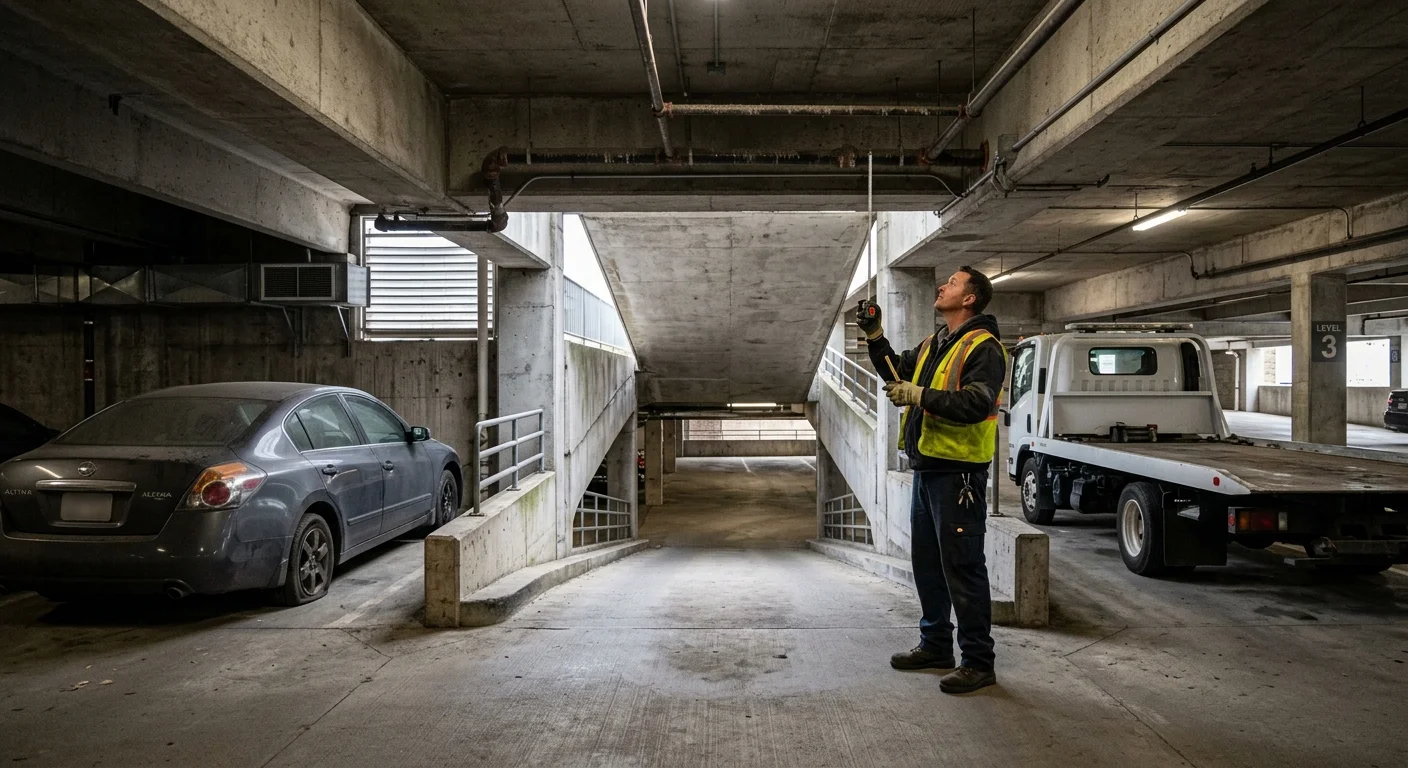
Share the garage entrance and vehicle location
Start with the full property address, but don’t stop there. A garage may have several entrances, and only one may reach your level. Give the entrance street, garage name, level, section, and nearest marker. Include the stall number if one is posted.
Describe the location as if the operator has never visited it. “Level four, blue section, beside elevator bank B” is more useful than “near the back.” If access begins on Lower Wacker, say that directly. A street-level pin elsewhere in the Loop may not identify the correct entrance.
The same principle applies outside downtown. In Schaumburg, Naperville, Aurora, or Oak Brook, include the building name and access road. For an O’Hare-area garage, identify whether the entrance belongs to a hotel, office, rental facility, or parking property. Don’t assume the property name alone identifies the correct gate.
Send current photos when possible. Useful views include the entrance, posted clearance, ramp, gate, car, and space around it. Remove readable personal information from the frame. A short video can also show the full path between the entrance and the vehicle.
Tell dispatch whether an attendant or property manager controls access. Share instructions for reaching the gate, but don’t send private access codes unless the operator requests them through an appropriate channel.
If the car has disappeared rather than broken down, treat that as a different problem. Chicago says a missing vehicle may have been relocated or impounded. Check the city’s Find Your Towed Vehicle tool before requesting parking garage vehicle recovery.
Measure or confirm available clearance
Low clearance towing begins with the posted entrance height. Photograph the sign and type the number into your message. Don’t rely on memory or describe the garage as merely “low.”
The entrance sign is only one part of the route. Look for additional posted limits between the entrance and the car. Tell the operator about overhead pipes, signs, beams, lights, hanging gates, or other fixed objects along that path. Report what you can observe without guessing at unmarked measurements.
Clearance also needs context. Say whether the car is on the entry level, underground, or above grade. Explain whether the route rises, drops, or crosses a steep transition. A setup that reaches the entrance still needs a workable path to the vehicle and back out.
Include anything that changes the car’s profile. Roof racks, cargo boxes, open hatches, lowered suspension, collision damage, and flat tires all belong in the description. Give the car’s year, make, model, and approximate parking position.
A flatbed isn’t automatically the answer for every garage. A wheel-lift isn’t automatically suitable either. Review our flatbed towing service and wheel-lift towing service pages to understand the request categories. Then let the operator compare the garage and vehicle details with the equipment being considered.
Our guide to flatbed or wheel-lift towing explains the broader choice. Garage access adds another layer because the truck must first reach the car. No general article can confirm fit for a specific structure.
Describe whether the car can roll and steer
Tell dispatch exactly what the car can do. Can it roll freely? Can the front wheels turn? Does the steering wheel move? Does the parking brake release? Are the keys present? Clear answers help an operator plan before entering the garage.
Don’t turn an uncertain answer into a yes. If the battery is dead and you can’t check the controls, say that. If the shifter won’t leave park, report the displayed gear and what happened when you tried. If a wheel is locked, bent, flat, or pressed against a curb, include that detail.
Explain why the car stopped. A no-start condition differs from collision damage, broken suspension, lost keys, or a vehicle resting against a wall. Report visible leaking fluid without identifying it unless you know what it is. Photos of the wheels and the open space around the car can help the operator assess positioning.
For an electric, hybrid, all-wheel-drive, modified, exotic, or classic vehicle, send the exact model and configuration. If you have the owner’s manual towing instructions, keep them available. The operator should review the vehicle requirements while choosing the setup.
Also describe the final parking position. A car pulled straight into a space presents different information than one backed in or parked beside a column. State which end faces the travel lane. Note whether another vehicle blocks direct access.
The goal isn’t to diagnose the failure over the phone. It’s to give the operator an accurate picture. “The car starts but won’t shift” and “the car is completely unresponsive” point to different planning questions, even when both vehicles occupy the same stall.
Explain ramps, turns, gates, and blocked access
Walk through the access route in order. Start at the usable entrance, then describe every ramp, turn, gate, and level change before the car. Mention sharp corners, narrow lanes, ticket arms, speed bumps, columns, dead ends, and one-way aisles.
Next, describe the space around the vehicle. An open drive aisle offers different options than a stall boxed in by cars. Say whether the space ahead, behind, and beside the car is open. Include any wall, curb, post, loading dock, or parked vehicle that limits positioning.
Loading space matters too. Tell dispatch whether the property has an outdoor drive, service area, or other location where the car could be transferred after leaving the covered section. Don’t assume the street outside can serve that purpose. Ask the garage manager where an operator may stage and whether any gate must remain open.
Confirm how entry will work. Some properties require an attendant, validation, resident access, or management approval. If a ticket arm, locked gate, or height bar blocks the entrance, explain who controls it. An operator shouldn’t arrive with access details still unresolved.
Be clear about who requested the tow. A vehicle owner seeking help for a disabled car isn’t the same situation as property management ordering an unauthorized vehicle removed. In Cook, DuPage, Kane, and Will counties, private-property relocations are performed by commercial vehicle relocators licensed by the Illinois Commerce Commission. The ICC relocation towing page explains that regulated process.
This distinction matters inside shared residential, office, hospital, and retail garages. If management ordered the removal, say so before dispatch. If you own or control the disabled vehicle, have proof of that relationship ready when the operator asks.
Confirm the equipment plan before dispatch
Before anyone is dispatched, review the complete request. Confirm the entrance, level, clearance, access route, vehicle condition, available space, and destination. Correct anything that changed while you waited, including a newly parked car blocking the aisle.
Ask the operator to state the proposed setup. The answer may depend on information that isn’t visible from one photo. Be ready for follow-up questions about wheel position, steering, drivetrain, keys, damage, and the route to an open loading area.
Use a compact read-back:
- Exact garage entrance and vehicle level
- Lowest posted clearance along the route
- Ramp, turn, gate, and aisle restrictions
- Whether the car rolls, steers, shifts, and releases its brake
- Visible wheel, tire, suspension, or collision damage
- Open space around the car
- Property access or staging instructions
- Vehicle destination after it leaves the garage
If any answer remains unknown, label it unknown. That’s better than choosing a truck around an assumption. The independent operator makes the final equipment decision based on the information available and conditions at the property.
Price works the same way. Quick Tow Chicago doesn’t set towing prices. The operator quotes the price before dispatch, based on the request and proposed setup. Confirm what the quote covers before the truck rolls.
A general search for a tow truck near you in Chicago may find nearby options, but proximity doesn’t answer the garage-fit question. Give the operator the full checklist before agreeing to dispatch. That conversation helps identify mismatches while the truck is still outside the structure.
When to call us
Call once the car can’t leave under its own power and the garage access needs an operator’s assessment. The line takes calls 24/7, and calls are recorded after a notice; we match the request with an independent local operator who confirms the setup and quotes the price before dispatch. Call us at (773) 830-6930.