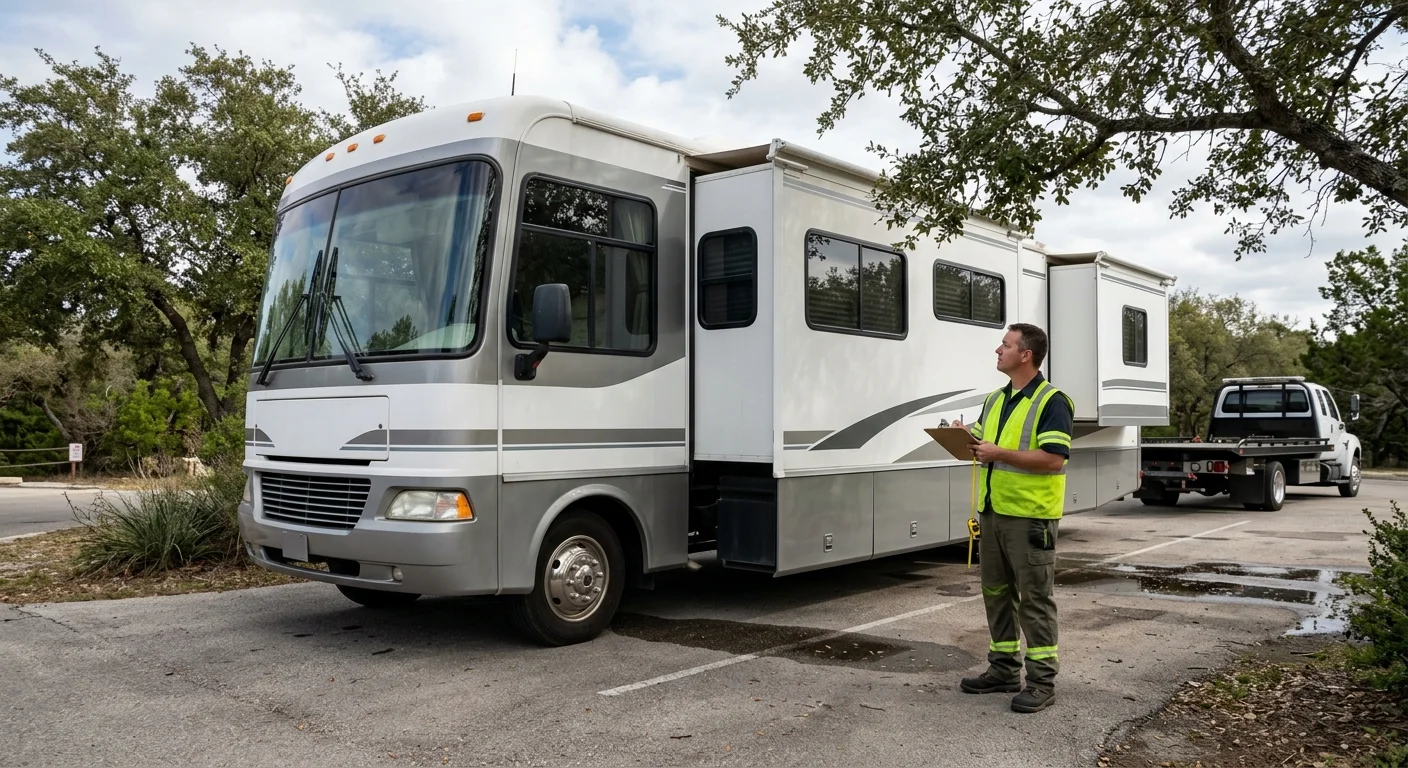
The slide room is still out, and the coach will not pull back to travel width. You are sitting in a campground near Joliet, a driveway in Naperville, or a shoulder off the Stevenson, and you need a straight answer on whether it can still be moved. Some coaches can be transported with a slide extended. Some cannot. The operator who shows up has to decide from the real dimensions, the route, and what the manufacturer says.
Stop before trying to move the RV
Don’t roll the coach. Don’t try to squeeze past a light pole on a Forest Preserve loop. Don’t creep it down a Naperville side street hoping the room will tuck itself in. An extended slide changes the width of the vehicle. Chicago-area streets, campground loops, and warehouse yards were not laid out for that extra footprint.
If you are on an expressway shoulder, stay with the coach if that is the safer choice. Keep people out of the live lanes. The Kennedy, the Dan Ryan, the Eisenhower, the Stevenson, and I-80 south of Joliet all run fast, even at odd hours. IDOT’s Chicago-area Emergency Traffic Patrol, the crews people call Minutemen, patrol those roads. They set up emergency lane closures and warn approaching traffic. They do not repair vehicles and they do not tow them away. A breakdown still needs an operator lined up for the actual move.
If you are in a private lot, a village street, or a city arterial, leaving the slide out can turn a mechanical problem into a parking problem. Those are different legal tracks. A City of Chicago tow goes to a city pound under Municipal Code 9-92-080. The city’s Common Towing Questions page publishes a $250 tow for a vehicle under 8,000 pounds and $350 at 8,000 pounds or more, plus storage of $50 or $100 a day. A motorhome often sits in the heavier band. Confirm the current figures on that city page before you pay anyone at a pound. A suburban village impound follows that village’s own administrative fee. We could not confirm a dollar figure for any suburb in this metro. A private-property relocation in Cook, DuPage, Kane, or Will County is performed only by a commercial vehicle relocator licensed by the Illinois Commerce Commission under 625 ILCS 5/18a. Quick Tow Chicago is a referral service. We take the call and match you with an independent local operator. We do not own trucks, we do not run a yard, and we do not perform relocations.
From December 1 through April 1, the city also runs a Winter Overnight Parking Ban on 107 miles of arterial street from 3am to 7am, snow or no snow. A separate two-inch ban covers another 500 miles of main street once two inches of snow sit on the pavement. An over-width coach sitting on those routes is a parking problem as well as a mechanical one. Stay put, get photos, and pull the owner’s manual if you can reach it without stepping into traffic. Then call so we can pass a real picture to an operator.
Document the slide-out position and surrounding clearance
Take photos from the front, the rear, and both sides. Shoot the slide itself, then step back and show the whole coach against whatever sits next to it. Note which room is out: living, kitchen, bedroom, or more than one. Say how far the room sticks past the body. You do not need a shop measurement. A tape from the ground, taken from a safe spot, is enough for the call. If you cannot measure without standing in a lane on the Dan Ryan, skip the tape and send the photos.
Name the obstacles. Trees, lamp posts, parked cars, garage overhangs, campground pedestals, fence lines, and low wires all matter. An operator cannot plan a path they cannot see. Tell us the surface too: dry asphalt, wet concrete, gravel, grass, packed snow, or ice. O’Hare’s climate normals put annual snowfall at 38.4 inches, with 121.3 nights at or below 32F and 6.5 nights at or below 0F. Slide seals and rams get stiff in that cold. Ice piled against the room is part of the job description, not a footnote.
Say whether the coach is on a slope, in a tight driveway in Cicero or Berwyn, or sitting across a drive aisle in a Joliet truck-stop lot. Say whether you can leave it where it is overnight. That is not a promise about storage. It is a fact about the scene. If a property manager is circling, say so. If the coach is already tagged, say so.
Do not start taking the room apart. Do not brace it with lumber from the campground fire pit. Do not crawl under the slide while it is loaded. Document it, then wait. The photos you send are what let an operator decide whether they can even approach.
Report the RV’s dimensions and mechanical condition
The call needs the coach, not a nickname. Say motorhome or trailer. If you know the class, say Class A, Class B, or Class C. If it is a fifth-wheel or a travel trailer, say that. Give length, stored width, height, and the GVWR from the door sticker if you can read it. Do not round down. An extra foot of length changes the truck an operator brings. We do not publish equipment limits here because we do not own the trucks, and no single figure on this site has been verified for every coach.
Tell us what still works. Does the engine crank. Do the brakes hold. Are the tires up. Is the hitch intact. Do you have the keys. A dead coach and a coach that can roll onto a bed are different jobs. If a tire is already down, say that too. A stuck slide plus a blown trailer tire is two problems, and the operator needs both. We have a separate walkthrough on travel-trailer tire failure and when roadside help is enough.
A regular wrecker is often the wrong tool for an RV even with the slides in. That is the whole point of whether a regular tow truck can move an RV or trailer. With a room still out, the operator has to match the method to the actual width, not to the brochure width. We line up RV towing through independent operators. The method is theirs. The price is quoted before the truck rolls. There is no published rate on this site, and there is no arrival window we can promise, because Quick Tow Chicago does not hold a fleet to measure.
If the only issue is power to the slide, and the coach is otherwise ready to travel, roadside assistance may be the first call. That still is not a repair lesson. Do not start jumping circuits from a forum post. The owner’s manual is the first document. The operator is the second. We are the referral in between.
Confirm manufacturer guidance and the operator’s plan
Open the owner’s manual to the slide and transport sections before anyone hooks up. Some makers forbid moving the coach with a room extended. Some allow it only with extra support or a specific transport method. We could not confirm a single Illinois statute or City of Chicago rule that answers this. There is no number in our claims ledger for clearance, tongue weight, or how far a slide may stick out on a public road. If it is not in the manual in your hand, treat it as unconfirmed.
Tell the operator what the manual says, in the manual’s words. If you cannot find the book, look up the make, model, and year and have that ready. The operator still has to inspect the coach. A PDF on your phone does not replace what they see on the ground in Elk Grove, Tinley Park, or a lot off I-88.
Do not force the room. Do not cut a hydraulic line. Do not ask anyone to close it by yanking on the wall. Those are repair jobs, and this page is not a repair guide. If the operator says the coach cannot move safely with the room out, that is the answer for this scene. Shopping for someone who will ignore the manufacturer is how coaches get torn up on the Bishop Ford.
The plan you should hear back is specific: how they intend to support the room, which roads they will use, and where they will take it. If that plan is vague, ask again before you accept the quote. The number you hear on the phone is the number that belongs on the invoice. We dispatch the operator. We do not set the method, and we do not set a price later.
Choose an accessible repair or storage destination
A stuck slide is only half the job. The other half is a place that can actually receive an over-width coach. Call the shop, the dealer, or the storage yard before the truck rolls. Ask about the gate width, the turning radius into the lot, overhead lines, and whether they will take a coach with a room extended. A bay that fits a travel-width motorhome may not fit the same coach with a living room hanging off the side.
Downtown alleys, the Lower Wacker approach, and tight blocks in Pilsen or Little Village are poor destinations for this. So are many indoor shops. Collar-county lots along I-55, I-80, and the industrial park in Elk Grove Village against O’Hare tend to have more room, but that is a question for the destination, not a rule we can publish. Joliet sits next to the largest inland port in North America. The freight yards there are built for big equipment. Your storage facility in Aurora or your driveway in the city may not be.
If home is the plan, walk the last two turns yourself. Look at tree limbs, basketball hoops, parked cars, and the angle into the drive. Send those photos with the rest. If the coach cannot fit at home with the slide out, pick a holding lot that can, then deal with the slide as a shop job later.
If the coach is already tagged or gone, that is no longer a breakdown move. Start with the city’s Common Towing Questions page for pound rules, fees, and the difference between an impound and a relocation. Call us for a disabled coach that is still sitting where you left it.
When to call us
When the slide will not retract and the coach has to leave that spot, this is no longer a do-it-yourself roll. Stay out of traffic, keep the photos handy, and call. The line takes calls 24 hours a day. A notice plays, then the call is recorded, and we match you with an independent local operator. Call us at (773) 830-6930.