Chicago has four city auto pounds, but only the city lookup can identify where your car went. Start with the Find Your Towed Vehicle tool before driving across town. A missing car may also have been relocated instead of impounded.
Check whether the car was impounded or relocated
The city lookup should be your first stop. Enter the information it requests and check the result carefully. The listed location matters more than the pound nearest where you parked.
Chicago may relocate a vehicle to clear space for street work. The city says emergency work can require relocation without an opportunity to post signs. That means a car missing from a Loop street, a residential block, or a construction zone isn’t automatically inside an auto pound.
The city’s guidance is to check its vehicle search and contact its nonemergency service line before reporting the car stolen. If the search doesn’t return a clear answer, follow the current instructions shown by the city. Save the result and note whether it says impounded or relocated.
That distinction changes your next step. An impounded vehicle must be redeemed from the listed pound. A relocated vehicle may simply be parked somewhere else. Quick Tow Chicago doesn’t control either process or have access to city records.
Don’t send a friend or hired operator toward a pound based on a guess. Confirm the lot first. If the owner can’t go personally, review the rules for when someone else picks up a car from an Illinois impound before anyone makes the trip.
Auto Pound 2 at 103rd and Doty
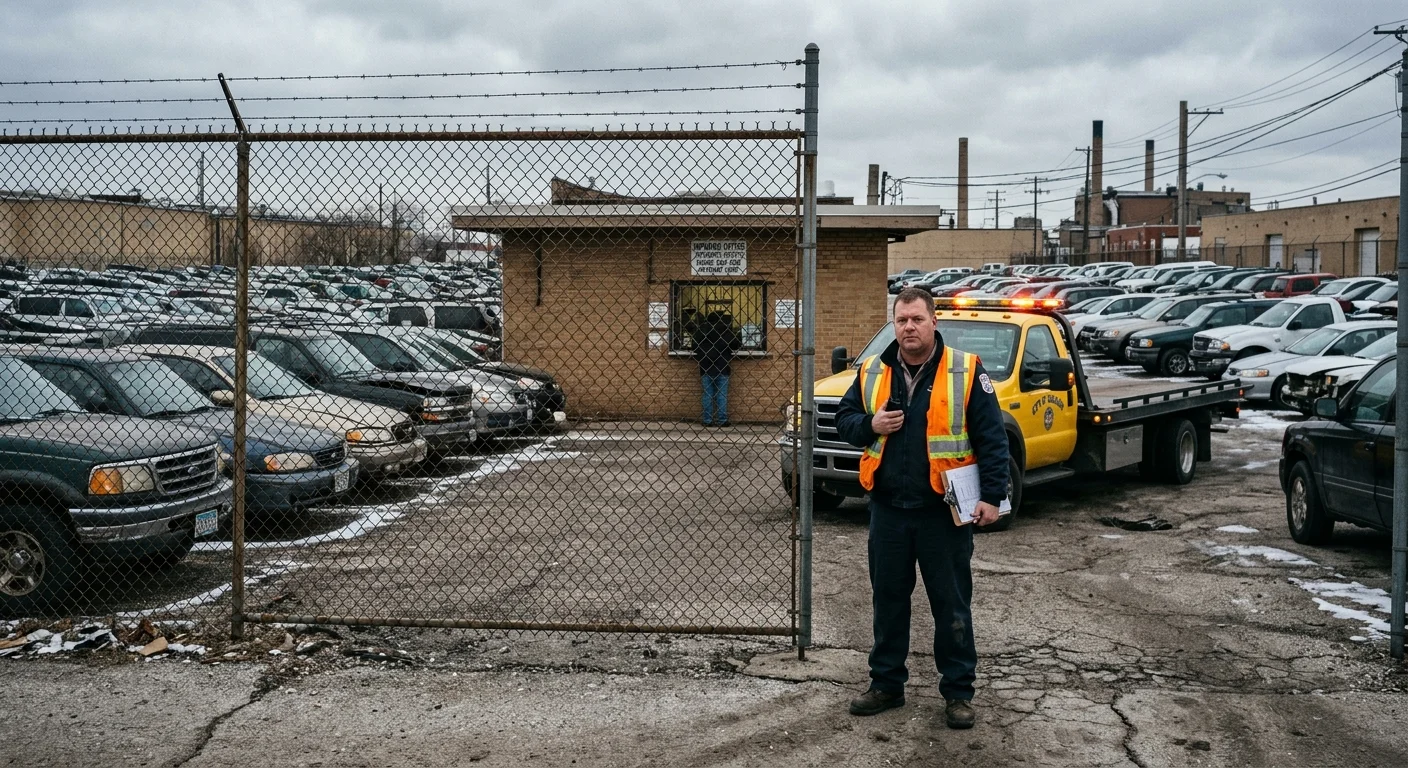
If the city lookup lists Auto Pound 2, the lot is at 103rd Street and Doty Avenue on the South Side. It is one of the four city pounds, not a suburban municipal lot. Use the city’s Find Your Towed Vehicle result as the deciding record. This page does not publish a confirmed direct pound phone number.
Chicago’s four city auto pounds
According to the city’s Common Towing Questions, Chicago operates four auto pounds. All four are open 24 hours a day, every day of the year:
- Central Auto Pound, 500 E Wacker Drive, Lower Level
- O’Hare International Airport Auto Pound, Bessie Coleman Drive
- Auto Pound 2, at 103rd Street and Doty Avenue
- Auto Pound 6, 701 N Sacramento Avenue
The names don’t create a dependable neighborhood map. A car missing near downtown isn’t automatically at Central. Likewise, an O’Hare-area tow shouldn’t be treated as proof that the airport pound has it. Use the city search result as the deciding record.
Central Auto Pound, 500 E Wacker Drive
The Central Auto Pound sits at 500 E Wacker Drive on the lower level, which is the stretch of Lower Wacker Drive under the east end of the Loop. People searching for a Lower Wacker tow are usually looking for this lot. It runs 24 hours a day, 365 days a year, like all four. Being the closest pound to the Loop does not make it the automatic destination for a downtown tow, and a car lifted from a Loop street can end up at any of the four.
Auto Pound 2, 103rd Street and Doty Avenue
Auto Pound 2 is at 103rd Street and Doty Avenue on the far South Side, and it is one of the two lots Chicago names for abandoned vehicles. It is also one of the two that receive vehicles relocated under the winter overnight parking ban. That combination is why a car towed from a North Side arterial in January can end up ninety minutes south of where it was parked. It is open 24 hours a day, every day of the year.
Auto Pound 6, 701 N Sacramento Avenue
Auto Pound 6 is at 701 N Sacramento Avenue on the West Side, and it is the second of the two pounds the city names for abandoned vehicles and for winter parking ban relocations. Like Pound 2, it is open 24 hours a day, 365 days a year. If the city lookup returns Pound 6, bring the redemption documents listed below before making the trip, because the lot will not release a vehicle without them.
O’Hare International Airport Auto Pound, Bessie Coleman Drive
The O’Hare pound is on Bessie Coleman Drive at the airport and runs on the same 24-hour, 365-day schedule. A tow from an airport lot or an airport roadway is the case it exists for. A tow from Rosemont, Des Plaines or another suburb near O’Hare is not a City of Chicago tow at all and will not be at this pound.
Contact the city to confirm which location received a particular vehicle. General questions go to the Bureau of Traffic Services at 312.746.4954, Monday to Friday, 7am to 3pm. If the car was booted before it was towed, the release runs through the Department of Finance rather than the pound, and our guide to how many tickets before you get a boot in Chicago explains that route.
The winter overnight parking ban also sends vehicles to Pound 2 or Pound 6. That ban covers 107 miles of arterial streets from 3 a.m. to 7 a.m., December 1 through April 1, regardless of snowfall. The separate two-inch ban covers another 500 miles of main streets after at least two inches accumulates. Under that second ban, a vehicle may be ticketed or relocated.
Bring the documents the pound requires
Every person claiming the vehicle needs valid photo identification. The owner must also show proof of ownership. Chicago accepts a valid title, a current registration card, or a bill of sale no more than 30 days old.
A lessee should bring the lease agreement. Someone acting for the owner needs an original notarized letter from that owner. If the claimant plans to drive the car away, that person also needs a current valid driver’s license.
Chicago won’t release a vehicle without current state plates. A Chicago Vehicle Sticker is also required when it applies to the vehicle. All charges and fines must be paid in full before release. A police investigation hold can prevent release even when the claimant has the documents and payment ready.
Some holds can’t be cleared at the pound. These include holds connected with narcotics, firearms, DUI, drag racing, fleeing and eluding, fireworks, and suspended or revoked licenses. Those matters go through the Vehicle Impoundment Office at 400 W Superior Street. Booted vehicles follow the Department of Finance process.
Check the city’s current instructions before leaving home. The owner name, representative documents, vehicle status, and hold type can each change what happens at the window. A complete folder is easier to manage than trying to retrieve a missing title, lease, or notarized letter after reaching the pound.
Understand the two city fee schedules
Chicago publishes a general auto-pound schedule under Municipal Code 9-92-080. The tow fee is $250 for a vehicle under 8,000 pounds and $350 for one weighing 8,000 pounds or more. Storage is $50 per day below 8,000 pounds and $100 per day at or above that weight.
The pounds accept cash, Visa, Mastercard, Discover, American Express, and Diners Club. Checks and money orders aren’t accepted. These are City of Chicago charges, not prices set by Quick Tow Chicago or an independent operator.
Chicago publishes a different schedule for winter parking-ban tows. The city’s Winter Snow Parking Restrictions page lists a minimum $150 towing fee, a $60 ticket, and $25 per day for storage. Those figures belong only to that city page and that stated situation.
Don’t combine the winter figures with the general schedule. Ask the pound which city action applies to your vehicle and confirm the current balance before paying. Our guide to City of Chicago impound fees explains the difference in more detail.
Any separate transport after release is a different service. An independent operator sets that price. Quick Tow Chicago provides the quote before an operator is dispatched.
Don’t apply Chicago rules to a suburban or private tow
The Chicago auto-pound system is one of three towing regimes in the metro. The other two are suburban municipal impounds and private-property relocations. They have different authorities, fees, and procedures.
A City of Chicago tow follows the city pound process. A municipal impound in Cicero, Berwyn, Naperville, Joliet, or another suburb doesn’t use Chicago’s published fee schedule. Each municipality sets its own administrative fee. Illinois law requires that fee to be reasonable and related to administrative and processing costs, but it doesn’t set a dollar cap.
For those municipal impounds, Illinois law provides a right to an administrative hearing. Notice must be sent within 10 days of impoundment. The initial hearing must be scheduled and held no later than 45 days after the notice was mailed. Those rules don’t turn a suburban vehicle into a Chicago pound case.
A private-property relocation is different again. In Cook, DuPage, Kane, and Will counties, that work is performed by commercial vehicle relocators licensed by the Illinois Commerce Commission. It isn’t the same as a police-directed tow or a city impound. Our guide to Chicago private towing laws covers that process.
Quick Tow Chicago is a referral service. We can connect property managers with qualified local relocators, but we don’t perform licensed private-property relocations.
Plan for the release clock and the trip home
Chicago normally stores an impounded vehicle for no less than 21 days from the date the city mails notice to the registered owner. Under Municipal Code 9-92-100(a), the registered owner may request one 15-day extension before the vehicle is sold or otherwise disposed of.
That extension isn’t a general hearing deadline. A separate 15-day hearing-request period applies only to Chicago’s specific vehicle impoundment program covering designated offenses. We couldn’t confirm a general post-tow hearing deadline for an ordinary city tow. Contact the Bureau of Traffic Services through the city’s published page for current instructions.
An unclaimed vehicle may be disposed of or sold at auction. The owner can still owe the related fines and fees. Our guide to what happens when a car remains at a Chicago pound explains that timeline.
Confirm the car’s condition before planning to drive it away. Collision damage, a mechanical failure, or missing keys may mean it needs separate transport after release. Ask the pound what it requires from a hired operator before requesting emergency towing or flatbed towing. The operator decides which equipment fits the vehicle, and the price is quoted before dispatch.
When to call us
Call after the pound confirms release but the car can’t be driven away. The line takes calls 24/7, and calls are recorded after a notice. We can take the details and line up an independent local operator at a price quoted before dispatch. Call us at (773) 830-6930.