You walked back to a stall off Arlington Heights Road, a space on Northwest Highway, or an apartment lot near the Metra station, and the car is gone. Arlington Heights is a Cook County village, so the next call is not a Chicago auto pound by default. Arlington Heights towing splits three ways, and the track you are on decides who has the keys.
Check whether the car left a street, a lot, or a driveway
Start with the ground the car was sitting on. That one fact sorts most “who towed my car Arlington Heights” nights before anyone quotes a fee.
A public street in the village is the village’s world. Overnight parking rules, snow routes, and police-directed tows run through Arlington Heights, not through Municipal Code 9-92-080. That ordinance is the City of Chicago pound schedule. It does not set what this village charges, and it does not name this village’s lot. If the car left a curb on Dunton, Campbell, or a residential block west of IL-53, treat it as a possible village impound until the police or village staff say otherwise.
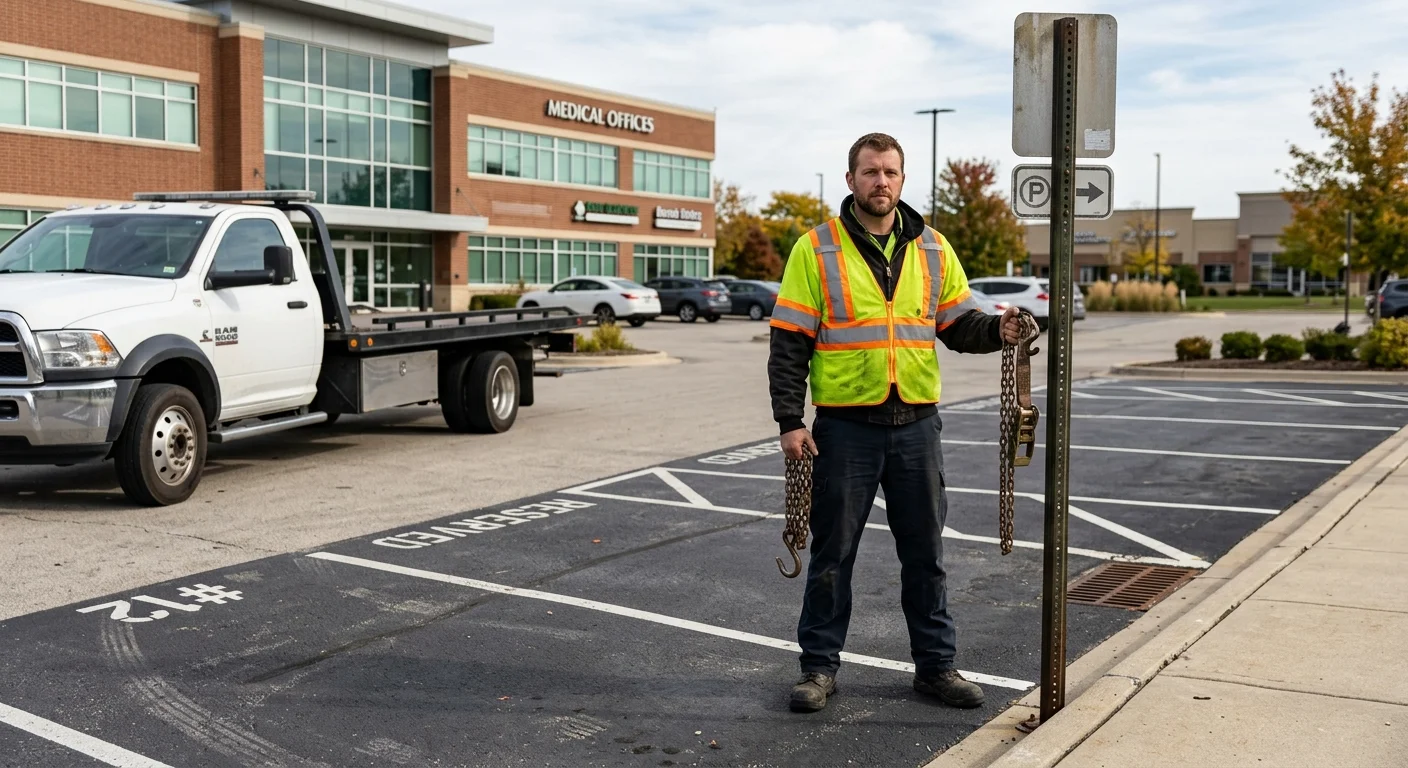
A private lot is a different statute. Shopping centers along Rand Road and Dundee Road, office parks near I-90, and apartment complexes with reserved stalls sit on private property. In Cook County, a commercial vehicle relocator licensed by the Illinois Commerce Commission is the firm that may move a car from that kind of ground under 625 ILCS 5/18a. A driveway on a two-flat or a clearly reserved residential stall still needs that same split: was this a police-ordered street tow, or a property-ordered relocation.
The third track is a breakdown you asked for. A dead battery on the Jane Addams, a flat on US-14, or a stall in a garage is emergency towing you (or a referral line) requested. IDOT’s Emergency Traffic Patrol, the Minutemen, may stop on the expressway to protect the scene. They do not repair the car and they do not tow it away. If you never called for a wrecker, you are not on this track.
Do not start with a theft report. Check the surface, then the signs, then the people who control that surface. If the empty space is actually inside Chicago city limits, use the city’s lookup path in who towed my car in Chicago and the Find Your Towed Vehicle tool. Arlington Heights is not those four city pounds.
Separate a village impound from a private relocation
Towing Arlington Heights IL is not one product. A village impound, an ICC relocation, and a breakdown tow each have their own paperwork, their own lot, and their own bill.
A suburban municipal impound is governed procedurally by 625 ILCS 5/11-208.7. The village may charge an administrative fee that the statute says must be reasonable and related to its processing costs. The statute sets no dollar cap. This site has not confirmed Arlington Heights’ own administrative fee, daily storage rate, lot address, or release hours. Those figures come from the Village of Arlington Heights, not from Chicago’s $250 / $350 tow schedule. Ask the village. Do not pay a Chicago pound price for a northwest-suburb hold.
A private-property relocation is the ICC’s world. Relocators in Cook, DuPage, Kane, Will, and Winnebago counties work under 625 ILCS 5/18a. The law does not apply to cars on public streets, disabled vehicles, repossessions, or police-directed towing. Signs, when required, have to meet 18a-302: at least 24 inches high by 36 inches wide, at least 4 feet off the ground and under 8, illuminated or reflective, with the relocator’s name, address, phone, and the towing charges a parker may face. Residential property clearly reserved for residents does not need that posted notice.
Other relocator rules are in the same chapter. Removal without written authorization from the owner, the person in lawful control, an authorized agent, or an authorized officer is unlawful. A relocator may not take the car if you are present before the removal is finished and you can move it immediately. The firm has to notify law enforcement in the jurisdiction within one hour. The car may not be stored more than 10 air miles from the lot in most places, or 15 air miles from an unincorporated location. If you try the number on the invoice for an hour during the hours the relocator must answer, and you cannot get through after a reasonable effort, all towing and storage fees are waived.
None of that is a City of Chicago pound process. Naperville drivers hit the same three-way split in DuPage County. The method is similar. The village, the lot, and the ordinance are not. Read Naperville private tow or village impound if you need that suburb’s version. Stay on Arlington Heights facts here.
Quick Tow Chicago is a referral service. We line up independent local operators for eligible jobs. We do not hold an ICC relocator licence, we do not run a village lot, and we cannot release a village impound.
Ask the property contact who ordered a lot tow
If the empty stall is in an apartment complex, a store lot, or a garage, the property is the first witness. The management office, the overnight attendant, or the number on the posted sign should be able to name the relocator that got the written authorization. 18a-300(7) makes that authorization the legal trigger. A neighbor’s guess is not.
Look at the sign itself, not a screenshot from another town. The board has to carry the relocator’s identity and the charge a parker may be subject to. Photograph the sign, the stall stripes, the building address, and the time. If the signs required by 18a-302 are missing where the statute requires them, removal from that property is unlawful. That is a complaint fact for the Illinois Commerce Commission relocation-towing desk, not a reason to invent a refund amount.
Ask who ordered the tow, when the truck arrived, and where the car went. Get the relocator’s name exactly as it appears on the truck or the sign. Illinois makes it unlawful to advertise relocation work without the relocator’s licence number in the ad. You want that name on paper before you drive toward Palatine, Rolling Meadows, or Elk Grove looking for a yard that may not have your car.
Drivers sometimes ask about an “80 percent rule” for towing. This site could not confirm any Illinois towing statute, ICC order, or Village of Arlington Heights ordinance that uses an 80 percent test to set a tow bill or to decide whether a car may be moved. Do not treat a blog rumor as the rate. What Illinois does publish, in 625 ILCS 5/3-117.1, is a salvage-certificate trigger when certain damaged vehicles, including some repossessed, fleet, and flood vehicles, are damaged beyond 50 percent of fair market value. That is a title process at the Secretary of State. It is not a village impound fee and it is not an ICC relocation rate.
If you manage the lot and you need a car moved, that is private property towing work for an ICC-licensed relocator. Quick Tow Chicago connects property contacts with operators who hold that licence. We do not relocate the car ourselves.
Confirm retrieval with the village or the relocator, not a guess
Do not drive to 500 E Wacker, 701 N Sacramento, 103rd and Doty, or the O’Hare pound unless you already know the City of Chicago has the car. Those four lots are the city’s auto pounds, open 24 hours. They are the wrong counter for a village tow in Arlington Heights.
Call the Village of Arlington Heights, or the police non-emergency channel the village publishes, and ask whether the car is in village custody. Ask for the lot name, the hours, the documents they want, and the amount due. This site has not confirmed those local figures. A plausible-sounding storage rate is still a fabrication. The village is the authority that sets them.
If the property named a relocator, call the number on the sign or the invoice and confirm the yard. Relocators must accept cash, money orders, cashier’s or certified checks, and major credit cards without extra card fees. You should get a complete Relocation Towing Invoice as a receipt, with complaint instructions on it. No storage charge is assessed after you claim the car, show proper identification, and tender payment. There is no storage fee if you claim it within 24 hours with ID and payment. There are no storage charges for hours or days the relocator is closed to the public. Stolen vehicles cannot be billed for more than 8 days of storage at the daily rate.
People searching “how much will it cost if my car gets towed” often want one number. There isn’t one that covers this village. Our operators quote before dispatch on a breakdown you asked for. The number you hear is the number on that invoice. A village administrative fee is whatever Arlington Heights has set, and it could not be verified for this page. An ICC relocation rate is set by Commission order. A circulating maximum of a few hundred dollars could not be confirmed on any current ICC page, so it is not printed here. Confirm the posted charge on the sign and the invoice in your hand.
Chicago’s own published pound fees are a separate schedule for cars the city towed inside city limits. Under Municipal Code 9-92-080, as listed on the city’s Common Towing Questions page, the tow is $250 under 8,000 pounds and $350 at 8,000 pounds or more, with storage at $50 or $100 per day. Payment there is cash or major card only. Checks and money orders are not accepted. The city’s winter-ban page publishes a different set for those ban tows: a minimum $150 towing fee, a $60 ticket, and $25 per day storage. Those two Chicago lists are not Arlington Heights prices, and they are not our prices.
Save photos and receipts before you challenge the tow
Pay to get the car moving if that is what the lot requires, then keep every scrap. Challenge the process with paper, not with a memory of a sign you did not photograph.
Save the stall photos, the sign face, the authorization story from management, the invoice, and the payment receipt. For a relocator, the complaint path is the Illinois Commerce Commission in Des Plaines, using the instructions printed on the Relocation Towing Invoice and the agency’s relocation-towing page. For a village impound, 11-208.7 gives the owner the right to an administrative hearing. Notice of the impoundment goes out within 10 days. An initial hearing is to be scheduled and convened no later than 45 days after that notice is mailed. If the hearing officer finds the village (or the State Police) impounded a car that was stolen or hijacked at the time, administrative fees already paid are refunded. That refund rule is for municipal administrative fees. It is not a confirmed City of Chicago pound rule, and it is not a promise that every tow is free.
There is no Illinois “30-day impound hold” to wait out. That is another state’s clock. Chicago’s own disposal floor, for city pounds only, is no less than 21 days from the date the city mails notice, plus one 15-day extension under 9-92-100(a). Arlington Heights’ own hold and sale clock was not confirmed here. Ask the village what it uses.
You cannot lawfully skip a valid bill by waiting it out. You can use the one-hour phone rule, the owner-present rule, missing 18a-302 signs, and the hearing rights the statute actually gives you. “How to avoid paying tow fees” as a search is usually one of those four facts, or a car that was never supposed to be moved.
Bring current ID and proof you have a right to the car. Chicago pounds publish a long redemption list. This village’s list is the village’s to state. Do not assume a Chicago Vehicle Sticker is required at an Arlington Heights counter. That sticker is a City of Chicago wheel-tax rule.
When to call us
Call when the car is disabled on I-90, IL-53, Northwest Highway, or a village street, and you need an independent local operator dispatched, or when a property contact needs an ICC-licensed relocator rather than a guess on a group text. Quick Tow Chicago is a referral line. It takes calls 24 hours a day, plays a recording notice, then matches you with an operator. It cannot open a village lot or pull a car from village custody. Call us at (773) 830-6930.