Your engine cuts out on I-55 through Bolingbrook. The shoulder is the only place left to sit. Searching bolingbrook towing doesn’t tell anyone which way you face. It also doesn’t say whether the car still rolls. Dispatch needs a direction, a visible marker, and a place the car can go. That’s how an independent operator gets assigned.
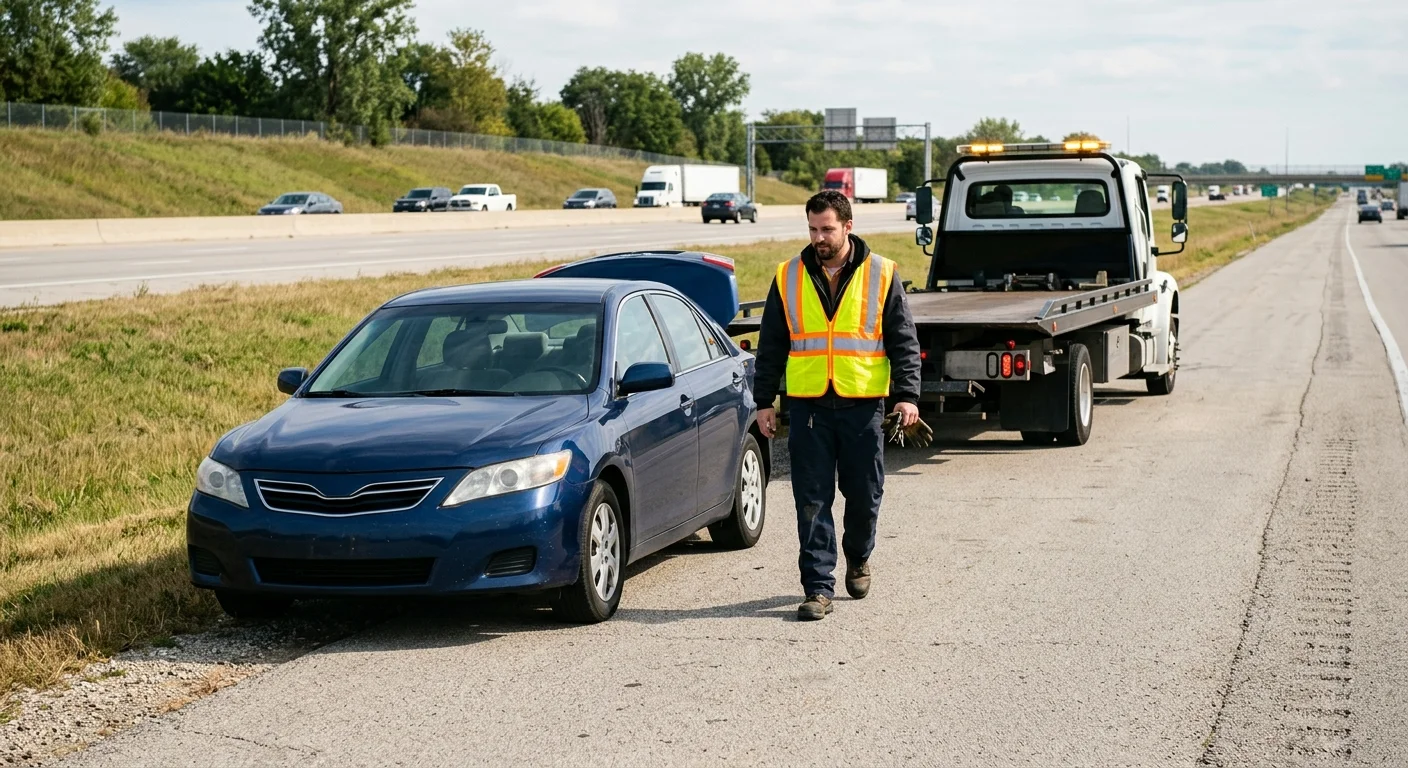
Share your direction and nearest visible location marker
I-55 through Bolingbrook isn’t one pin on a map. Northbound traffic is pointed toward the I-355 interchange, Downers Grove, and Chicago. Southbound traffic is pointed toward Romeoville, Joliet, and the rest of that corridor. An operator who comes in from the wrong side of the I-55 and I-355 junction is staring at the other wall of cars. Say northbound or southbound before you say anything else.
Then name a marker you can read without leaving the seat. Weber Road, Boughton Road, and Illinois Route 53 are the exits most drivers can actually see. Veterans Parkway and Remington Boulevard matter if you already left the mainline. The Promenade, IKEA, and the WeatherTech campus only help if they’re in sight. A mall name with no heading still leaves the truck on the wrong carriageway.
If you’re between the I-355 ramps and Weber, say that pair out loud. If you drifted onto a frontage road, say you’re off the interstate. Right shoulder, left shoulder, and a ramp gore are three different setups. Don’t walk a live lane to hunt a better sign. Read what you can see from where you sit.
Phone GPS helps, and it also lies on this stretch. Pins snap to the opposite direction or to a parallel frontage. Read the pin in one breath: town, road, heading. “Bolingbrook, I-55 south, just north of Boughton” is a location. “I’m on 55” isn’t. If the screen says Woodridge, Romeoville, or 60440 versus 60490, say that too. Those borders sit on the same corridor.
This call isn’t the Chicago expressway call. The city stretch of I-55 is a different set of ramps, and a different legal regime if the city takes the car. We already wrote that mainline version in broke down on I-55 or I-90 in Chicago. Bolingbrook sits in Will and DuPage counties. If your phone offered tow truck near me in Chicago as autocomplete, still start with Bolingbrook and the heading. The metro isn’t one map.
A car breakdown on I-55 in Bolingbrook is usually a disabled vehicle on a public highway. That’s a tow you ask for, unless police take over. It isn’t a private-lot relocation. It isn’t a Chicago auto pound. Keep those three regimes apart or you’ll brief the wrong people.
Contact the proper authority when traffic creates immediate danger
If you’re sitting in a live lane, on a blind curve, or anyone is hurt, that’s 911 first. Tow dispatch doesn’t close an interstate lane. Quick Tow Chicago is a referral service. We take the call and match you with an independent local operator. We don’t own patrol trucks. We don’t run the highway.
Illinois Department of Transportation staffs an Emergency Traffic Patrol on the Chicago-area expressways. Those crews are also called Minutemen. They set emergency lane closures, warn traffic, and protect the people already on scene. They don’t repair your car. They don’t tow it away. IDOT doesn’t publish a public call-out number for that patrol. You reach them by being in a documented incident, usually after 911 or after a state or local unit is already there. Read the agency’s own description on the Emergency Traffic Patrol page.
Don’t stand in a travel lane to flag a truck. Don’t send kids across I-55 to a gas station. If it’s safer to stay belted with the hazards on, stay there. If it’s safer to get out and get behind a barrier, move as a group and keep everyone off the pavement. We won’t script a shoulder walk from a desk. You can see the traffic. We can’t.
Bolingbrook Police and Illinois State Police handle the public roadway. If an officer is already with you, tell dispatch that. An officer on scene changes how the operator stages. It can also mean the car will move under a police-directed tow. That path isn’t the same as a voluntary breakdown call. Private-property relocation rules under 625 ILCS 5/18a don’t apply to disabled vehicles on public streets. They also don’t apply to police-directed towing. That statute is for commercial vehicle relocators licensed by the Illinois Commerce Commission in Cook, Will, Kane, DuPage, and Winnebago counties. Different job. Different license. Different signs.
If the car isn’t on I-55 at all, stop and sort the regime. A lot tow at The Promenade or an apartment complex isn’t this shoulder. A Village of Bolingbrook impound follows municipal process under 625 ILCS 5/11-208.7, not Chicago’s pound schedule. Each suburb sets its own administrative fee. The statute says that fee must be reasonable and related to processing costs. It sets no dollar cap. No Bolingbrook figure is published here because we haven’t confirmed one from the village’s own ordinance. Notice is due within 10 days, and an initial hearing is to be convened no later than 45 days after the notice is mailed. If the hearing officer finds the vehicle was stolen or hijacked when it was taken, administrative fees already paid are refunded. None of that is a City of Chicago pound rule.
Chicago’s published tow and storage fees under Municipal Code 9-92-080 apply inside Chicago city limits only. Don’t use them as a stand-in for a Will County lot. If you later learn the car was taken in the city, use the city’s Common Towing Questions page and the city’s vehicle lookup. That’s a Chicago problem. It isn’t this shoulder.
Describe whether the car can roll or steer
Operators need to know if this is a roll-on, a drag, or a winch. “It just died” doesn’t answer that.
Can you shift to neutral. Does the steering still turn. Do the wheels roll if the car is nudged. Is the transmission locked in park. Is a wheel, axle, or underbody on the ground. Is it all-wheel drive that shouldn’t be pulled on two wheels. Is it an EV that should ride on a flatbed. Say those things in plain words.
A dead battery on a quiet Bolingbrook frontage may only need roadside assistance: a jump, a spare tire, a lockout. A car that won’t roll on the I-55 shoulder is an emergency towing job. Mixing those two is how the wrong truck shows up. Roadside assistance in Bolingbrook still starts with the same location brief. The equipment is the part that changes.
If the engine runs but the car won’t move, say that. If you already tried to limp toward Weber or Boughton and it died again, say how far you got. If a wheel is folded under, say it. If you’re in snow, mud, or a ditch off the paved shoulder, say it.
Once an operator is on scene, the work has a clock of its own. A jump often takes five to ten minutes. A soft-ground winch often takes fifteen to thirty. A deep recovery can take one to two hours. Those are job durations, not arrival promises. This brand doesn’t publish an ETA. It doesn’t own the trucks to measure one.
Don’t crawl under the car to diagnose it for the call. Don’t try to push it back into a live lane. Describe what you can see. Describe what the car will still do.
Size belongs in the same breath. A compact sedan, a crew-cab pickup, a cargo van, and a box truck aren’t the same hookup. If you’re towing a trailer, say so before anyone is assigned. A motorcycle is its own setup. Guessing the truck type from “it’s a white car” is how an operator drives past you at dusk.
Report passengers, vehicle size, and access conditions
Tell dispatch who’s in the car. Children, a person who can’t walk far, a pet, or someone who needs to stay with the vehicle all change staging. If everyone can wait in the car, say that. If a passenger already left in a rideshare, say who remains and who has the keys.
Give the vehicle in one line: color, make, model, and body type. Year if you know it. Sedan, SUV, pickup, van, motorcycle, or something larger. Low-clearance cars and many EVs need a flatbed. A dual-rear-wheel truck may need a heavier unit than a Camry. Quick Tow Chicago doesn’t run a fleet. The independent operators in the network bring the truck that matches the description you give. “White car on I-55” isn’t a description. “Silver Highlander, northbound I-55 shoulder, just south of Weber” is.
Access is the rest of the picture. Right shoulder or left. Behind a concrete wall or on an open grass strip. Under an overpass. In a construction taper. On a frontage road with a curb the truck has to clear. After dark. In rain. In the kind of January night the Chicago climate normals still describe. O’Hare averages 38.4 inches of snow a year, 121.3 nights at or below 32F, and 6.5 nights at or below 0F. Will County logged 13,570 crashes in 2024, 56 of them fatal. DuPage logged 17,323, with 54 fatal. I-55 through Bolingbrook sits in that weather and that volume. None of that’s a reason to stand in the road.
If a plow windrow or a construction barrier is blocking the approach, say it. If there’s only room for one truck, say it. If your hazard lights are dead, say that too. Keep the phone on. If the first description was wrong, call back. A northbound pin that was actually southbound is the classic miss between Bolingbrook and Romeoville.
Choose a safe destination before dispatch
The operator can’t start with “just get it off the highway” as the only address. Pick a destination that can actually take a dead car: a shop that’s open, a driveway you can access, a dealer, a home in Naperville or Romeoville, a lot that won’t ticket a disabled car overnight. Confirm the shop will take a drop after hours. Many won’t.
Quick Tow Chicago doesn’t have a yard. We don’t store vehicles. The independent operator quotes the job before anyone is dispatched. The number you hear on that quote is the number that belongs on the invoice. There’s no published minimum for a tow truck in Bolingbrook IL on this site. There’s also no Illinois-wide typical fee we can print. No partner rate card is on file, and the ICC maximum relocation rate couldn’t be confirmed from a Commission source. City of Chicago pound fees are a different schedule under Municipal Code 9-92-080. They don’t apply to a Bolingbrook breakdown. Don’t use them as a stand-in.
If you want the car at a specific shop in Bolingbrook or Naperville, name it. If you don’t have a shop, say so. The operator can still quote a drop at a location you choose. What we won’t do is invent a cheap package or a free estimate. We won’t offer to hold the car at “our lot.” There is no lot.
Mileage is real even when a dollar figure isn’t. A short hop off I-55 isn’t the same job as a drop in the city. If the destination is downtown Chicago, you’re leaving Will County and entering a different street grid. Say that up front so the quote matches the trip.
Once the destination is set, stay put unless an officer tells you to move. Changing the drop after the truck is assigned means a new quote. Have a payment method the operator can actually take. Ask on the recorded call, before anyone rolls.
When to call us
If the car won’t roll to a safe lot on its own, this is no longer a wait-and-see. Call when you have a direction, a marker, a yes or no on rolling, and a destination in mind. The line takes calls 24 hours a day. A notice plays, then the call is recorded, and an independent local operator is dispatched from there. Call us at (773) 830-6930.