Illinois law bars private-property relocators from towing without required signs and written authorization. It also controls removal distances, police notice, charges, storage, and what happens when an owner appears before the tow is complete. Those protections don’t govern every tow around Chicago, so first identify who ordered the removal.
Which towing rules apply
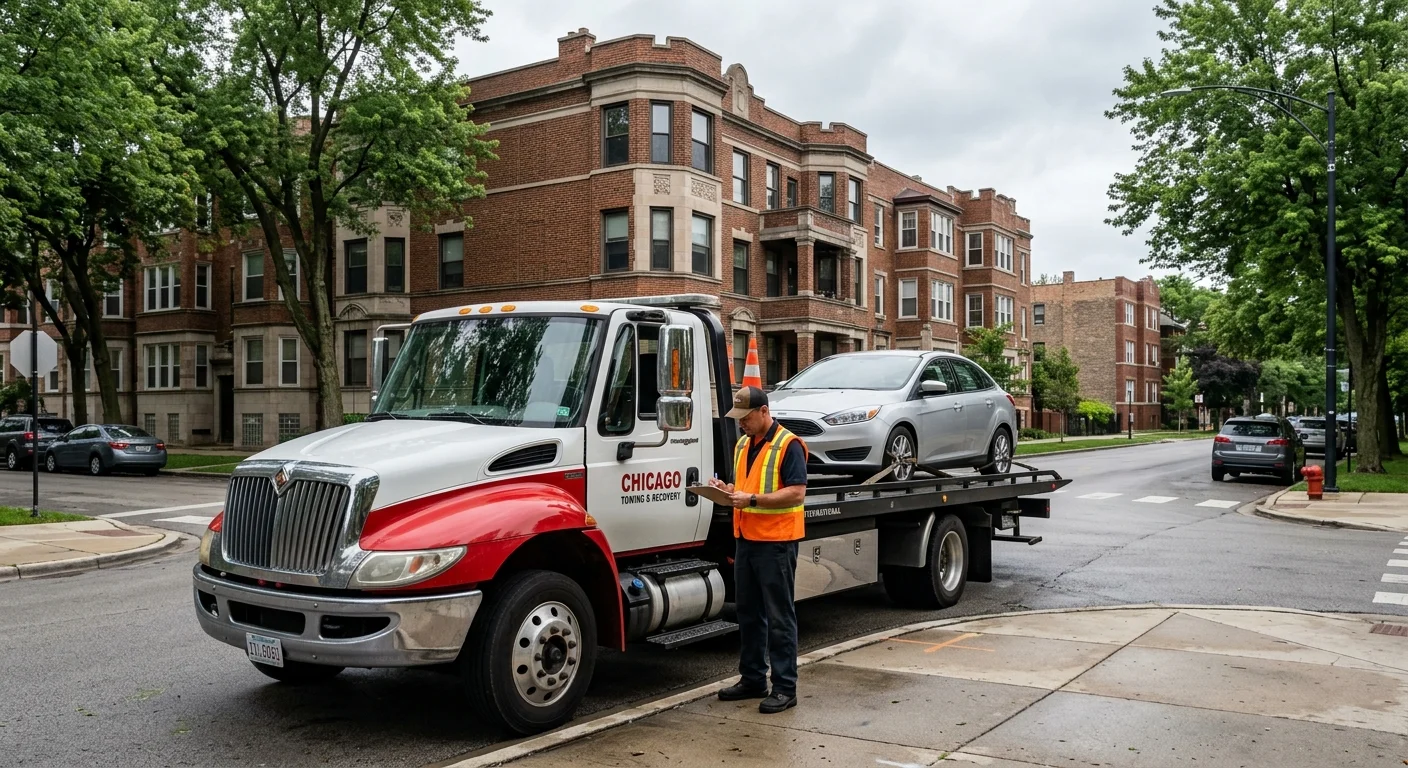
The Chicago area has three separate towing systems. Applying the wrong rules can derail a valid complaint.
A private-property relocation starts on property such as a shopping center or private parking lot. In Cook, DuPage, Kane, and Will counties, that work must be performed by a commercial vehicle relocator licensed by the Illinois Commerce Commission. Chapter 18a doesn’t cover vehicles on public streets, disabled vehicles, repossessions, or police-directed towing.
That means a breakdown on the Kennedy or Dan Ryan isn’t a private-property relocation. It’s a roadside service requested by the driver, police, or another authorized party. Our emergency towing service matches stranded drivers with independent local operators.
A suburban municipal impound is different. A village or another government body orders that removal. State law supplies hearing and notice rules, but each municipality sets its own administrative fee.
The City of Chicago operates another pound system inside city limits. A vehicle may also be relocated, rather than impounded, when a street must be cleared for agency work or an emergency. The city’s Common Towing Questions page explains that distinction.
Start with three facts: where the vehicle sat, who ordered the tow, and where it went. Our guide to Illinois towing laws gives more context for each track.
What a private-property relocator may not do
Illinois doesn’t label every disputed removal “predatory towing.” Instead, 625 ILCS 5/18a-300 identifies specific unlawful practices for commercial vehicle relocators.
A relocator may not remove a vehicle without written authorization. That authorization must come from the property owner, a person controlling the property, an authorized agent, or an authorized law enforcement officer.
A relocator also may not remove a vehicle from an area requiring signs when the proper signs aren’t posted. Each sign must be conspicuous and measure at least 24 by 36 inches. It must sit at least four feet, but less than eight feet, above the ground. It must be illuminated, reflective, or both.
The sign must identify the relocator and show its address, telephone number, and towing charge. Clearly reserved residential property has a limited exception from the express notice requirement.
For most vehicles, removal must stop when the owner or operator appears before it is complete and can move the vehicle immediately. A narrow exception covers certain CDL vehicles. It may permit a service fee of no more than one-half the posted towing rate per tow vehicle, with a limit of two tow vehicles.
The relocator must notify law enforcement in the jurisdiction within one hour after removal. It also can’t move the vehicle more than 10 air miles from most locations. The limit is 15 air miles when removal begins in an unincorporated area.
Advertisements must include the relocator’s license number. Tow trucks must display the relocator’s name, address, and telephone number on both sides in contrasting colors.
Charges, storage, payment, and pickup
The Illinois Commerce Commission sets private-property relocation rates. A current maximum relocation rate could not be confirmed from the Commission’s published guide, regulations, or statute. Check the ICC Relocation Towing page before relying on a figure found elsewhere.
Illinois rules still provide several clear protections at pickup. A relocator can’t assess a storage fee when the vehicle is claimed within 24 hours, provided the owner shows proper identification and tenders payment.
Storage also can’t be charged for days or hours when the facility is closed to the public. Once the vehicle is claimed, identification is produced, and payment is tendered, additional storage charges must stop.
Relocators must accept cash, money orders, cashier’s checks, certified checks, and major credit cards. They can’t add another fee merely because a customer uses a major credit card.
The owner must receive a complete Relocation Towing Invoice. It serves as the receipt and must contain complaint instructions. The relocator must also provide the relevant statutes, regulations, and ordinances in the written form required by Commission rules.
Keep a record of every attempt to contact the storage facility. If an owner makes a reasonable effort but can’t reach the relocator for one hour during a period when it must answer, all towing, storage, and related fees must be waived.
For more on the distinction between allowed charges and unverified online figures, read how much a tow company may legally charge in Illinois.
City and suburban impounds follow different rules
A City of Chicago tow isn’t governed by the private-property relocation rules above. The city’s regular pound schedule under Municipal Code 9-92-080 lists a $250 tow fee for vehicles under 8,000 pounds and $350 for heavier vehicles. Storage is $50 or $100 per day, depending on that same weight threshold.
Those are city charges, not Quick Tow Chicago prices. They’re also not suburban impound fees. The city’s winter parking restriction page publishes a different fee set for parking-ban tows, so the two schedules shouldn’t be combined.
Chicago has four auto pounds, all open around the clock. Vehicle release requires valid photo identification, proof of ownership, and full payment of applicable charges and fines. Current state plates and a Chicago Vehicle Sticker are also required where applicable. A police investigation hold can prevent release.
Chicago normally stores a vehicle for no less than 21 days after notice is mailed to the registered owner. The owner may request one 15-day extension before sale or disposal. That extension isn’t a hearing request.
A general hearing deadline for an ordinary Chicago tow could not be confirmed. The verified 15-day hearing window applies only to Chicago’s separate 19-offense impoundment program. Drivers with an ordinary city tow should confirm the current process with the Bureau of Traffic Services.
Suburban municipal impounds follow 625 ILCS 5/11-208.7. An administrative fee must be reasonable and related to processing costs, but the statute sets no dollar cap. Notice must be sent within 10 days. An initial hearing must be scheduled and held within 45 days after that notice is mailed.
How to challenge a suspected predatory tow
Document the scene before signs or vehicles move. Photograph every entrance, the full parking area, and each posted towing sign. Capture the sign’s height, lighting, wording, relocator information, and listed charge.
Write down when you discovered the removal. Save call records, messages, receipts, and the complete Relocation Towing Invoice. If you arrived while the vehicle was still being removed, record what stage the operator had reached and whether you offered to move it immediately.
Ask which person authorized the removal. Don’t assume a property employee had authority merely because that person was nearby. Written authorization is one of the law’s required protections.
For a private-property relocation, complaints go to the Illinois Commerce Commission. Its relocation towing page provides consumer guidance and the complaint form. Our guide to who regulates Illinois towing companies explains when the Commission, a municipality, or Chicago handles the issue.
For a suburban municipal impound, use the hearing procedure named in the notice. State law gives the vehicle owner a right to an administrative hearing. It also requires a refund of administrative fees already paid when the hearing officer finds the vehicle was stolen or hijacked when impounded.
Don’t use the private-property process for a city pound dispute. Likewise, don’t apply Chicago’s fees or pound rules to Berwyn, Cicero, Naperville, Joliet, or another suburb. Each system has its own authority and paperwork.
When to call us
If the vehicle is disabled or in a dangerous position, the situation has moved beyond paperwork and needs an operator. Quick Tow Chicago can line up an independent local operator, the line takes calls 24/7, and calls are recorded after a notice. Call us at (773) 830-6930.