Illinois towing and storage laws don’t create one statewide price list. What you owe depends on whether Chicago impounded the vehicle, a suburb ordered the tow, or a licensed relocator removed it from private property. Identify that system first, then check each charge against its rules.
Start by identifying the towing system
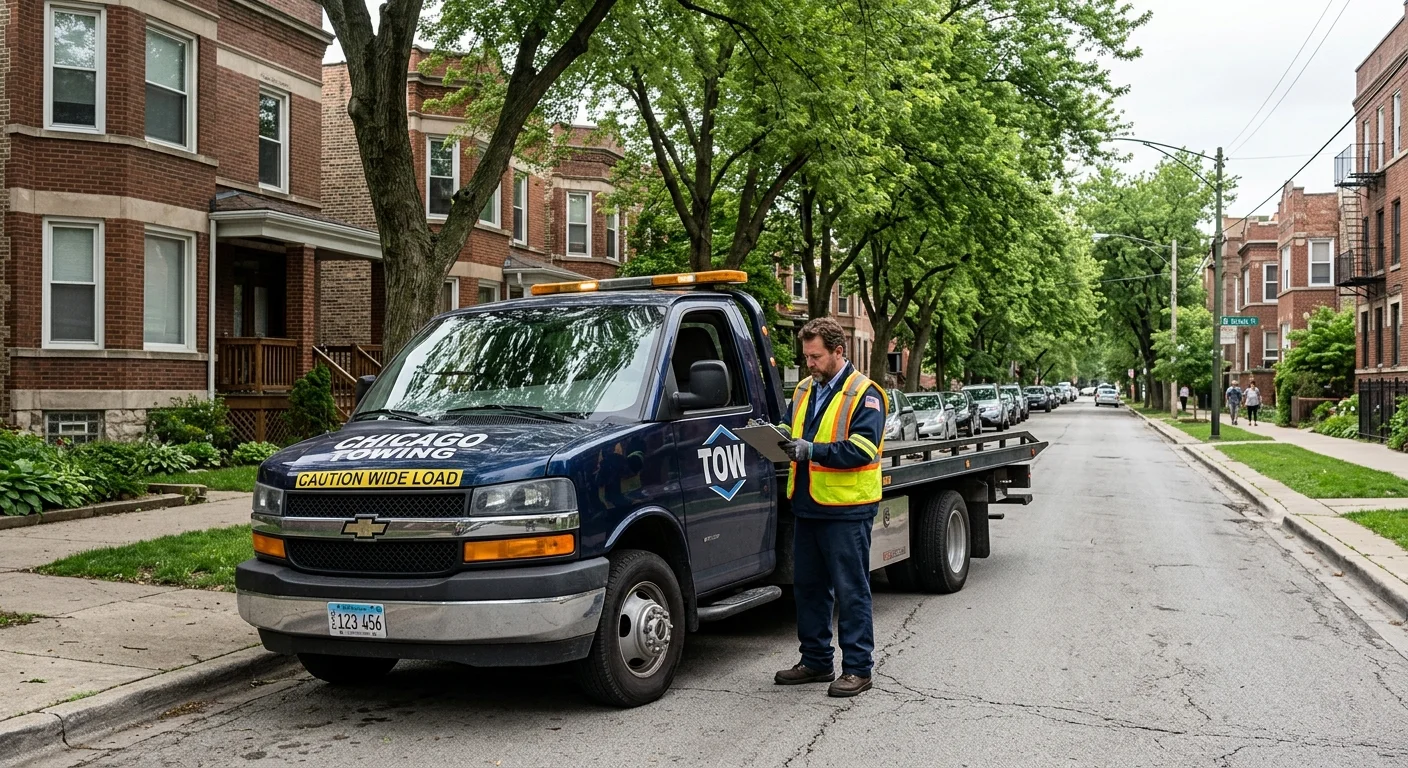
Chicago drivers deal with three separate towing systems. Each has different fees, storage rules, payment methods, and dispute procedures.
A City of Chicago tow goes through the city pound system. This includes vehicles removed from public streets and vehicles impounded under certain city programs. Chicago publishes its standard pound fees and operates four auto pounds.
A suburban municipal impound works differently. Berwyn, Cicero, Naperville, Joliet, Schaumburg, and other municipalities set their own administrative fees. Chicago’s pound schedule doesn’t apply outside Chicago city limits.
A private-property relocation is the third system. This usually involves a vehicle removed from an apartment lot, shopping center, office property, or another privately controlled location. In Cook, DuPage, Kane, Will, and Winnebago counties, that work falls under Illinois Commerce Commission regulation.
Your paperwork often identifies the system. Look for the agency ordering the tow, the location where the vehicle was parked, and the company holding it. A public-street tow in Pilsen isn’t governed like a private-lot removal in Oak Brook.
A missing car may also have been relocated for street work instead of impounded. Chicago advises drivers to use its vehicle lookup and contact 311 before reporting the car stolen. Our guide to Illinois towing laws explains these categories in more detail.
Private-property towing has separate storage protections
Private-property relocations in Cook, DuPage, Kane, Will, and Winnebago counties must be performed by commercial vehicle relocators licensed by the Illinois Commerce Commission. These rules don’t cover public-street tows, disabled vehicles, repossessions, or police-directed towing.
Illinois law requires written authorization from the property owner, lawful occupant, authorized agent, or law enforcement officer. When signs are required, they must be conspicuous, reflective or illuminated, and measure at least 24 by 36 inches. They must sit at least four feet but less than eight feet above the ground. The sign must identify the relocator and state the towing charge.
The relocator can’t complete the removal if the owner arrives before it’s finished and can move the vehicle immediately. The law also limits how far a vehicle may be relocated. The limit is 10 air miles from most locations and 15 air miles from an unincorporated location. Law enforcement in that jurisdiction must be notified within one hour.
Storage protections can make a major difference. No storage fee may be charged when the vehicle is claimed within 24 hours with proper identification and payment. Relocators also can’t charge storage for days or hours they’re closed to the public. Storage stops accruing after the vehicle is claimed, identification is produced, and payment is tendered.
Relocators must accept cash, money orders, cashier’s or certified checks, and major credit cards without an added fee. The owner must receive a complete relocation towing invoice with complaint instructions.
Illinois also has a narrow telephone-contact rule. After a reasonable effort, if the owner can’t reach the relocator for one hour during required response hours, all towing and storage fees must be waived. These requirements appear in 625 ILCS 5/18a-300.
A current maximum ICC relocation rate could not be confirmed from the published sources reviewed. Ask the Illinois Commerce Commission for the current Commission-set rate before accepting an unsupported number. See our guide to who regulates Illinois towing companies for complaint details.
Chicago publishes its standard pound fees
Chicago’s standard pound schedule is published under Municipal Code 9-92-080. The tow fee is $250 for a vehicle under 8,000 pounds and $350 for a vehicle weighing 8,000 pounds or more.
Daily storage is $50 for a vehicle under 8,000 pounds. It’s $100 for a vehicle at or above that weight. These are City of Chicago charges, not Quick Tow Chicago prices or suburban impound rates.
The city accepts cash, Visa, Mastercard, Discover, American Express, or Diners Club. It doesn’t accept checks or money orders. The city’s Common Towing Questions page lists the current requirements and four auto pounds.
Every person claiming the vehicle needs valid photo identification. Proof of ownership can include a valid title, current registration card, or bill of sale no more than 30 days old. A lessee needs the lease agreement. A representative needs an original notarized letter from the owner. Anyone driving the vehicle away needs a current driver’s license.
Current state plates and a Chicago Vehicle Sticker are required where applicable. A vehicle also can’t be released while police hold it for an investigation.
The disposal clock matters when storage charges are growing. Chicago normally stores a vehicle for no less than 21 days after mailing notice to the registered owner. Under Municipal Code 9-92-100(a), the registered owner may request one 15-day extension before sale or disposal. That extension isn’t an automatic pause in storage charges.
No current maximum total storage charge could be confirmed from the city material reviewed. Ask the Bureau of Traffic Services to confirm the current rule rather than relying on a figure copied from an unofficial page.
Chicago’s winter tow schedule is different
Chicago publishes another fee set for winter parking-ban tows. It must not be merged with the standard pound schedule.
The Winter Overnight Parking Ban covers 107 miles of arterial streets. It runs from 3 a.m. to 7 a.m., December 1 through April 1, regardless of snowfall. Vehicles can be taken to Pound 2 near 103rd and Doty Avenue or Pound 6 at 701 North Sacramento Avenue.
For this ban, the city publishes a minimum $150 towing fee, a $60 ticket, and storage of $25 per day. Those amounts come from Chicago’s Winter Snow Parking Restrictions page. They aren’t replacements for the standard fees published under Municipal Code 9-92-080.
Chicago also has a separate Two-Inch Parking Ban. It covers another 500 miles of main streets and activates after at least two inches of snow accumulates on the street. It can apply at any hour and on any date. Affected vehicles may receive a ticket or be relocated.
That difference explains why two Chicago drivers may see different paperwork. One vehicle may have entered the ordinary pound system. Another may have been removed under a winter restriction. Check the stated reason, removal date, street signs, and pound record before comparing charges.
Suburban impounds use municipal fee schedules
A village impound in Cicero or Oak Lawn isn’t a City of Chicago pound tow. The municipality sets its own administrative fee, while towing and storage charges may appear separately.
Illinois law says a municipal administrative fee must be reasonable and related to administrative and processing costs. The statute doesn’t set a dollar cap. No individual suburban fee is confirmed here because each municipality maintains its own schedule.
The owner has a right to an administrative hearing. Notice must be sent within 10 days of impoundment. The initial hearing must be scheduled and convened no later than 45 days after the notice was mailed.
If the hearing officer finds that the vehicle was stolen or hijacked when it was impounded, the municipality, county, or Illinois State Police must refund administrative fees already paid. That rule concerns the administrative fee. It shouldn’t be restated as a blanket promise covering every towing or storage charge.
Ask the municipality for its current ordinance, written fee schedule, notice, and hearing instructions. Ask the storage facility for an itemized invoice and its current storage terms. Don’t use Chicago’s $250 or $350 tow fee as an estimate for a suburban case.
Our article on how much an Illinois towing company may legally charge separates municipal fees from private-property relocation charges.
Check the invoice before paying
Start with the tow type, ordering authority, removal location, vehicle weight, and storage dates. Then compare the paperwork with the correct legal system.
For a private-property relocation, check the posted sign, written authorization, law-enforcement notice, storage hours, payment methods, and complete invoice. If something doesn’t match, keep photographs of the parking area and every document. The Illinois Commerce Commission handles complaints involving regulated commercial vehicle relocators.
For a Chicago pound tow, confirm which city rule caused the removal. Check whether the standard pound schedule or the separate winter-ban schedule applies. Bring the required identification and ownership documents so another storage day isn’t added because paperwork is missing.
For a suburban impound, request the municipality’s current administrative fee schedule and hearing instructions. Keep the mailing envelope because the hearing timeline runs from the notice date. Don’t assume a neighboring village uses the same amount or process.
Quick Tow Chicago doesn’t set pound, storage, relocation, or municipal fees. We’re a referral service that matches drivers with independent local operators. For a new roadside tow, the operator sets the price, and it’s quoted before dispatch. If the dispute concerns a completed impound or private-property relocation, contact the responsible government agency or regulator.
When to call us
Call when your vehicle is disabled and needs an independent local operator, including after a breakdown on the Kennedy, Dan Ryan, Eisenhower, or another Chicago-area route. The line takes calls 24/7, and calls are recorded after a notice. Call us at (773) 830-6930.