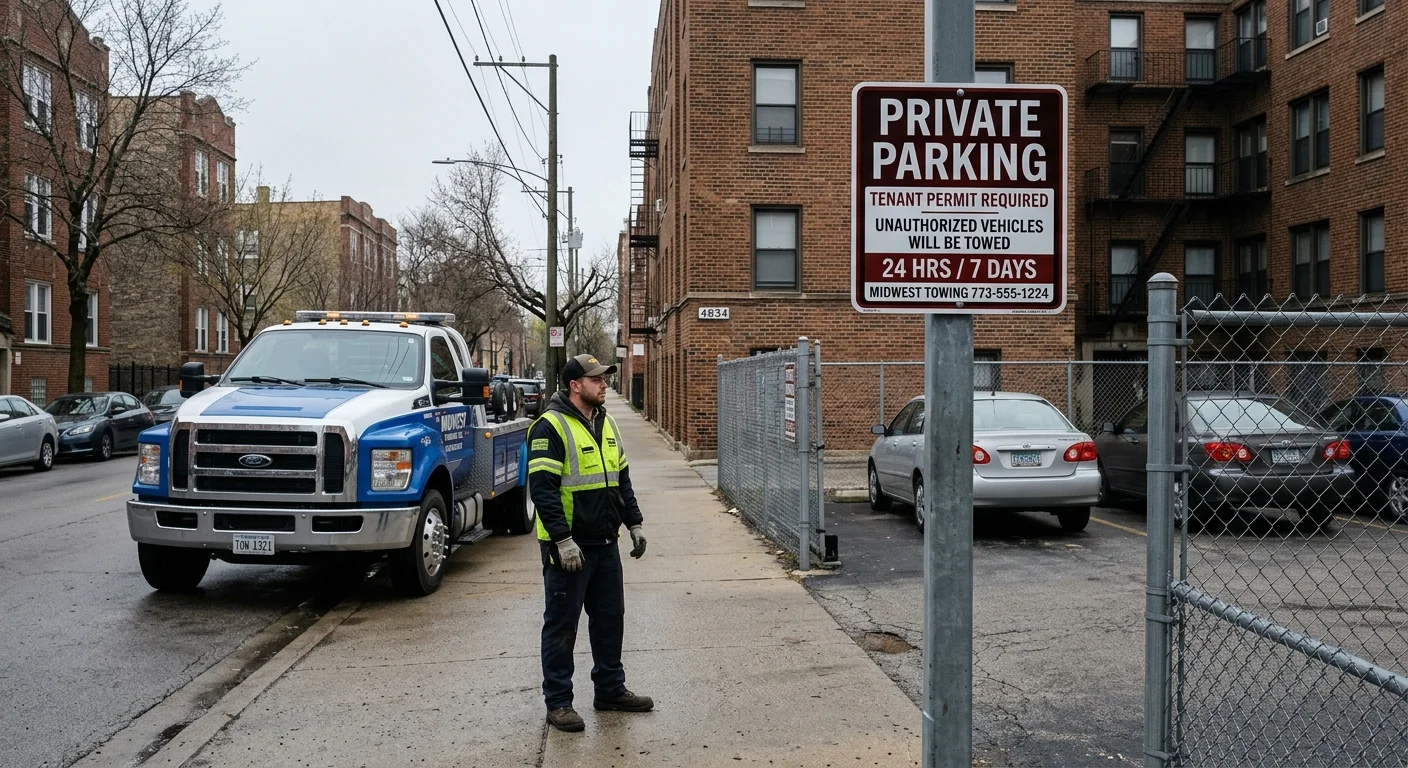
Illinois towing laws for private property require specific signs before many vehicles can be removed. In Cook, DuPage, Kane, Will and Winnebago counties, those signs must meet exact rules for size, height, visibility and content. The rules apply to private-property relocations, not every tow in the Chicago area.
Start with the correct towing regime
A private parking sign matters only after you identify the towing regime. Chicago has three, and their rules aren’t interchangeable.
First, a City of Chicago tow involves a vehicle removed under city authority. It may end at one of the city’s four auto pounds. Public-street violations, police holds and city impounds belong in this category. The city’s pound procedures don’t become private-property rules just because the vehicle disappeared inside Chicago.
Second, a suburban municipality may impound a vehicle under its own program. State law gives the owner a right to an administrative hearing. Notice must be sent within 10 days, and the initial hearing must occur within 45 days after notice is mailed. Each village sets its own administrative fee. The City of Chicago pound schedule doesn’t apply to a village impound in Cicero, Naperville or Joliet. Our guide to Illinois impound laws explains that process separately.
Third, a property owner may authorize a private-property relocation. In the five covered counties, the operator must be a commercial vehicle relocator licensed by the Illinois Commerce Commission. This is the regime governed by the sign rules below.
A lot-owner tow in Little Village can be a private relocation, despite its Chicago address. A public-street tow nearby can follow city rules instead. That distinction matters more than the neighborhood name. For a wider comparison, read our guide to Chicago private towing laws.
What the Illinois sign must show
Section 18a-302 sets unusually detailed requirements for private-property towing signs. Where notice is required, the sign must be conspicuously posted in the affected area.
The Illinois statute on towing signs requires each sign to meet these conditions:
- It must be at least 24 inches high and 36 inches wide.
- It must stand at least 4 feet above the ground.
- It must remain below 8 feet above the ground.
- It must be illuminated, painted with reflective paint, or both.
- It must identify the appropriate commercial vehicle relocator.
- It must show that relocator’s name, address and telephone number.
- It must state the towing charge a person may face.
A small warning taped to a storefront window doesn’t match those dimensions. Neither does a faded sign placed below the minimum height. The statute also makes removal unlawful when signs are required but appropriate signs aren’t posted.
The required charge must appear on the sign, but no current statewide maximum relocation rate is stated here. That figure couldn’t be confirmed from the statute, administrative rules or ICC consumer guide reviewed for this page. Don’t rely on an unsourced number circulating online. Check the current rate directly with the Illinois Commerce Commission through its relocation-towing page.
There’s also a residential exception. Express notice isn’t required on residential property clearly reserved or intended exclusively for residents or their vehicles. That’s a narrow description. It shouldn’t be treated as a blanket exemption for every mixed-use building, visitor space or shared commercial lot.
A proper sign isn’t the only requirement
A compliant sign doesn’t give a relocator unlimited authority. Illinois law lists several other practices that can make a private-property removal unlawful.
The relocator needs written authorization from the property owner, the person lawfully controlling the property, an authorized agent or an authorized law-enforcement officer. Advertising a relocation service without placing the relocator’s license number in the advertisement is also unlawful.
The vehicle owner has an important protection at the scene. If the owner or operator appears before removal is complete, and is willing and able to move the vehicle immediately, the relocator may not remove it. The statute contains a narrow service-fee exception involving certain commercial vehicles that require a commercial driver’s license.
After removal, the relocator must notify law enforcement in that jurisdiction within one hour. Distance limits also apply. A vehicle taken from an unincorporated area can’t be moved more than 15 air miles. The limit is 10 air miles for other locations covered by the law.
Telephone access matters too. If the owner makes a reasonable effort but can’t reach the relocator for one hour during a required response period, all towing, storage and related fees must be waived. Our explanation of the Illinois one-hour towing rule covers that protection in more detail.
These requirements appear in 625 ILCS 5/18a-300. They apply alongside the sign rule, not instead of it.
What to check after a private-property tow
Start by documenting the parking area. Photograph every sign, including its position and condition. Capture the entire sign face so the relocator’s information and posted charge remain readable. Note whether lighting or reflective paint was present. If possible, record the sign’s approximate width, height and distance above the ground.
Next, identify who ordered the removal. The property owner or authorized agent should have provided written authorization. Ask the relocator for a complete Relocation Towing Invoice. That invoice serves as the receipt and must include complaint instructions.
Storage rules offer additional checks. No storage fee may be assessed when the vehicle is claimed within 24 hours, proper identification is produced and payment is tendered. Relocators also can’t assess storage for days or hours when they’re closed to the public. Once the vehicle is claimed, identification is provided and payment is offered, storage charges must stop.
A relocator must accept cash, money orders, cashier’s checks, certified checks and major credit cards. It can’t add an extra fee merely because a major credit card was used.
If the sign, invoice or release process appears inconsistent with these rules, preserve your records. The Illinois Commerce Commission relocation-towing office provides its consumer guide and complaint process. The Commission regulates commercial vehicle relocators in the covered counties.
Don’t compare the invoice with Chicago’s city-pound charges. Those are separate city fees for a different towing regime. A private relocation also isn’t one of Quick Tow Chicago’s own charges. The independent relocator sets and collects it.
What property managers should verify
Property managers should confirm the legal setup before authorizing a removal. Start with the property’s county and the reason the vehicle is being moved. A private relocation from an apartment, retail or office lot isn’t the same as a police-directed impound or public-street tow.
In Cook, DuPage, Kane and Will counties, confirm that the company performing the relocation holds the required Illinois Commerce Commission license. Quick Tow Chicago is a referral service, not the licensee. We connect property managers with licensed commercial vehicle relocators through our private property towing service.
Review each affected parking area before relying on existing signs. Check the required 24-by-36-inch size, mounting height, visibility treatment and relocator details. The sign must name the actual relocator and state the applicable towing charge. Quick Tow Chicago’s name shouldn’t replace the licensed relocator’s information.
Property managers also need a written authorization process. Staff should know who may approve a removal and how that approval gets recorded. A verbal request alone doesn’t replace the statute’s written-authorization requirement.
Finally, plan for a driver who returns before removal finishes. The relocator must follow the owner-present rule when the driver is ready and able to move the vehicle immediately. Clear instructions help staff avoid turning a parking dispute into a towing complaint.
These rules cover private-property relocations in the named Illinois counties. For property elsewhere in Illinois, confirm the governing requirements with the local municipality and the Illinois Commerce Commission before posting signs or authorizing a tow.
When to call us
Call once a disabled vehicle needs an independent operator, or when a property situation requires a properly licensed relocator. The line takes calls 24/7, and calls are recorded after a notice. Call us at (773) 830-6930.