Chicago doesn’t have one document called a towing bill of rights. Your protections depend on whether Chicago ordered the tow, a suburban municipality impounded the car, or a private-property relocator removed it. Identifying that first will tell you which rules, fees, and dispute process apply.
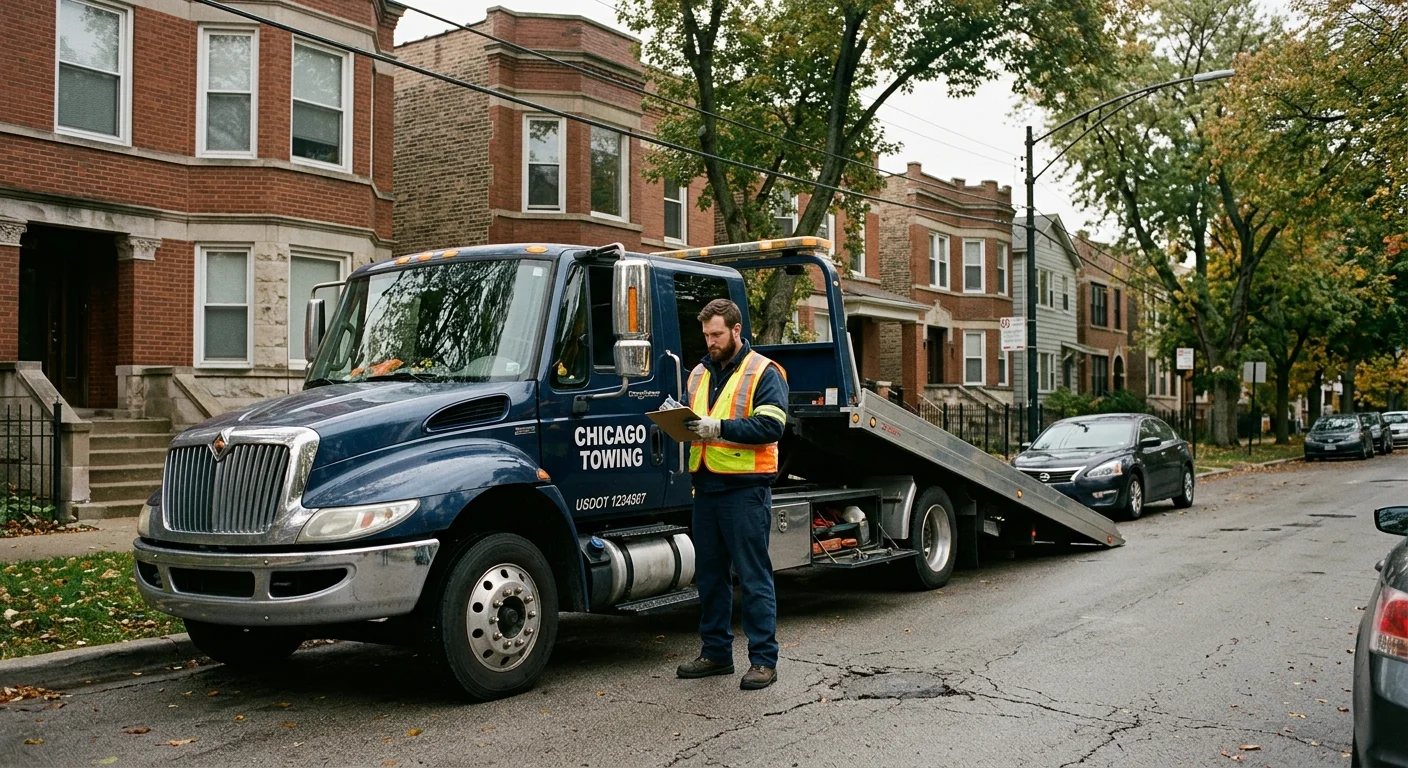
Start by identifying the type of tow
A missing car isn’t always sitting in an impound lot. Chicago sometimes relocates vehicles to clear streets for agency work. An emergency relocation may happen without posted signs.
Use the city’s Find Your Towed Vehicle tool before reporting the car stolen. If the search doesn’t locate it, contact Chicago’s non-emergency city service. Have the plate number, vehicle description, and last known location ready.
Next, place the tow into one of three categories:
- A City of Chicago tow sends the car into the city pound system.
- A suburban municipal impound follows the municipality’s process.
- A private-property relocation uses an ICC-licensed commercial vehicle relocator.
Location alone doesn’t settle the question. A car removed from a Chicago street follows different rules than one removed from an apartment lot. A village impound in Cicero also doesn’t use Chicago’s city fee schedule.
Look at the paperwork, signs, and agency name. Ask who authorized the removal and where the car went. Don’t assume the operator’s storage yard is the authority that ordered the tow.
Our broader guide to Illinois towing laws explains how these systems fit together. The distinction matters before you challenge a charge or request a hearing.
Your rights after a City of Chicago tow
The city publishes its standard pound charges under Municipal Code 9-92-080. According to Chicago’s Common Towing Questions, the tow fee is $250 for a vehicle under 8,000 pounds. It’s $350 at 8,000 pounds or more. Storage is $50 or $100 per day, based on the same weight split.
Those are city charges, not Quick Tow Chicago prices. They also aren’t suburban impound fees or private-property relocation rates.
Chicago operates four auto pounds. They’re Central Auto Pound at 500 E Wacker Drive, lower level; the O’Hare pound on Bessie Coleman Drive; Pound 2 at 103rd and Doty; and Pound 6 at 701 N Sacramento. All four remain open every day, around the clock.
Every person claiming the vehicle needs valid photo identification. Proof of ownership can include a valid title, current registration, or a bill of sale no more than 30 days old. Lessees need their lease agreement. A representative needs an original notarized letter from the owner.
You’ll also need a valid driver’s license to drive the car out. Current state plates and a Chicago Vehicle Sticker are required where applicable. Police investigative holds can’t be cleared at the pound.
The city normally stores a vehicle for no less than 21 days after mailing notice. The registered owner can request one 15-day extension before disposal under 9-92-100(a). Don’t confuse that extension with a hearing deadline.
A general post-tow hearing deadline for ordinary Chicago tows couldn’t be confirmed. Ask the Bureau of Traffic Services about the process for your specific tow. The verified 15-day hearing request applies only to Chicago’s separate 19-offense vehicle impoundment program.
Your rights after a private-property relocation
Private-property relocation covers cars removed from places such as apartment lots, shopping centers, and reserved parking areas. In Cook, DuPage, Kane, and Will counties, that work must be performed by a commercial vehicle relocator licensed by the Illinois Commerce Commission.
Quick Tow Chicago isn’t the relocator or license holder. We connect customers with independent operators. Property managers seeking private-property towing help are matched with relocators who hold the required license.
Illinois law usually requires a conspicuous sign in the affected area. Under 625 ILCS 5/18a-302, it must measure at least 24 by 36 inches. It must stand at least four feet but less than eight feet above ground.
The sign must be illuminated, reflective, or both. It must identify the relocator and display the towing charge. Clearly reserved residential property has a narrow exception to the express notice requirement.
The relocator also needs written authorization from the property owner, lawful possessor, authorized agent, or law enforcement. If you arrive before removal is complete and can move the car immediately, the relocator generally may not remove it. A narrow service-fee exception applies to certain commercial vehicles.
The relocator must notify local law enforcement within one hour of removal. The storage site generally can’t be more than 10 air miles away. The limit becomes 15 air miles when the removal site is in an unincorporated area.
You also have payment and storage protections. A relocator must accept cash, money orders, cashier’s or certified checks, and major credit cards without an added card fee. You must receive a complete Relocation Towing Invoice with complaint instructions.
No storage fee applies when you claim the vehicle within 24 hours with identification and payment. Storage also can’t be charged for periods when the relocator is closed to the public. Read more about the Illinois towing and storage rules.
Illinois also has a specific one-hour contact rule. If reasonable attempts to reach the relocator fail for one hour during required response periods, towing, storage, and other fees must be waived.
A current statewide maximum relocation rate couldn’t be confirmed from the published ICC material. Don’t rely on figures copied from an old website. Confirm the current authorized rate directly with the Illinois Commerce Commission.
Your rights after a suburban municipal impound
A municipal impound in Berwyn, Cicero, Naperville, Joliet, or another suburb isn’t a Chicago pound tow. Each county or municipality sets its own administrative charge. None of the individual suburban fee schedules was verified for this guide.
That means Chicago’s $250 and $350 tow figures don’t apply automatically. Ask the village or city for its current ordinance, administrative fee schedule, storage terms, and payment rules before paying.
State law still provides procedural protections. Under 625 ILCS 5/11-208.7, an administrative fee must be reasonable and related to administrative and processing costs. The statute doesn’t publish a dollar cap.
The owner has a right to an administrative hearing. Notice must be sent within 10 days of impoundment. The initial hearing must be scheduled and convened no later than 45 days after the notice was mailed.
The same statute addresses stolen or hijacked vehicles. If the hearing officer finds the vehicle was stolen or hijacked when impounded, the government body must refund administrative fees already paid.
That refund rule concerns municipal administrative fees under state law. It hasn’t been verified as a no-fee rule for Chicago pound towing or storage. Keep those systems separate when speaking with the agency.
Save the mailed notice and its envelope. The mailing date controls the verified hearing timeline. Ask for the written reason for impoundment, the applicable local ordinance, and instructions for requesting the hearing.
How to protect your position
Start a written record as soon as you locate the car. Save photographs of the parking space, nearby entrances, curb markings, and every posted sign. Capture enough background to show where each sign stood.
Keep the tow invoice, payment receipt, ownership documents, and mailed notices. Note when you first contacted the pound or relocator. For private relocations, preserve call records if the operator didn’t answer during required response hours.
Before paying a disputed private-property charge, request the complete Relocation Towing Invoice. Check the listed removal location, authorization, storage dates, and complaint directions. Payment doesn’t replace the need for accurate paperwork.
For a city tow, confirm whether the vehicle was impounded or merely relocated. Ask whether a police, boot, or administrative hold blocks release. A hold may need clearance from another Chicago department before the pound can release the car.
For a suburban impound, direct the hearing request to the municipality named on the notice. Don’t send a village dispute to the Chicago pound or the ICC. Private-property relocation complaints go to the Illinois Commerce Commission.
Move quickly even when a rule doesn’t provide a confirmed deadline. Storage can continue while you collect documents. If a deadline isn’t published in the material you received, ask the responsible agency to provide it in writing.
This guide explains verified towing rules, not legal advice. A lawyer can assess damaged vehicles, disputed ownership, missed hearings, or court claims. Quick Tow Chicago can’t reverse an impound, decide a statutory dispute, or order a pound to release your car.
When to call us
A towing dispute stays with the pound, municipality, or Illinois Commerce Commission. Call us when you need a separate tow, such as moving a released but disabled car or arranging emergency towing after a breakdown. The line takes calls 24/7, and calls are recorded after a notice. We’ll match you with an independent local operator, with the price quoted before dispatch. Call us at (773) 830-6930.