In Illinois, what makes a vehicle abandoned depends on its location and the removal process. Inside Chicago, one qualifying condition can be enough: undrivable disrepair, more than seven days without movement while apparently deserted, missing registration for at least two days, or hazardous dilapidation in public view. A single statewide checklist couldn’t be confirmed from approved Illinois sources, so Chicago’s rules shouldn’t be applied automatically in Cicero, Aurora, Naperville, or Joliet.
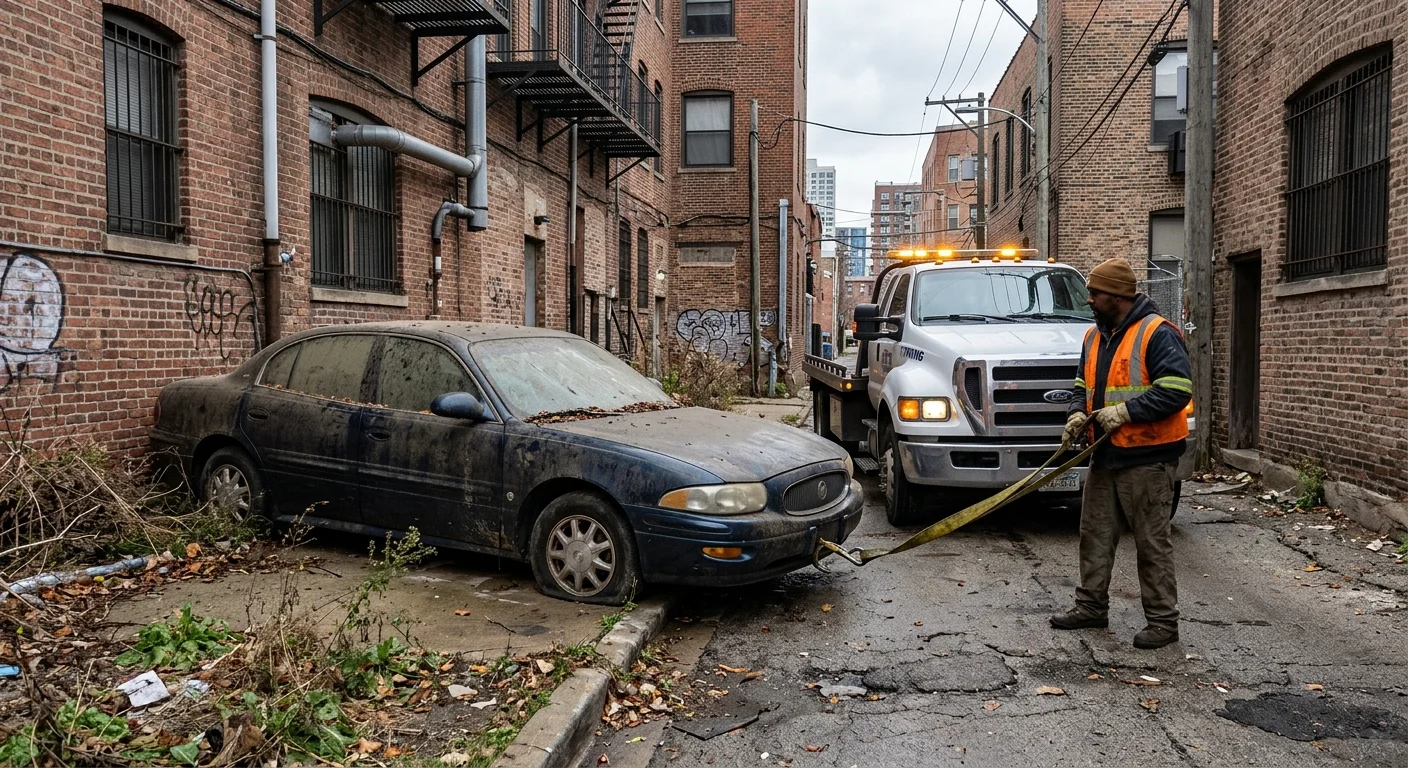
Chicago uses four specific conditions
The City of Chicago says a vehicle can be classified as abandoned when it meets one or more listed conditions. It doesn’t need to satisfy every condition.
The first condition covers a vehicle on a public way that’s in such poor condition it can’t be driven as it sits. A worn exterior isn’t the test. The stated condition concerns disrepair that makes the vehicle incapable of being driven.
The second applies when a vehicle hasn’t moved or been used for more than seven consecutive days and appears deserted. Both parts matter. Seven days without movement doesn’t automatically settle the question if the vehicle doesn’t appear deserted.
The third covers a vehicle left on a public way without state registration or a temporary state registration placard for two or more days. That time period differs from the seven-day condition.
The fourth condition is broader. It covers a hazardous, dilapidated vehicle left in full view of the public. That condition can apply on public or private property. Bicycles are excluded from the city’s abandoned-vehicle classification.
These are Chicago’s published standards. They shouldn’t be presented as one universal rule for every Illinois municipality. A vehicle in Little Village, Pilsen, or Gage Park falls within Chicago’s system. One in Cicero or Oak Lawn is under a different local government.
For a closer look at the state and city distinction, see our guide to Illinois abandoned vehicle law.
Long parking alone doesn’t answer the question
A dusty car, flat tire, or expired-looking plate may attract attention. Those details don’t replace the city’s actual criteria.
For Chicago’s seven-day condition, the vehicle must also appear deserted. For the registration condition, the city specifies a public way and at least two days. For the disrepair condition, the vehicle must be incapable of being driven in its present state.
That wording matters in dense neighborhoods. A car may sit through several street-cleaning cycles, winter weather, or a long repair. Another vehicle may have no registration displayed and appear untouched. The city applies its published conditions, not a neighbor’s guess.
Don’t remove plates, enter the vehicle, or attempt to move it yourself. Record the location and the condition you can see from a lawful position. Note whether the vehicle is blocking access or creating an immediate hazard. Then use Chicago’s nonemergency city service channel for an abandoned-vehicle report.
A missing vehicle presents a different problem. Chicago may relocate a car to clear a street for agency work. During an emergency, that can happen without an opportunity to post signs. Check the city’s Find Your Towed Vehicle tool and use its nonemergency service before reporting the car stolen.
Our guide to whether a Chicago car was towed or stolen explains that first search in more detail.
Public removal and private-property towing are different
An abandoned-vehicle report isn’t the same as a private parking-lot tow. Chicago’s public process and an Illinois private-property relocation follow different rules.
In Cook, DuPage, Kane, Will, and Winnebago counties, private-property relocations are performed by commercial vehicle relocators licensed by the Illinois Commerce Commission. That law doesn’t cover vehicles on public streets, disabled vehicles, repossessions, or police-directed towing.
When signs are required, Illinois law sets detailed standards. The sign must be conspicuous, at least 24 inches high by 36 inches wide, and between four and eight feet from the ground. It must be illuminated, reflective, or both. It must also identify the relocator and state the towing charge that may apply. Residential property clearly reserved for residents or their vehicles has a stated exception to the express-notice requirement.
Written authorization from the property owner, lawful controller, authorized agent, or law enforcement is also required. If the owner or operator appears before removal is complete and can move the vehicle immediately, the relocator generally may not remove it. The statute contains a narrow exception involving certain commercial vehicles.
Those requirements come from Illinois private-property relocation law. They don’t turn every unwanted car into a legally abandoned vehicle.
Quick Tow Chicago isn’t a licensed relocator. We connect property managers and authorized vehicle owners with independent operators. Our private-property towing page explains that referral role.
An impound isn’t automatically an abandonment case
Chicago has its own pound system. Suburban municipalities operate separate impound processes. Private relocators follow another system. Calling all three an “abandoned tow” hides important differences.
Chicago says abandoned vehicles are impounded, but its public pages use different names for the destination lots. One page uses older pound labels. The city’s common towing page identifies the abandoned-vehicle destinations by their current street locations. Don’t guess which lot holds a vehicle. Use the city vehicle search and confirm the destination through Chicago’s nonemergency service.
For a vehicle held at a City of Chicago pound, the city normally stores it for no less than 21 days from the date notice is mailed to the registered owner. The registered owner has a right to one 15-day extension before sale or other disposal under Municipal Code section 9-92-100(a).
That’s a disposal clock, not a punitive 30-day Illinois impound rule. It’s also different from the separate hearing deadline that applies only to Chicago’s specified vehicle-impoundment program involving certain offenses.
An unclaimed vehicle may eventually be sold or otherwise disposed of. Owners facing that situation should act before the disposal clock expires. Our guide to what happens when a Chicago pound vehicle isn’t claimed covers that process.
If the vehicle is still yours and removal is voluntary, junk-car and abandoned-vehicle removal is a different path from a city impound.
Suburbs can apply their own local rules
Chicago’s seven-day and two-day conditions come from the City of Chicago. They aren’t confirmed here as statewide deadlines.
Cicero, Berwyn, Schaumburg, Naperville, Aurora, Elgin, and Joliet aren’t part of Chicago’s pound system. Each municipality can operate its own impound process and set its own administrative fee. No individual suburb’s abandoned-vehicle definition or fee has been confirmed for this page.
Illinois law does establish procedural rules for certain municipal impounds. An administrative fee must be reasonable and related to administrative and processing costs. The law doesn’t set a dollar cap. It also provides a right to an administrative hearing, notice within 10 days, and an initial hearing no later than 45 days after notice is mailed.
Those rights appear in Illinois law governing municipal administrative impounds. They don’t supply one abandoned-vehicle definition for every city and village.
Before reporting or arranging removal outside Chicago, identify the municipality with jurisdiction. Check that government’s current ordinance or official department page. Ask which facts it needs, where the vehicle may be taken, and how an owner can contest the action.
Don’t substitute Chicago’s rules because the suburb shares a border or county. Cicero’s process isn’t Chicago’s process. Naperville also crosses county lines, which makes the exact location especially important.
What owners and property managers should do next
Start by identifying who controls the location. A vehicle on a Chicago public way belongs in the city reporting process. A vehicle on private property may require an authorized ICC-regulated relocator. A suburban street or municipal lot requires that municipality’s rules.
Document only what you can confirm. Record the exact location, visible condition, registration status, and dates when movement was observed. Photos can preserve those details, but they don’t make the legal classification.
If you own the vehicle, don’t assume an abandoned label transfers ownership or ends the matter. Confirm whether it was reported, relocated, or impounded. If it remains lawfully accessible and can be moved, handle that before a removal process advances.
A vehicle reaching the end of its usable life may need a junking process instead. Illinois treats junking and salvage as different title outcomes. A junking certificate prevents another certificate of title from being issued for that vehicle. Review junking versus salvaging a car in Illinois before signing ownership documents.
If the vehicle needs transport, Quick Tow Chicago can line up an independent local operator. The operator sets the price, and it’s quoted before dispatch.
When to call us
This stops being a do-it-yourself job when an authorized owner or property manager can’t move the vehicle normally. The line takes calls 24/7, and calls are recorded after a notice before we match you with an independent local operator. Call us at (773) 830-6930.