Illinois abandoned vehicle law depends on the vehicle’s location and who orders its removal. Chicago has its own abandoned-vehicle rules, suburban governments run separate impound systems, and private-property relocations follow Illinois law. Identifying the right system is the first step.
What counts as an abandoned vehicle in Chicago
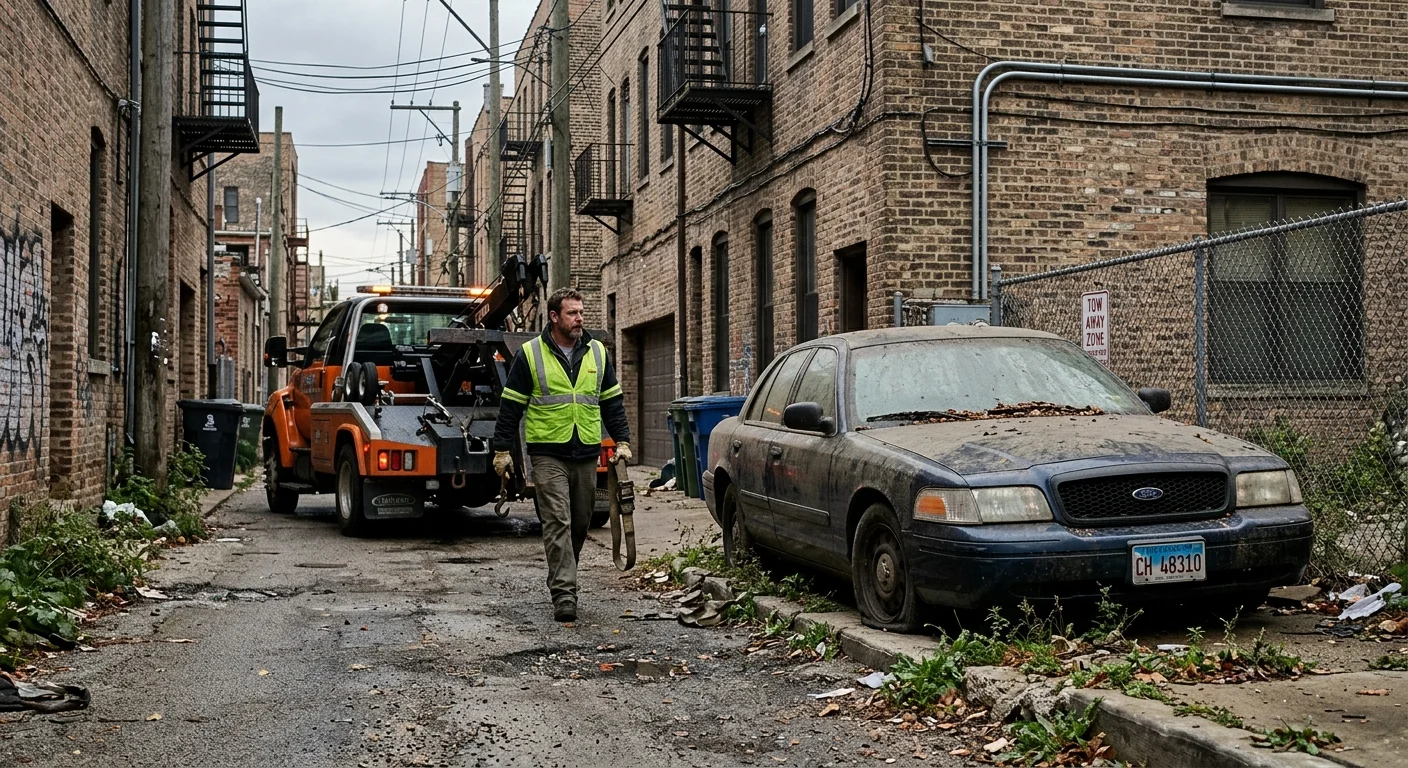
Chicago may classify a vehicle as abandoned when it meets at least one published condition. The city’s rules cover vehicles on public streets and certain hazardous vehicles visible from public areas.
A vehicle may qualify when it:
- Sits on a public way in such disrepair that it can’t be driven.
- Hasn’t moved or been used for more than seven consecutive days and appears deserted.
- Remains on a public way without state registration or a temporary registration placard for at least two days.
- Is hazardous and dilapidated while fully visible to the public, whether it sits on public or private property.
Bicycles aren’t included in this definition.
The seven-day condition has two parts. The car must remain unused for that period and appear deserted. A legally parked car doesn’t automatically become abandoned simply because a neighbor dislikes it or doesn’t recognize it.
Registration creates a separate issue. A vehicle left on a Chicago public way without state registration can meet the city’s standard after two days. Its mechanical condition doesn’t need to match the disrepair condition.
Report a suspected abandoned vehicle through Chicago’s city-service channel. Describe its exact location and visible condition without entering or moving it. If it later disappears, use the city’s vehicle search process before assuming it was stolen. Our guide to finding a towed car in Chicago explains that process.
Location determines which towing system applies
The phrase “abandoned vehicle law” can hide three different systems across Chicago’s metro. They aren’t interchangeable.
A City of Chicago case applies inside city limits. Chicago decides whether a vehicle on its public way meets the city’s abandoned-vehicle definition. A removed vehicle enters the city pound system.
A suburban municipal impound follows another process. Berwyn, Cicero, Naperville, Joliet, and other municipalities don’t use Chicago’s fee schedule. Each municipality sets its own administrative fee. Illinois law says that fee must be reasonable and related to administrative and processing costs, but the statute doesn’t set a dollar cap.
Private-property relocation is the third system. In Cook, DuPage, Kane, Will, and Winnebago counties, it’s regulated by the Illinois Commerce Commission. It applies when an unauthorized vehicle is removed from private property by a commercial vehicle relocator. It doesn’t govern public-street vehicles, disabled vehicles, repossessions, or police-directed towing.
That distinction matters in an alley, apartment lot, or industrial property. A car on a Chicago public alley may involve the city. A vehicle in a private apartment lot may fall under relocation law. A vehicle held after a suburban police action may enter that municipality’s impound process.
Read our comparison of an impound versus relocation in Chicago before applying one system’s deadlines or fees to another.
Private-property removal has specific safeguards
A private-property owner can’t treat an unwanted vehicle like a Chicago public-way report. In the five covered counties, commercial vehicle relocators must hold an Illinois Commerce Commission license.
Required signs generally must be conspicuous and measure at least 24 inches high by 36 inches wide. They must sit at least four feet, but less than eight feet, above the ground. They also need illumination, reflective paint, or both.
The sign must identify the appropriate relocator. It must include the relocator’s name, address, telephone number, and the towing charge a person may face. Residential property clearly reserved or intended only for residents or their vehicles doesn’t require this express notice.
Illinois law also requires written authorization from the property owner, the person controlling the property, an authorized agent, or law enforcement. Removal from property requiring signs is unlawful when the proper signs aren’t posted. The full requirements appear in 625 ILCS 5/18a-302.
The relocator generally can’t remove the vehicle if its owner arrives before removal is complete and can move it immediately. After removal, the relocator must notify law enforcement in that jurisdiction within one hour. The relocation distance is capped at 10 air miles in most locations and 15 air miles from an unincorporated-area location. These practices are addressed in 625 ILCS 5/18a-300.
No current maximum relocation rate could be confirmed from the approved sources. Don’t rely on figures repeated by third-party websites. Confirm the current rate directly through the Illinois Commerce Commission’s relocation towing page.
Our private-property towing guide covers the practical differences. Quick Tow Chicago connects property managers with licensed relocators. The brand isn’t itself an ICC-licensed relocator.
City pounds and suburban impounds use different clocks
Chicago’s pound process doesn’t impose a punitive 30-day hold. The city normally stores an unclaimed vehicle for no less than 21 days from the date it mails notice to the registered owner. Under Municipal Code 9-92-100(a), the registered owner may request one 15-day extension before sale or disposal.
That 15-day extension isn’t a general hearing deadline. Chicago has a separate 15-day hearing-request window for its 19-offense vehicle impoundment program. That program covers specified offenses and shouldn’t be treated as the rule for every ordinary tow or abandoned vehicle.
Chicago’s pages also use different pound labels when discussing abandoned vehicles. Current city towing information identifies the locations at 103rd and Doty Avenue and 701 North Sacramento Avenue. The abandoned-vehicle page uses older pound labels. Contact the city’s traffic services department to confirm the actual location before traveling.
Suburban impounds follow 625 ILCS 5/11-208.7. The owner must receive notice within 10 days of impoundment. An initial administrative hearing must be scheduled and held no later than 45 days after the notice is mailed.
The hearing officer can review whether the municipality’s administrative action was proper. If the vehicle was stolen or hijacked when impounded, the municipality, county, or Illinois State Police must refund administrative fees already paid.
No individual suburb’s administrative fee or storage rate has been confirmed here. Ask the municipality that ordered the impound for its current ordinance, hearing instructions, and payment rules. Don’t apply Chicago’s pound schedule to a vehicle held by Cicero, Aurora, Elgin, or Joliet.
When an old car becomes salvage or junk
An owner choosing to dispose of an old car faces a different question. Abandonment, salvage, and junking don’t mean the same thing.
Illinois requires a salvage certificate in six statutory situations under 625 ILCS 5/3-117.1. These include certain insurance total losses, qualifying self-insured losses, some auction acquisitions, and qualifying damage to repossessed, fleet, or flood-damaged vehicles. Some categories use damage exceeding 50 percent of fair market value.
When the salvage requirement applies, the title holder must promptly deliver or mail the title, application, and fee to the Secretary of State within 20 days. No current title or salvage fee is stated here because an approved amount couldn’t be confirmed. Check directly with the Illinois Secretary of State before submitting paperwork.
Junking is more final. Under 625 ILCS 5/3-117.2, a junking certificate authorizes possession, transport, or transfer of the junked vehicle. Illinois won’t issue another certificate of title for that vehicle.
A scrap processor or automotive parts recycler receiving the ownership documents doesn’t have to obtain a junking certificate. It must submit those documents with a Junk Vehicle Notification within 15 days. The Secretary of State won’t later issue a title or salvage certificate for a vehicle listed on that notification.
That makes the paperwork decision important. A repairable total-loss vehicle and a vehicle intended only for parts may follow different paths. Review junking versus salvaging a car in Illinois before signing ownership documents.
When to call us
When loading, transporting, or removing the vehicle stops being a practical do-it-yourself job, Quick Tow Chicago can line up an independent local operator through our junk car and abandoned vehicle removal service. The line takes calls 24/7, calls are recorded after a notice, and the operator’s price is quoted before dispatch. Call us at (773) 830-6930.