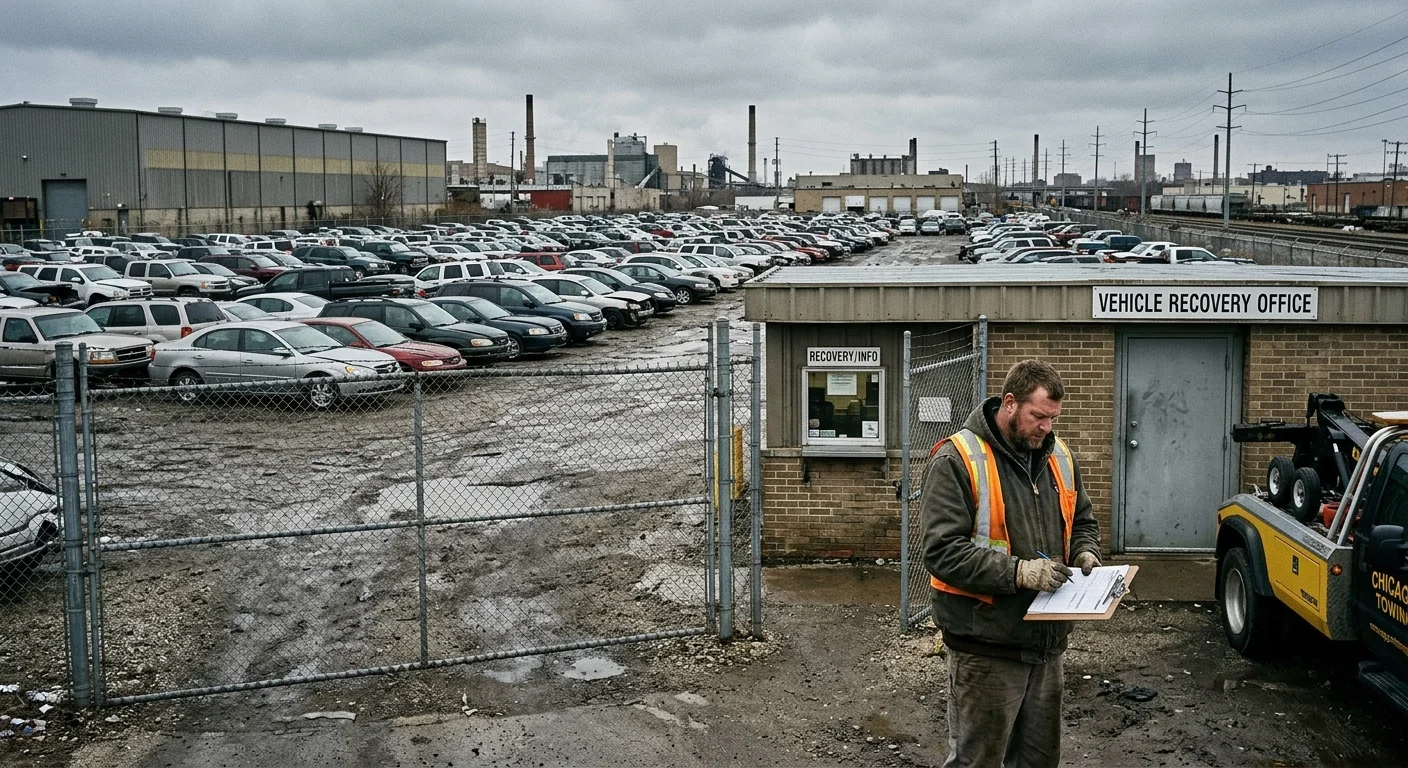
For a City of Chicago pound tow, the published charge starts at $250, plus $50 per storage day, for a vehicle under 8,000 pounds. Vehicles weighing 8,000 pounds or more carry a $350 tow charge and $100 per storage day. Your final amount depends on the vehicle, storage time, fines, and why it was removed.
Start with the city’s published fee schedule
Chicago publishes its standard pound charges under Municipal Code 9-92-080. The City of Chicago’s towing guide lists these amounts:
- Vehicle under 8,000 pounds: $250 tow charge
- Vehicle weighing 8,000 pounds or more: $350 tow charge
- Storage under 8,000 pounds: $50 per day
- Storage at 8,000 pounds or more: $100 per day
These are city charges, not Quick Tow Chicago prices. Quick Tow Chicago is a referral service that connects drivers with independent local operators. It doesn’t run a pound, set city fees, or control a vehicle’s release.
The tow and daily storage charges may not be your whole obligation. Chicago requires all applicable charges and fines to be paid before release. A police hold can also stop the pound from releasing the vehicle, even when someone is ready to pay.
Don’t rely on a calculator that assumes every Chicago-area tow follows this schedule. The reason for removal matters. Winter parking-ban tows have a different city-published fee set. Private-property relocations follow Illinois Commerce Commission rules. Suburban municipalities set their own administrative fees.
That distinction is the starting point for understanding any pound bill. Our guide to Illinois towing and storage fee rules explains how those systems differ across the metro.
Confirm that the car was actually impounded
A missing car in Chicago may have been impounded, relocated, stolen, or moved by someone authorized to use it. Confirm its status before traveling to a pound or arranging another ride.
Start with the city’s Find Your Towed Vehicle tool. The city advises checking for a relocation and contacting its nonemergency service before reporting the car stolen. Street work, emergencies, and other agency activity can lead to relocation. During an emergency, the city says there may be no opportunity to post signs.
Chicago operates four auto pounds:
- Central Auto Pound, 500 E. Wacker Drive, Lower Level
- O’Hare International Airport Auto Pound, Bessie Coleman Drive
- Auto Pound 2, 103rd and Doty Avenue
- Auto Pound 6, 701 N. Sacramento Avenue
All four are open every day, around the clock. Still, confirm the location before leaving. A car’s original parking spot doesn’t always tell you which pound has it.
This city system doesn’t cover every tow in the metro. A vehicle removed by Berwyn, Cicero, Naperville, Joliet, or another suburb falls under that municipality’s process. The Chicago fee schedule doesn’t apply there. Each municipality sets its own administrative fee, and no single suburban amount could be confirmed for this page.
A car removed from a private lot is different again. That’s generally a private-property relocation, not a city impound. Our guide to Chicago private towing laws covers that separate process.
Bring everything required for release
Payment alone isn’t enough to redeem a vehicle from a Chicago pound. Every person claiming the vehicle needs valid photo identification. The claimant must also show acceptable proof of ownership.
Chicago accepts a valid title, current registration card, or a bill of sale no more than 30 days old. A lessee needs the lease agreement. Someone acting for the owner needs an original notarized letter from that owner.
Bring a current valid driver’s license if you plan to drive the car away. The vehicle also needs current state plates and a Chicago Vehicle Sticker where required. The pound won’t release a vehicle that remains under a police investigation hold.
Chicago pounds accept cash, Visa, Mastercard, Discover, American Express, and Diners Club. Checks and money orders aren’t accepted. Verify that your chosen payment method is ready before making the trip.
Look at the vehicle’s condition before assuming you can drive home. A dead battery, collision damage, missing wheel, or mechanical failure may leave the car unable to leave under its own power. Pound release and roadworthiness are separate issues.
If the car can’t be driven after release, an independent operator can transport it to a repair shop, home, or another permitted destination. That tow is separate from the city’s impound bill. Quick Tow Chicago can connect you with an operator, and the operator’s price is quoted before dispatch.
Check whether a winter parking restriction caused the tow
Chicago publishes a separate set of charges for winter parking-ban tows. Don’t combine those figures with the standard pound schedule.
The city’s winter parking restrictions page lists a minimum $150 towing fee, a $60 ticket, and $25 per storage day for parking-ban enforcement. Those figures come from the winter-ban page. The $250 or $350 tow charges and $50 or $100 daily storage charges come from the city’s general towing page.
Ask the pound which rule produced your bill. Don’t add both schedules together or assume the lower set applies. The removal notice, ticket, and pound record should identify what happened.
Chicago’s Winter Overnight Parking Ban covers 107 miles of arterial streets. It runs from 3 a.m. to 7 a.m., December 1 through April 1, regardless of snowfall. Vehicles removed under that ban go to Pound 2 or Pound 6.
The Two-Inch Parking Ban is separate. It covers another 500 miles of main streets once at least two inches of snow are on the street. It can apply at any hour and on any calendar date. The city says vehicles there could receive a ticket or be relocated.
That difference matters on streets connecting neighborhoods to the Kennedy, Dan Ryan, Eisenhower, Stevenson, and other major routes. A clear curb on a dry evening doesn’t cancel the overnight restriction when permanent signs are posted.
Act before storage keeps growing
Storage is charged by the day under the applicable schedule, so delaying can increase the amount needed for release. Confirm the pound, required documents, vehicle status, and payment method as soon as possible.
Chicago normally stores a vehicle for no less than 21 days from the date the city mails notice to the registered owner. Under Municipal Code 9-92-100(a), the registered owner may request one 15-day extension before the vehicle is sold or otherwise disposed of.
That extension protects time before disposal. It isn’t free storage, and it doesn’t erase fines or towing charges. An unclaimed vehicle may be sold or otherwise disposed of, while the owner can remain responsible for applicable fines and fees.
Be cautious with unsourced claims about a maximum storage charge at the city pound. A specific ceiling circulates online, but it couldn’t be confirmed from the current city pages reviewed for this article, so it isn’t presented here as Chicago law. Ask the Bureau of Traffic Services to confirm any claimed cap directly.
A general post-tow hearing deadline for an ordinary Chicago tow also couldn’t be confirmed. The verified 15-day hearing-request window applies only to Chicago’s specific vehicle-impoundment program involving listed offenses. It isn’t a general deadline for every pound tow.
Suburban impounds follow another process. Illinois law requires a reasonable, cost-related municipal administrative fee, notice within 10 days, and an initial hearing within 45 days after notice is mailed. Read more in our guide to Illinois impound laws, then confirm the local amount with the municipality holding the car.
When to call us
When the pound releases your car but it won’t start or can’t be driven, moving it stops being a do-it-yourself job. Quick Tow Chicago can line up an independent local operator through the emergency towing, and calls are recorded after a notice. Call us at (773) 830-6930.