To report an abandoned vehicle in Chicago, call 311. Give the exact block, the plate if you can read it, and what makes the car look abandoned. The city handles every report on a public way. A private towing company cannot remove a car from a Chicago street on a neighbour’s say-so.
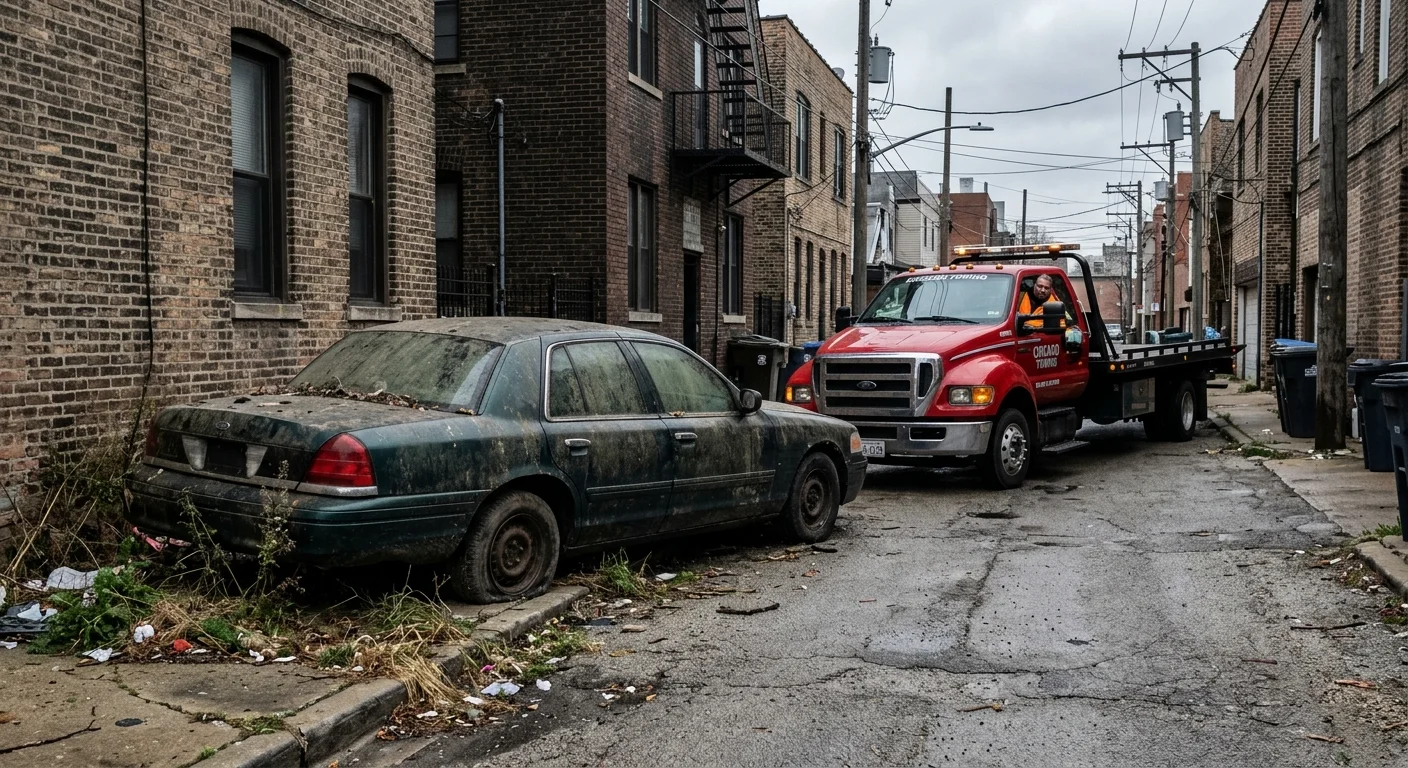
Check whether Chicago may classify it as abandoned
A dusty windshield alone doesn’t make a vehicle abandoned. Chicago publishes four conditions that can support that classification. A vehicle only needs to meet one of them.
The city may classify a vehicle as abandoned when it:
- Sits on a public way in such disrepair that it can’t be driven in its present condition.
- Hasn’t moved or been used for more than seven consecutive days and appears deserted.
- Has remained on a public way without state registration or a temporary registration placard for two or more days.
- Is hazardous and dilapidated while visible to the public, whether it sits on public or private property.
Bicycles aren’t included in Chicago’s abandoned-vehicle definition. Different procedures may apply to damaged bikes, scooters, trailers, or loose debris.
Focus your report on what you can observe. State how long the car has remained there, if known. Mention a missing plate, broken windows, flat tires, major damage, or parts left around it. Don’t claim that it’s stolen or legally abandoned unless you know that.
Location also matters. A car beside a curb in West Lawn is different from one inside a private Pilsen parking lot. An alley behind a Little Village building may also raise questions about whether the vehicle rests on a public way or private land. Our guide to what counts as an abandoned vehicle in Illinois explains the broader distinction.
Make the report useful
Make the report by calling 311, Chicago’s nonemergency city-service line. Ask to file an abandoned-vehicle report, then describe the vehicle and its location plainly. The city has used a contracted abandoned-vehicle removal program since 1989, and states that more than 500,000 vehicles have been towed and impounded under it, but the report still begins with 311.
Have these observations ready:
- The nearest street address or intersection.
- Whether the vehicle is on the street, in an alley, or on private property.
- Its color, body style, make, and model, if recognizable.
- The plate number and state, if visible.
- Visible damage or missing parts.
- The date you first noticed it.
- Whether it has moved during the past seven days.
Use a clear landmark when an alley has no obvious address. For example, identify the alley’s entrance and the nearest cross street. “Behind the brick building near the northwest corner” is more useful than “somewhere off Western Avenue.”
Keep a copy of the location and description you submitted. Don’t add guesses about ownership or the driver. A factual description gives the city a cleaner starting point.
Chicago’s criteria apply within city limits. A vehicle in Cicero, Berwyn, Evanston, or Oak Park needs to be reported to that municipality. Those places operate under their own local systems, not Chicago’s abandoned-vehicle process. The Illinois abandoned vehicle law guide covers how the location can change the next step.
Reporting a car parked in front of your house
Parking in front of someone’s house is not by itself a violation in Chicago, and a car with current plates that its owner moves every few days will not qualify as abandoned no matter how long it feels like it has been there. The seven-day test is about the vehicle not being moved or used and appearing deserted, not about whose frontage it sits on.
Two situations are different. A car blocking a driveway is its own complaint and goes to the city’s blocked-driveway line at 312-746-4520 rather than through the abandoned-vehicle process. And a car on a public way with no state registration or temporary placard for two or more days meets the abandoned test on registration alone, whatever its condition. If the car in question is your own and the worry is enforcement rather than a neighbour, the boot threshold is the number that matters.
Rule out relocation, impound, or theft
A missing car isn’t always abandoned, impounded, or stolen. Chicago says agencies sometimes relocate vehicles to clear streets for work. During an emergency, that can happen without time to post signs.
Start with the city’s Find Your Towed Vehicle tool. Search before treating the vehicle as stolen. The city also advises contacting its nonemergency service before filing a stolen-vehicle report.
This distinction matters after utility work, construction, parades, street closures, or an emergency restriction. A car may be moved to another nearby block rather than taken to a pound. Our guide to finding a towed car in Chicago walks through that search.
An impound is different. The city takes custody of the vehicle and sends it to an auto pound. Chicago’s Common Towing Questions explains the city pounds, release documents, payment methods, and police holds.
A private-property relocation is different again. That involves an Illinois Commerce Commission licensed commercial vehicle relocator, not Chicago’s public-street towing process. If the words feel interchangeable, read our breakdown of impound versus relocation in Chicago before deciding whom to contact.
Use the right process for the location
Chicago’s reporting process is the right starting point for a suspected abandoned vehicle on a city street or public alley. A property owner can’t simply hire an ordinary operator to remove a vehicle from the public way. Public-street enforcement belongs to the city.
Private property follows another system. In Cook, DuPage, Kane, Will, and Winnebago counties, private-property relocations are performed by commercial vehicle relocators licensed by the Illinois Commerce Commission. State law requires written authorization from the property owner, lawful possessor, authorized agent, or law enforcement.
Signs may also be required. When required, Illinois law sets rules for their dimensions, placement, visibility, relocator information, and posted towing charge. Residential property clearly reserved for residents or their vehicles has a specific sign exception. The Illinois Commerce Commission’s relocation towing page provides its consumer guide and complaint process.
Don’t mix that process with a city abandoned-vehicle report. A neglected car behind an apartment building may still qualify for city attention if it’s hazardous, dilapidated, and visible to the public. That doesn’t erase Illinois relocation rules if the property owner instead seeks a private tow.
Property managers should document where the car sits and who controls that land. Our private property towing guide explains how we connect property managers with qualified relocators. Quick Tow Chicago isn’t the relocator and doesn’t hold the required Commission license.
A suburban municipal impound is a third regime. Each municipality sets its own administrative fee. Chicago’s pound schedule doesn’t apply to a village impound, and no single suburban price can be assumed.
What happens if the city removes the vehicle
Chicago says abandoned vehicles are impounded at the locations at 103rd and Doty and 701 North Sacramento. Another city page uses different pound labels, so confirm the current lot through the city’s nonemergency service before traveling anywhere.
If you own the vehicle, use the city lookup tool and follow the pound’s instructions. Chicago requires valid photo identification from anyone claiming a vehicle. The owner must also provide acceptable proof of ownership. That can be a valid title, current registration card, or a bill of sale no more than 30 days old. Different documents apply to lessees and representatives.
A vehicle can’t be released while it remains under a police investigation hold. Current state plates and a Chicago Vehicle Sticker are also required where applicable. Read the four Chicago auto pounds before making the trip.
The city normally stores a vehicle for no less than 21 days after mailing notice to the registered owner. The registered owner has the right to one 15-day extension before sale or disposal. An unclaimed vehicle may be sold or otherwise disposed of, while its owner can remain responsible for fines and fees.
If the vehicle is yours and hasn’t entered city custody, city reporting may not be the right route. You may need an operator who handles junk car and abandoned vehicle removal. Have your ownership records ready and ask what documents the operator needs. The operator sets the price, and it’s quoted before dispatch.
When to call us
Call when the vehicle is yours, or when you control the property and need help finding the correct independent operator. The line takes calls 24/7, and calls are recorded after a notice. Call us at (773) 830-6930.